

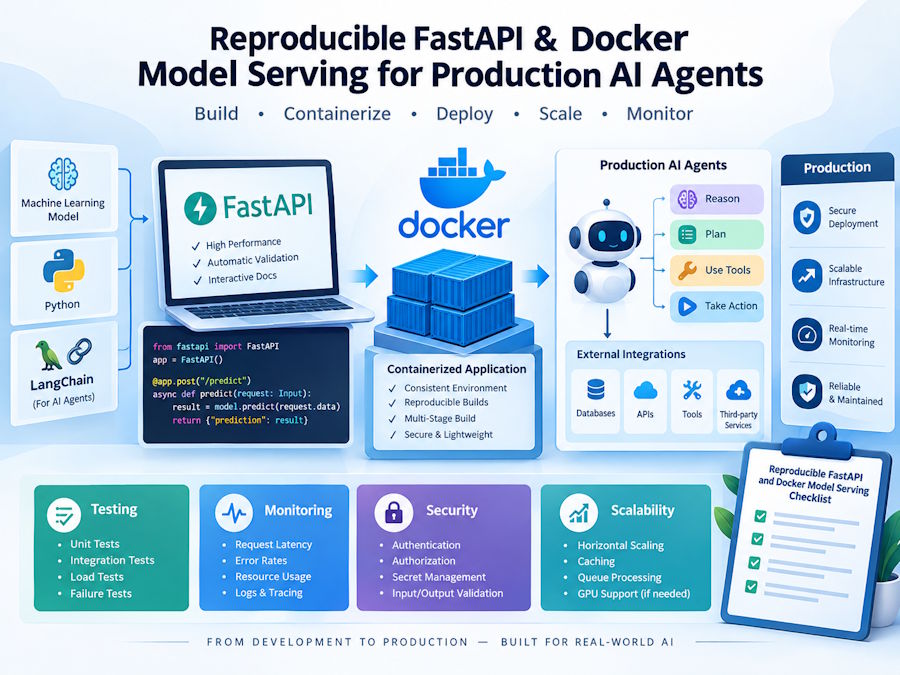
Deploying AI models in production requires more than building a model that performs well in a development environment. Businesses need reliable APIs, consistent dependencies, scalable infrastructure, and deployment processes that can be repeated across different environments. FastAPI and Docker provide a practical foundation for serving machine learning models and powering production-ready AI agents.
When these technologies are combined with structured testing, version control, and monitoring, development teams can reduce deployment errors and make AI applications easier to maintain.
Why Reproducibility Matters in AI Deployment
AI applications often depend on multiple software libraries, model versions, environment variables, and external services. A model that works correctly on a developer's laptop may fail when deployed to a production server because of differences in dependencies or system configuration.
Reproducibility addresses this problem by ensuring that the same application can be built and deployed consistently. Teams can achieve this through pinned package versions, standardized container images, controlled configuration, and automated testing.
For production AI agents, reproducibility is particularly important because an agent may combine a language model, external tools, databases, and business APIs. A small change in one dependency can affect the entire workflow.
Building a FastAPI Model-Serving Layer
FastAPI is a Python framework designed for creating high-performance APIs. It provides automatic request validation, asynchronous support, and interactive API documentation, making it suitable for applications that expose machine learning models or AI agent functionality.
A typical model-serving API accepts an input, validates the request, runs inference, and returns a structured response. Separating the API layer from the model logic makes the application easier to test and update.
Developers should organize their projects into clear modules for API routes, model loading, business logic, configuration, and error handling. This structure prevents the application from becoming difficult to maintain as new capabilities are introduced.
Model initialization should also be handled carefully. Loading a large model for every request can increase latency and waste computing resources. Depending on the model and deployment architecture, loading it during application startup or managing it through a dedicated inference service can improve performance.
Containerizing the Application with Docker
Docker packages an application and its dependencies into a portable container image. This helps teams maintain a consistent runtime environment across development, testing, staging, and production.
A reproducible Docker deployment begins with a suitable base image, explicitly declared dependencies, and a controlled build process. Teams should avoid relying on unpinned packages or undocumented configuration because these introduce uncertainty into future builds.
Multi-stage builds can reduce the size of production images by separating build-time dependencies from runtime requirements. Developers should also use non-root users where practical, avoid embedding secrets in images, and scan dependencies for known vulnerabilities.
The container should receive environment-specific settings through secure configuration mechanisms rather than hardcoded values. This allows the same image to be promoted across environments without rebuilding it for every deployment.
Teams looking for a practical implementation reference can follow this reproducible FastAPI and Docker model serving checklist to structure their deployment process and identify common configuration and reliability issues.
Integrating AI Agents into Production Services
AI agents introduce additional complexity because they can make decisions, invoke tools, retrieve information, and execute multi-step workflows. Unlike a simple prediction endpoint, an agent-serving system may need to manage conversation state, tool permissions, execution limits, and failures across several external services.
A well-designed architecture separates the API gateway, agent orchestration logic, model inference, and external integrations. This separation makes it easier to test individual components and replace one model or tool without redesigning the entire application.
For teams exploring agent development, building autonomous AI agents with Python and LangChain provides a useful starting point for understanding how Python-based agent workflows can be constructed and extended.
Production implementations should impose limits on execution time, token consumption, retries, and tool calls. They should also validate tool inputs and restrict access to sensitive operations. Human approval may be appropriate for consequential actions such as financial transactions, account changes, or deleting business data.
Testing and Monitoring Production Deployments
A successful deployment process includes more than building a container and starting an API server. Teams should verify that the application behaves correctly under normal conditions, invalid requests, dependency failures, and increased traffic.
Useful testing practices include:
- Unit tests for model and business logic.
- Integration tests for API endpoints and external tools.
- Container-level tests to verify the production image.
- Load tests to measure latency and throughput.
- Failure tests to evaluate timeouts, retries, and recovery behavior.
Health endpoints can help orchestration platforms determine whether an application is running and ready to accept traffic. Readiness checks should reflect whether essential dependencies are available, while liveness checks should identify processes that require restarting.
Production monitoring should capture request latency, error rates, resource consumption, model failures, and agent execution outcomes. Structured logs and distributed tracing can help developers identify problems across multiple services. Sensitive prompts, credentials, and personal information should not be logged unnecessarily.
Security and Scalability Considerations
Security should be incorporated throughout the deployment lifecycle. API authentication, authorization, encrypted connections, secure secret management, and regular dependency updates help reduce the risk of unauthorized access.
AI agents also require specific safeguards. External tool permissions should follow the principle of least privilege, and model-generated instructions should never automatically override established security policies. Input validation, output checks, and explicit authorization for sensitive actions are important components of a secure system.
Scalability depends on the model's resource requirements and traffic patterns. Lightweight models may run efficiently inside application containers, while larger models may benefit from dedicated inference servers or GPU-enabled infrastructure. Horizontal scaling can increase API capacity, but teams must also consider model-loading costs, memory requirements, and concurrency limits.
Caching can improve performance for appropriate workloads, although personalized or sensitive requests require careful cache design. Queue-based processing may be more suitable for long-running agent tasks than keeping an HTTP request open indefinitely.
Conclusion
Reliable production AI agents require a deployment strategy that combines reproducible environments, well-structured APIs, secure containerization, automated testing, and continuous monitoring. FastAPI provides an effective interface for serving models, while Docker helps standardize the runtime environment and simplify deployment across systems.
By establishing clear boundaries between API services, model inference, and agent orchestration, development teams can create systems that are easier to debug, scale, and maintain. A disciplined approach to reproducibility and security ultimately makes AI applications more dependable as they move from experimentation into real-world business operations.

