

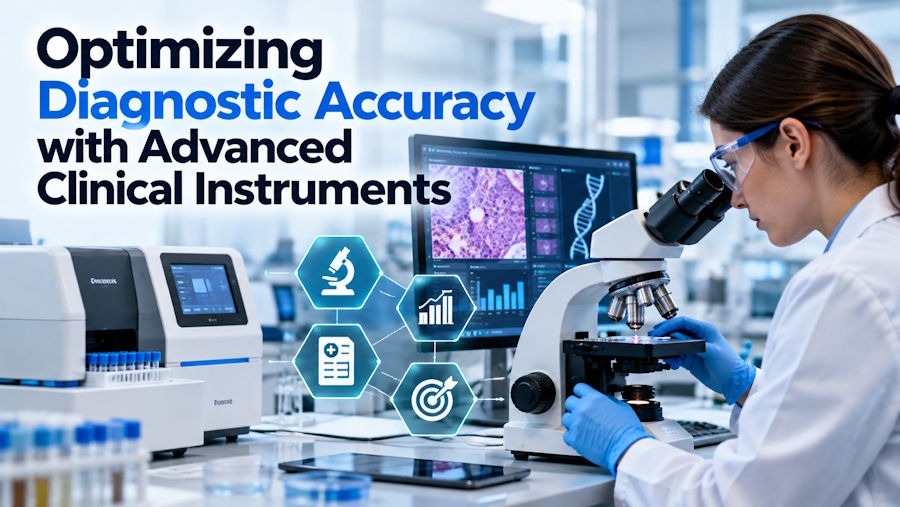
Accurate diagnosis is the foundation of effective patient care. Clinical instruments have evolved from simple mechanical devices to complex systems that combine optics, electronics, chemistry, and software. These advances enable clinicians to detect disease earlier, characterize conditions more precisely, and monitor treatment response with greater confidence. Achieving optimal diagnostic accuracy requires a deliberate approach to instrument selection, validation, workflow integration, and ongoing quality assurance.
Choosing the right instruments
Selecting instruments begins with a clear understanding of diagnostic goals. Sensitivity, specificity, throughput, sample type compatibility, and maintenance requirements must be balanced against budget and space constraints. High-resolution imaging platforms and mass spectrometers offer deep analytical power but demand experienced staff and strict environmental controls. Conversely, point-of-care analyzers deliver rapid results with simpler operation, which can be advantageous for triage and immediate decision-making. When planning capital investments, administrators should evaluate not only purchase price but total cost of ownership, including consumables, software licenses, calibration supplies, and service contracts.
Infrastructure and procurement strategies
Upgrades to infrastructure often unlock the full potential of advanced technology. Centralizing processing areas to reduce sample transport times, optimizing bench layout for uninterrupted workflows, and ensuring stable power and climate control are essential. Purchasing decisions should be informed by compatibility with existing information systems and the vendor’s commitment to long-term support. For example, replacing outdated instruments with modern, network-enabled devices can streamline data flow and reduce transcription errors. Thoughtful procurement that anticipates future needs helps laboratories remain adaptable as diagnostic paradigms evolve. Upgrading pathology lab equipment as part of a phased modernization plan can be cost-effective when prioritized by clinical impact and return on investment.
Validation, calibration, and quality control
Instrument performance must be verified before clinical use and monitored continually. Validation protocols should confirm analytic sensitivity, specificity, linear range, and inter-run reproducibility against reference standards. Calibration schedules need to be documented and adhered to, with traceable standards and recorded outcomes. Implementing daily controls, periodic proficiency testing, and automated self-check routines helps detect drift or malfunction early. When problems arise, root-cause analysis combined with corrective and preventive action (CAPA) ensures that errors are not only fixed but that systemic weaknesses are addressed. A culture that values transparency and continuous improvement is as important as the technical measures themselves.
Workflow integration and connectivity
Even the most advanced instrument cannot deliver accurate diagnosis in isolation. Workflow design that minimizes manual data handling reduces transcription errors and speeds turnaround. Integrating instruments with the laboratory information system, electronic health record, and decision-support tools permits seamless transfer of results, flags critical values, and enables longitudinal data analysis. Barcode-driven sample tracking and automated aliquoting reduce misidentification risks. In multidisciplinary settings, structured reporting and image sharing foster consistent interpretation across clinicians. Harmonization of operating procedures across shifts and sites supports reproducibility, particularly in larger networks or reference laboratories.
Human factors and training
Sophisticated instruments require skilled operators. Investing in structured training programs that combine hands-on practice with competency assessments ensures consistent operation. Training should encompass routine operation, troubleshooting, data interpretation, and adherence to safety protocols. Cross-training staff increases resilience against absences and turnover. Psychomotor ergonomics, clear user interfaces, and vendor-provided online resources reduce cognitive load and improve adherence to protocols. Performance metrics and feedback loops—such as monitoring error rates and turnaround times—can identify training gaps and guide targeted interventions.
Data integrity and interpretive support
Accurate measurement is only part of the challenge; correct interpretation determines clinical utility. Advanced instruments generate volumes of complex data that benefit from statistical validation, reference range harmonization, and integration with clinical metadata. Automated algorithms and artificial intelligence can enhance pattern recognition, prioritize abnormal results, and assist in differential diagnosis, but they require rigorous validation to avoid bias and overfitting. Transparent reporting of algorithmic performance and clear delineation of human oversight responsibilities preserve clinical accountability. Secure data management and audit trails maintain integrity and traceability—critical for regulatory compliance and patient safety.
Maintenance, vendor partnerships, and regulatory compliance
Long-term diagnostic accuracy depends on proactive maintenance and strong vendor relationships. Service agreements should guarantee timely parts replacement, software updates, and remote diagnostics capability. Collaboration with vendors for preventive maintenance schedules and firmware validation minimizes downtime. Laboratories must also stay current with regulatory standards and accreditation requirements, incorporating changes into SOPs and training. Documentation of maintenance, validation records, and corrective actions supports audit readiness and builds confidence in reported results.
Future directions and continuous improvement
The trajectory of clinical instrumentation points toward greater miniaturization, multiplexing, and integration of molecular and phenotypic data. Emerging modalities such as digital assays, high-throughput sequencing, and advanced imaging will broaden diagnostic horizons. To leverage these capabilities, laboratories must maintain flexible architectures and invest in workforce development. Continuous quality improvement, informed by outcome tracking and stakeholder feedback, ensures that technological advances translate into better patient outcomes. By aligning instrument capability with clinical priorities, laboratories can optimize diagnostic accuracy while remaining resilient to evolving demands.
Precision in diagnosis emerges from the interplay of reliable instruments, disciplined processes, and competent people. Optimizing diagnostic accuracy is not a one-time project but an ongoing commitment to validation, connectivity, and quality. When institutions approach technology as part of an integrated system—rather than isolated gadgets—they unlock the full value of advanced clinical instruments for patients and clinicians alike.

