

Introduction
Modern websites have a lot to live up to. They need to cope with growing traffic, load quickly and look just as good on a cracked phone screen on a bus as on a large office monitor. Visitors have very little patience. A page that takes too long to load is often closed before it’s even finished. As businesses and organizations grow their online presence, their websites usually need more features, tighter security and extra server capacity along the way. Building and looking after a site like that entirely from scratch can be slow, expensive and technically tricky. Modern web development frameworks help developers rise to those challenges by offering structured tools, reusable components and well-tested ways of working. They don’t do the job for anyone, but they mean nobody has to reinvent the wheel every Monday morning.
Understanding Modern Web Development Frameworks
Web development frameworks are collections of tools, libraries and ready-made structures that make building web applications far simpler. They provide tried-and-tested answers to everyday development jobs, including routing, data handling, managing the user interface, logging people in and passing information between applications and servers. Without them, a developer might spend days building a login system that a framework could provide in an afternoon.
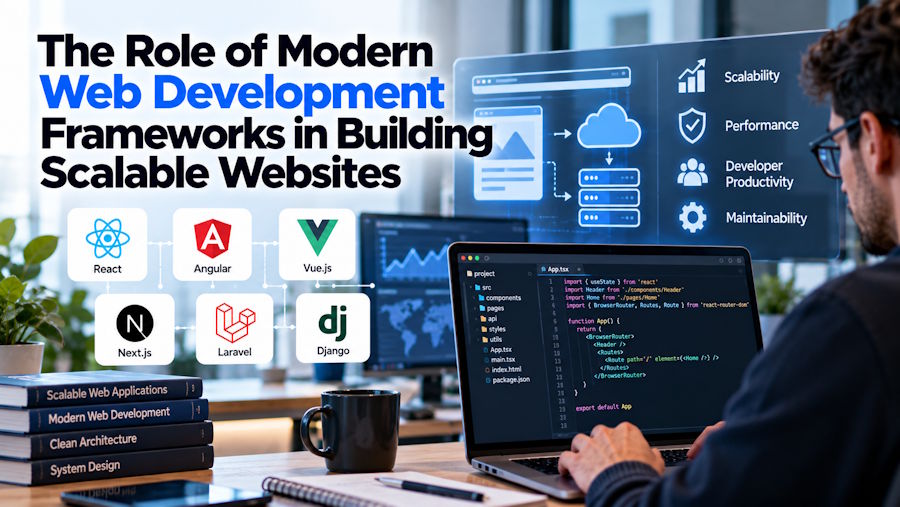
Popular frameworks and technologies include React, Angular, Vue.js, Next.js, Django and Laravel. Each one has its own strengths and suits particular ways of working. React, for example, helps developers build lively, interactive user interfaces, while Next.js builds on React with features such as server-side rendering and static site generation. Django and Laravel offer structured environments for building the backend, the part of a website visitors never see but always rely on. Choosing between them can feel a little like choosing a car. They’ll all get from A to B, but some suit a family road trip far better than a quick dash across town.
The right framework depends on what the project needs, how complex it is, what the team already knows and how much the site is expected to grow. A small team of three that knows Python inside out may be far happier with Django than with something trendier that nobody on the team has touched before.
Improving Code Organization and Maintainability
One of the biggest advantages of modern frameworks is the way they keep code organized. Component-based development lets developers break complicated interfaces into smaller, reusable pieces. Buttons, navigation menus, forms and content sections can each be looked after separately and reused right across a website. It’s a bit like building with well-labelled boxes of parts instead of one enormous drawer full of odds and ends.
That structure becomes especially valuable as a website grows and needs regular updates. Developers can change one component without accidentally upsetting unrelated parts of the site. Most developers have a story about changing the color of a single button and somehow breaking the checkout page. Clear organization makes that far less likely. It also helps teams work together smoothly, track down errors faster and add new features without a string of nasty surprises. A new developer joining on a Monday can find their way around in days rather than weeks.
Maintainable code cuts the long-term effort of looking after a growing website. For professional service providers, including Thomas Law Offices, a well-organized website can also support accessible information, simple navigation and a consistent experience for visitors looking for legal resources. Someone reading about their rights late at night, perhaps worried about a letter that arrived that morning, deserves a site that’s calm, clear and easy to find their way around.
Enhancing Performance and User Experience
Website performance has a direct effect on how easy a site is to use, how long people stay and how visible it is in search engines. A shopper scrolling on a train with patchy signal rarely waits around for a sluggish page. Modern frameworks offer techniques that help developers make sites load faster and feel more responsive.
Server-side rendering builds page content on the server before sending it to the browser, while static site generation prepares pages ahead of time. In the right situations, both approaches reduce the work a visitor’s device has to do, which matters a great deal on older phones. Code splitting and lazy loading let applications load only what’s needed for a particular page or action, rather than sending everything at once. There’s no point loading the entire photo gallery for someone who only came to find the opening hours.
Frameworks can also support efficient rendering and state management. Real performance gains still depend on how well everything is built, though, along with the hosting setup, caching strategies and the amount of data a site has to handle. A powerful framework running on a cheap, overloaded server will still feel slow.
Supporting Scalability and Growing Traffic
Scalability is the ability of a website to serve more users, more requests and more intensive workloads without halting. It’s what separates a site that can handle a sudden rush of visitors, from one that crashes when a popular event is released for sale. Modern frameworks also allow scalable development with modular architecture, reusable services, and integration with databases, APIs, and cloud infrastructure.
If a project can benefit from it, developers are able to decouple the frontend visitors see from the backend services behind it. The modularity allows for different components to be updated and deployed or scaled separately. Caching, load balancing, database optimization and content delivery networks can also help a site gear up for sudden spikes, like a rush of shoppers on Black Friday or a rush of readers after a news story goes viral.
A framework on its own doesn’t guarantee scalability, though. The whole system needs careful design, steady monitoring of resources and an eye for bottlenecks before they start affecting real people. It’s far better to spot a struggling database during a quiet Tuesday afternoon than to discover it through a three o’clock alert in the middle of the night.
Strengthening Security and Reliability
Security is essential for any website that handles personal information, user accounts or payments. A single breach can undo years of trust in an afternoon. Many frameworks include built-in protections or well-established methods for dealing with common vulnerabilities, such as cross-site request forgery, unsafe handling of user input and injection attacks.
Those framework features only work when they’re set up properly. Validating user input, applying sensible access controls, keeping sensitive credentials safely out of sight and keeping dependencies up to date are all part of the job. An outdated plugin left unpatched is a bit like leaving the back door unlocked while carefully bolting the front. Automated testing and solid error handling also help catch problems before they ever reach the live site, rather than letting customers discover them first.
Together, these practices make websites far more reliable and reduce the risks that come with running complex online platforms. Visitors rarely notice good security. They notice very quickly when it’s missing.
Conclusion
Modern internet development frameworks offer a practical basis for designing websites that are maintainable, responsive, secure and scalable as per the requirement. The structured approach and development tools help teams manage complexity and support better performance and reliable updates. Developers are able to build scalable websites that will be flexible for years to come, with the right framework, some thought put into architecture, testing, monitoring and good security practices. The best frameworks do more than just build a site. They keep it buzzing long after the launch party is done.

