

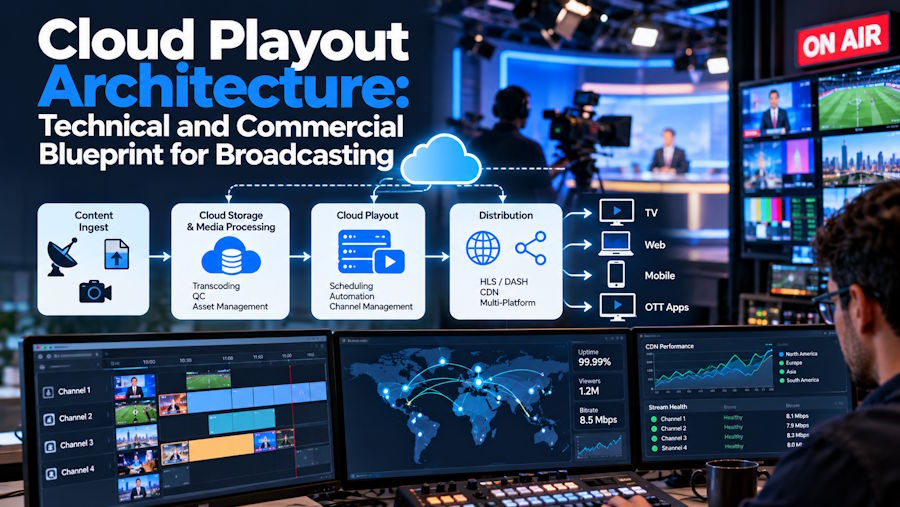
The global media landscape is undergoing a massive migration. Traditional linear broadcasting long dependent on costly master control rooms (MCRs), complex satellite transponders, hardware video switchers, and miles of SDI cabling is rapidly being replaced by virtualized, cloud-native environments.
As media networks, digital brands, and FAST (Free Ad-Supported Streaming TV) operators seek to reduce operational expenses and accelerate time-to-market, cloud playout has emerged as the definitive standard for modern channel creation, automation, and global distribution.
This technical guide provides media executives, solution architects, and broadcast engineers with an operational breakdown of how cloud playout works, its architectural benefits, monetization strategies, and best practices for scaling 24/7 linear channels.
What is Cloud Playout?
Cloud playout is a software-defined broadcast management framework that shifts traditional linear master control room (MCR) functionalities such as playlist scheduling, video decoding, dynamic graphics insertion, SCTE marker injection, and stream packaging to cloud infrastructure (such as AWS, Azure, or private cloud environments).
Instead of relying on localized rack servers and physical switchers, broadcasters manage channels remotely through a unified web interface. Raw video assets stored in cloud repositories are dynamically processed, stitched, and encoded in real time into linear video feeds ready for global delivery over OTT, FAST, cable, or satellite networks.
Architectural Blueprint of a Cloud Playout Engine
A cloud-native playout system operates as an end-to-end pipeline that ingests media, applies real-time channel branding, and packages output manifests for multi-device distribution.
1. Asset Ingestion and Quality Control
Mezzanine files (such as ProRes, MXF, or high-bitrate MP4s) enter the cloud asset management layer. Automated Quality Control (QC) engines evaluate aspect ratios, frame rates, and audio loudness (conforming to ATSC A/85 or EBU R128 standards) before placing content into ready-to-play storage buckets.
2. Playlist Automation and Frame-Accurate Switching
Channel management software executes automated schedules. Software-defined playout engines stitch disparate video files and live contribution feeds (via SRT, RTMP, or Zixi) seamlessly, maintaining frame accuracy without visual artifacts or audio sync issues.
3. Dynamic Branding and Graphics Overlays
Broadcast-grade cloud channels feature real-time HTML5 graphics rendering. Operational teams can inject lower-thirds, station bugs, countdown clocks, and live tickers without needing on-premise hardware character generators (CGs).
4. SCTE-35 Ingest and Ad Triggering
Monetizing digital linear channels relies on precise metadata injection. The playout engine inserts frame-accurate SCTE-35 splice markers signaling commercial breaks, which downstream Server-Side Ad Insertion (SSAI) engines convert into targeted programmatic ad inventory.
To build a resilient 24/7 linear pipeline, operators rely on dedicated enterprise software solutions like cloud playout engines to manage scheduling, graphics, and live feed switching seamlessly.
Key Benefits: Cloud-Native vs. On-Premise Master Control
Migrating master control workflows to cloud environments delivers major strategic, technical, and economic advantages over legacy hardware infrastructures.
| Operational Feature | Legacy On-Premise MCR | Enterprise Cloud Playout |
|---|---|---|
| Capital Investment (CapEx) | High (Hardware racks, switchers, SDI cabling) | Zero Upfront Hardware Costs (OpEx Model) |
| Channel Deployment Time | 3 to 6 Months (Procurement & Build) | Minutes to Hours (API / Cloud Provisioned) |
| Disaster Recovery (DR) | Expensive 1:1 Mirroring Facility | Automated Multi-Region Cloud Failover |
| Monetization Engine | Fixed Linear Ad Insertion | Dynamic Server-Side Ad Insertion (SSAI) |
| Scalability | Fixed Capacity; Hard to Expand | Elastic; Unlimited Simultaneous Channels |
Monetizing Cloud Channels with FAST and SSAI
The rapid growth of FAST platforms (such as Pluto TV, Tubi, Samsung TV Plus, and The Roku Channel) has transformed linear video economics. Cloud playout bridges the gap between traditional broadcast scheduling and modern digital ad monetization.
Server-Side Ad Insertion (SSAI)
Unlike client-side ads that often get blocked by browser extensions or cause buffering spinners, SSAI stitches ads directly into the video stream manifest at the cloud level:
- SCTE-35 Trigger: The playout engine fires an ad break cue.
- Ad Decision Request: The SSAI manipulator queries an Ad Decision Server (ADS) in real time.
- Manifest Stitching: Targeted commercial clips are inserted into the user's video manifest without interrupted playback, ensuring a seamless, broadcast-quality experience.
Optimizing Quality of Experience (QoE) with Real-Time Analytics
Operating a successful cloud broadcast pipeline requires continuous operational visibility. Because cloud video flows through public and private IP networks, tracking telemetry at every stage of the video pipeline is essential.
Integrating real-time video analytics into your playout ecosystem allows broadcast engineers to monitor critical performance indicators in real time:
- Buffer Ratios: Tracking viewer rebuffering rates to detect network degradation before it affects retention.
- Join Time / Playstart Latency: Ensuring streams begin instantly across Smart TVs, mobile clients, and web browsers.
- SCTE-35 Execution Tracking: Verifying that ad markers trigger successfully to prevent missed ad revenue opportunities.
- Egress Throughput: Monitoring bandwidth health and CDN routing efficiency across global distribution regions.
Best Practices for Deploying Enterprise Cloud Playout
- Implement Multi-Region Failover Architecture: Run active-active or active-backup playout instances in geographically isolated cloud regions (e.g., AWS us-east-1 and eu-central-1) to ensure zero airtime loss during cloud outages.
- Leverage Secure Transport Protocols: Use Secure Reliable Transport (SRT) or Zixi for remote live feed ingestion and point-to-point syndication to overcome public internet packet loss.
- Automate Asset Normalization: Standardize audio normalization, frame rates, and closed captioning formats (EIA-608/708) automatically during asset ingestion to eliminate manual quality check bottlenecks.
- Unify CMS and Playout Workflows: Connect your asset catalog directly to the playout automation engine to prevent manual metadata re-entry and streamline channel scheduling.
Frequently Asked Questions (FAQs)
What is cloud playout and how does it work?
Cloud playout is a software system hosted on cloud infrastructure that automates linear 24/7 video broadcasting. It ingests video files, applies live schedules, inserts graphics and ad cues, encodes the feed, and distributes the final stream to OTT platforms, FAST apps, or cable networks.
Can cloud playout handle live news or sports switches?
Yes. Modern cloud playout engines ingest remote live streams via SRT, RTMP, or Zixi protocols. Automation schedulers or manual operator controls switch seamlessly between pre-recorded VOD playlists and live contribution feeds with sub-frame accuracy.
What transport protocols are used to distribute cloud playout streams?
For point-to-point syndication to cable headends or MVPDs, broadcast protocols like SRT, Zixi, and RIST are used. For direct-to-consumer digital distribution across OTT apps and Smart TVs, streams are packaged into low-latency HLS or MPEG-DASH manifests.
How does cloud playout help lower operational costs?
Cloud playout eliminates the need to buy, house, power, and maintain expensive physical MCR hardware. It transitions costs from a heavy upfront Capital Expenditure (CapEx) to a predictable, usage-based Operational Expenditure (OpEx) model.
Is cloud playout secure against cyber threats and stream piracy?
Yes. Enterprise playout systems protect linear streams using end-to-end TLS encryption, tokenized stream authentication, AES-128 encryption, and Multi-DRM (FairPlay, Widevine, PlayReady) token management across distribution edge nodes.
Conclusion
Cloud playout has evolved from a niche alternative to the core foundation of modern linear broadcasting. Shifting master control operations to cloud-native software allows media networks and digital publishers to eliminate physical infrastructure costs, deploy channels globally in minutes, and maximize monetization through automated SSAI workflows.
By combining elastic cloud automation, studio-grade stream security, and detailed performance analytics, forward-thinking media organizations can build scalable, broadcast-quality streaming networks designed for the future of digital entertainment.

