

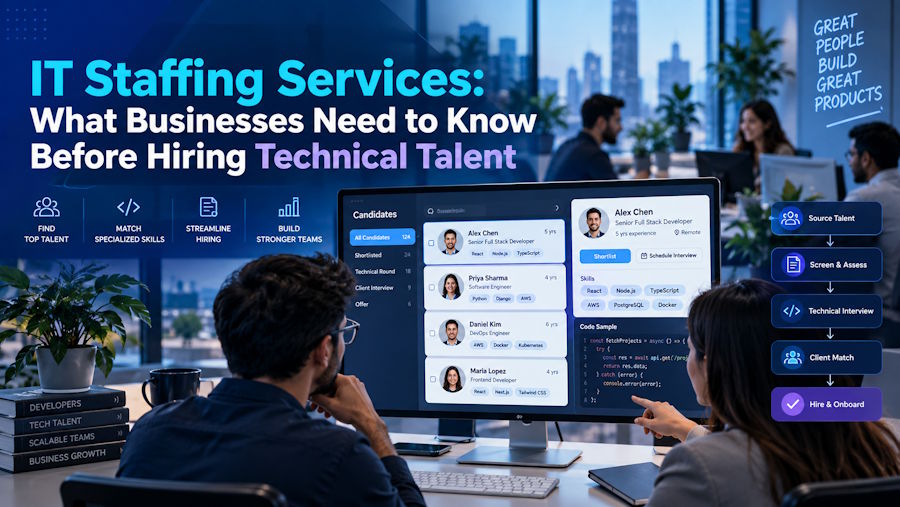
Hiring IT professionals takes time. You need to find people with the right skills, assess their experience, and make sure they fit your team's working style. For a small company, this process often puts extra pressure on an already busy team.
The problem gets harder when you need a specialist for a short-term project. Hiring a full-time employee might not make sense if the work will last only a few months.
This is where IT staffing services come in. They help businesses find technical professionals for different roles, from software development to quality assurance and IT support. The type of service you choose depends on your team's needs, budget, and project timeline.
Companies like BolsterBiz offer IT staff augmentation for front-end and back-end development, full-stack engineering, DevOps, and QA testing. Businesses use these arrangements to add technical talent without going through the full permanent hiring process.
But IT staffing covers more than adding a few developers to your team. Here are seven common services and what each one offers.
1. Contract Staffing
Contract staffing works well when a company needs technical support for a specific period.
Suppose your team is preparing to launch a new application. You have enough developers, but your testing team is short on people. Bringing in a few contract or outsourced QA engineers for three months might help you meet the release deadline.
Once the project ends, the contract ends according to the agreed terms.
This arrangement helps businesses manage temporary workloads without adding permanent positions. It also works for system upgrades, software migrations, and seasonal demand.
Before hiring, agree on the contract period, responsibilities, payment terms, and expectations. It is also worth discussing what happens if the project takes longer than planned.
2. IT Staff Augmentation
Sometimes, your existing team has the experience to manage a project but lacks enough people to get the work done on time.
IT staff augmentation addresses this problem. You bring external professionals into your team, and they work under your direction.
For example, a software company might have four developers working on a product update. The deadline is approaching, and the team needs another developer with experience in a particular programming language. Staff augmentation helps fill this gap without changing the entire team structure.
Businesses use this model for software development, QA testing, DevOps, cloud engineering, and other technical roles.
The important part is to define responsibilities early. External employees need access to the right tools, clear instructions, and regular communication with your internal team. Without these basics, adding more people might create confusion instead of improving productivity.
3. Permanent IT Recruitment
Some positions need long-term attention. A cybersecurity manager, systems architect, or senior software engineer often becomes closely involved in a company's daily operations.
For these roles, permanent recruitment is usually worth considering.
IT staffing agencies help businesses identify candidates, review applications, conduct initial interviews, and shortlist suitable people. The employer then makes the final hiring decision.
This saves time, especially when internal recruiters have several open positions to manage.
Still, permanent hiring involves more than paying a recruiter's fee. You also need to account for salaries, benefits, onboarding, training, and the time spent interviewing candidates.
Take time to define the role before starting the search. A clear job description helps attract people with relevant experience and reduces unnecessary interviews.
4. Dedicated Development Teams
A dedicated team is useful when a business needs consistent technical support over several months or years.
The team might include developers, QA engineers, designers, and a project manager. They work on the company's products or technical projects according to an agreed structure.
Consider a growing SaaS business. Its internal team handles customer requests and fixes existing bugs, but new feature development keeps getting delayed. A dedicated external team gives the business additional capacity to manage both responsibilities.
The arrangement needs proper planning. Decide who sets priorities, reviews the work, tracks progress, and handles technical decisions.
You should also agree on documentation and knowledge transfer. These details matter when a team member leaves or the project changes direction.
5. Specialist IT Staffing
Some projects require skills your current employees do not have.
A business moving its systems to the cloud, for instance, might need an engineer with experience in cloud infrastructure and security. A company developing an AI product might need someone familiar with machine learning models and data pipelines.
Specialist IT staffing helps businesses find professionals for these roles.
When reviewing candidates, look beyond their qualifications and job titles. Ask about projects they have handled, problems they solved, and tools they used. A practical assessment often tells you more than a long list of technical skills on a résumé.
Be clear about which skills the role requires from day one. This helps avoid hiring someone who looks suitable on paper but needs extensive training before starting the actual work.
6. Technical Recruitment and Screening
Finding applicants is one part of hiring. Identifying the right people is another.
Technical recruitment services help companies screen candidates before they reach the final interview stage. The process often includes résumé reviews, initial interviews, technical assessments, and reference checks.
For example, a company hiring a backend developer might ask candidates to complete a coding task or explain how they would troubleshoot a performance issue.
The assessment should reflect the actual job. Lengthy tests with little connection to daily responsibilities often waste time for both candidates and employers.
Businesses should also assess communication skills. Technical employees need to explain problems, discuss solutions, and work with colleagues across departments.
7. IT Support Staffing
IT support teams handle everyday technical problems. These include login issues, software errors, device problems, network access, and employee requests for technical assistance.
When internal support teams have too many tickets to handle, businesses often bring in additional staff.
IT support staffing helps fill these gaps. Depending on the requirement, businesses might hire help desk agents, system administrators, or technical support specialists.
Before choosing a provider, define the support hours, response targets, escalation process, and reporting requirements. Decide how staff should record incidents and share solutions with the internal team.
Good documentation helps prevent the same problems from being investigated repeatedly.
Choosing the Right IT Staffing Service
The right option depends on what your business needs at the time.
If you need extra developers for a short project, contract staffing or staff augmentation might work. If you need a permanent technical leader, direct recruitment is a better fit. A dedicated team makes more sense when you have ongoing development work and need consistent support.
Before making a decision, consider these points:
- Project duration. Estimate how long you need the additional skills.
- Budget. Compare the total cost of hiring, onboarding, and managing external professionals.
- Team structure. Decide who will assign tasks and review performance.
- Technical requirements. Identify the skills your current team lacks.
- Security. Set clear rules for system access, confidential information, and data handling.
IT staffing is not a replacement for proper planning. You still need clear goals, realistic deadlines, and people who understand their responsibilities.
Start by identifying the gap in your current team. Then choose a staffing arrangement based on the work you need to complete, rather than hiring more people without a clear plan. This approach helps you control costs, manage workloads, and bring the right technical skills into your business.

