


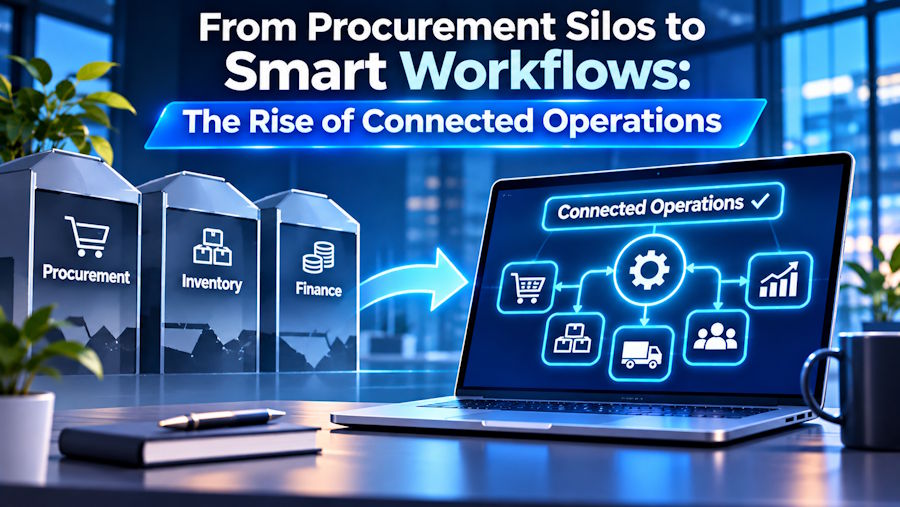
Sourcing, approval, suppliers, purchase orders and invoices, and spend analysis are only a handful of the various moving parts in the procurement workflow that are increasingly becoming more complex. This is a potential scenario of team duplication of effort, team pain around visibility and slower processes.
In modern times, these are connected through the procurement value chain, but with the aid of intelligence, sharing and automation. AI for procurement can help with mundane tasks, uncover actionable intelligence and support teams in handling more transactions while retaining personalisation in critical business decisions.
Connecting Procurement Intelligence With Smarter Workflows
The procurement processes of today should be linked to each other and be mindful of transparency to reduce manual work and optimise the information in the product procurement process across the organisation.
-
Automating Routine Procurement Activities
Document handling and document analysis, supplier identification, repetitive document processing in purchasing, spend analysis and other repetitive tasks in purchasing can be assisted using AI for procurement. There are many tasks that can be automated to free up procurement team time to focus on strategic planning, negotiations, supplier management and other tasks of importance. Smart workflows can be used to route the information to the appropriate stage and move the information to the right system, automating the movement of the information between systems that are separate, which makes it unnecessary or minimises the need for transferring the information manually. This is a way to ensure consistency in the process and improve communication among teams throughout the procurement process.
-
Improving Supplier Discovery and Sourcing
The discovery and sourcing process may consist of a collection of steps, beginning with possible suppliers and the following bidding and business relationships. These activities can be facilitated by intelligent procurement systems, which can be used to access, organise and manage supplier information, automate RFQs, analyse supplier responses and help the team decide on their options. The use of AI for procurement will also be effective in making recommendations and analysis, allowing procurement to be part of the conversation on important supplier decisions. By adopting a connected approach to sourcing, the sourcing process can be made more structured and attend to information regarding suppliers without relying on spreadsheets, emails, and other tools.
-
Creating Better Spend Visibility
The assumption here is that the information that the procurement department has on the purchasing process is accurate enough to help them know where the purchasing money is going and identify opportunities. The centralised data can help to achieve a more convenient place with all the necessary information from the purchase requests, purchase orders, invoices, suppliers and business units. Artificial intelligence procurement helps companies to understand how much they save, what other things affect their decision-making process when creating budgets, analyse transactions and watch for any abnormalities. Better visibility can also help companies to see their bad purchasing habits.
-
Strengthening Approval and Policy Controls
For purchases to go through an organisation's authorised processes, it is important that there is an approval workflow. Depending on the type of request, budget, department, etc. or based on defined rules, automated routing can route to the person or the department it is intended for. This decreases idle wrapping and gives increased visibility on the approval status. Integrated policy control can also help an organisation manage its buying processes in a compliant fashion by steering employees towards approved suppliers during the buying process, catalogues and purchasing channels. While there is some structure in the procurement process with these controls, that doesn't imply that a procurement team doesn't have to be manually monitoring all of the outgoing transactions.
-
Connecting Procurement With Finance
Procurement and finance have a strong relationship; because of this, there is often a direct flow of the following activities: Purchase orders, Invoice capture, payments, Budget allocation and spend reporting. Linking these processes can help minimise this information gap across departments and give greater transparency of financial commitments. Also, automated invoice processing and matching can help eliminate manual data entry and deliver an even more precise payment process. This helps enterprises make more calculated purchasing decisions and have greater awareness of financial activity over time, budgets and commitments, supplier activity and spending over time.
Unifying Procurement Operations Through Connected Orchestration
A lack of information sharing between procurement and other systems means there's an inconsistent workflow between sourcing and the workflow that flows into procurement, purchasing, supplier management, AP and spend analysis. The activities are consolidated in an orchestrated procurement process to enable the information to flow more smoothly between them during a well-orchestrated procurement process information flow.
Processes can be linked together through procurement orchestration without having to do everything manually. Requests might be approved, the sourcing process could be linked to supplier data, and purchase order data could be used for the invoice process, while spend data can be analysed. This will give the buyer better visibility throughout the procurement process and provide more continuity in handling this process. It's about people, systems, data, and policies in coordination, not automation.
Extending Procurement Visibility Across Business Functions
Procurement increasingly becomes a multi-functional process and is increasingly related to other teams like finance, leadership, suppliers, business and operations. This strategy can help to streamline the flow of information and minimise data duplication in the process.
By providing a common ground to coordinate purchasing activities across departments, a mature procurement orchestration strategy can help to offer a common ground for the management of purchasing activities. The centralised information can come in handy to streamline interaction with suppliers, monitor approvals, review the exact terms of the contract, receive invoices and make spending analysis. It could also provide mechanisms to adapt to various business necessities and to provide uniformity of administration. From the process of procurement, the various stages and their pertinent information can be used in Roadmap Planning to deliver effective efficiencies - working beyond the realm of procurement transactional administration towards visibility, supplier control and informed decision-making.
Final Thoughts
The need for increased visibility, automation, compliance and collaboration through the procurement lifecycle mirrors the trend towards connected procurement. With procurement orchestration, organisations can coordinate these activities while minimising the restrictions of interdependent systems and manual work.
Procol provides an AI-driven procurement platform to link all procurement & finance processes ranging from intake to supplier transactions, purchase-to-pay, accounts payable, spend control, and orchestration. Their AI-powered platform, with an orchestration engine, is ideal for tasks such as approval routing, policy validation, autonomous monitoring, supplier management, invoice processing, spend analysis and much more.

