

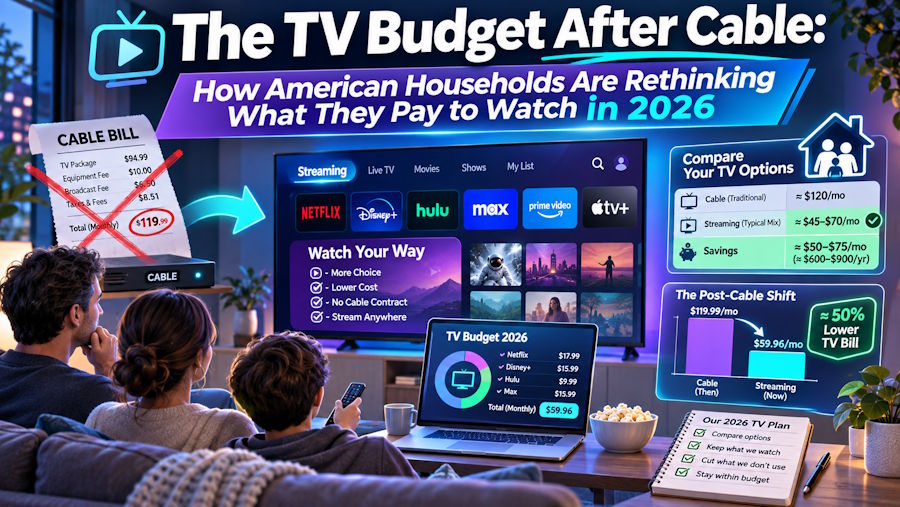
For years the TV bill was one of those costs nobody looked at closely. It came every month, it went up a little every year, and it was easier to pay it than to think about it. That has changed. With grocery, rent and insurance bills all climbing, more households are going line by line through their fixed costs, and the TV package is usually the first one that doesn't survive the review.
But cutting the cable is only half a decision. The other half is what replaces it, and that's where a lot of people end up paying almost as much as before, just spread across more apps. Here's a practical way to think about the TV budget after cable, without spreadsheets or jargon.
Start with what you actually watch
Before comparing prices, write down what the household really watches in a normal week. Not what you might watch, what you do watch. For most families it comes down to three groups:
- Live TV: news, live sports and a few favorite channels at set times.
- On-demand shows and movies, watched whenever.
- Kids' content, which often runs in the background for hours.
This list matters because each group is priced differently. Paying for live channels you never open, or for three movie apps that overlap, is where most post-cable budgets leak.
The hidden costs nobody mentions
The monthly price on the website is rarely the full picture. When you add up the real cost of any TV setup, include:
- Equipment: a streaming stick, a box, or a newer TV if the old one can't run modern apps.
- Internet: if you stream more, check that your plan can handle it. Around 10 Mbps per HD screen and 25 Mbps for 4K is a comfortable margin.
- Price changes: introductory prices often rise after a few months, so read what the regular price will be.
- Overlap: two services carrying the same shows means you are paying twice for one thing.
A simple habit helps: once a quarter, look at every TV-related charge on your bank statement and cancel anything nobody used in the last month.
Monthly vs yearly: when paying ahead makes sense
Many services now offer a discount for paying for a full year. It can be a good deal, but only under two conditions: you have already tested the service properly, and there is a clear refund policy if it doesn't work out. Paying twelve months upfront for something you tried for ten minutes is how people get stuck.
A fair rule: pay monthly for the first month or two, then switch to a longer plan once you know the service holds up on the nights you actually watch. If you want to see how the numbers compare in practice, here is a plain breakdown of what IPTV plans cost by month and by year.
Where IPTV fits in a household budget
IPTV, internet protocol television, has become one of the more popular ways to replace a cable package because it bundles live channels, sports and on-demand content into a single subscription that runs on a streaming stick, a smart TV or a phone. For budget-minded households, the appeal is simple: one bill instead of several.
As with any service, the value depends on the provider. At IPTVService4K, we see the same pattern in our own support chats: customers who test first and then choose a longer plan are the ones who end up happiest with what they pay. That's why we keep the terms simple and in writing: a 24-hour free trial before any payment, a monthly plan for people who want flexibility, a yearly plan for those who already know it works for them, and a 30-day money-back guarantee either way.
Five questions to ask before you pay for any TV service
- Is there a free trial long enough to watch a live event at prime time?
- Is the full price shown before checkout, with no surprise fees?
- How many screens can watch at the same time?
- Is the refund policy written down, and how do you use it?
- How fast does support answer, and does a real person reply?
If a provider can't answer these clearly, the low price on the homepage doesn't mean much.
The bottom line
Cutting the cord isn't automatically cheaper. It becomes cheaper when you pay only for what the household really watches, avoid paying twice for the same content, and choose services that let you test before you commit. Treat the TV bill like any other fixed cost: review it, question it, and make it earn its place in the budget.

