

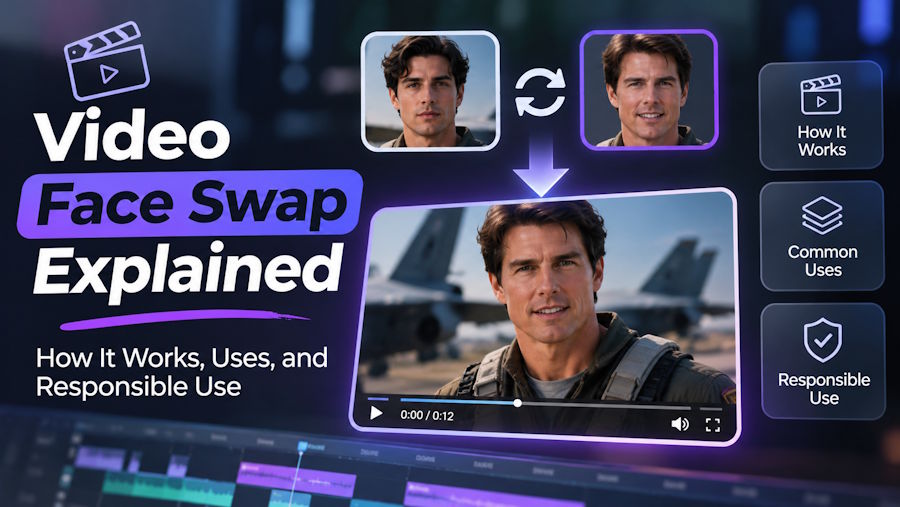
Video face swap technology has moved from film studios and research labs to browsers and phones. Anyone can now replace a face in a clip with another face in minutes, which is why it has become popular for memes, parody, short films and personal projects.
That ease is also why the technology deserves some explanation. This guide covers how video face swapping works, what it's useful for, how to get good results and what responsible use looks like.
What Is Video Face Swapping?
Video face swapping replaces one person's face in a video with another person's face while keeping the original body, motion, lighting and background. The aim is for the new face to move, blink and speak as though it belonged there.
It's a form of synthetic media, and it's often grouped with "deepfakes," a term for AI-generated or AI-altered audio and video. Not every face swap is deceptive, though. A clearly labelled parody, a film effect or a personal joke is very different from a fake designed to mislead.
How It Works
Most modern tools follow a similar pipeline.
- Face detection. The software finds faces in each frame of the video.
- Alignment. It identifies landmarks such as the eyes, nose and mouth so the face can be positioned and scaled correctly.
- Encoding. A neural network turns the face into a compact numerical description of its features and expression.
- Synthesis. Using the source face's identity and the target face's pose and expression, the model generates a new face for each frame.
- Blending. The result is matched to the surrounding skin tone, lighting and edges so it sits naturally in the shot.
- Smoothing. Because the process runs frame by frame, the software applies consistency checks to reduce flicker.
Common approaches include autoencoders and generative adversarial networks, and newer systems also use diffusion models.
Why Video Is Harder Than Photos
A photo face swap only has to work once. A video has to work across hundreds or thousands of frames, which creates several challenges.
- Consistency. The new face must stay stable as the head turns, so identity doesn't drift.
- Lighting changes. Moving through shadows or different light sources can expose mismatches.
- Occlusion. Hands, hair, glasses or objects crossing the face are hard to handle.
- Extreme angles. Profile views and tilted heads give the model less information.
- Speed and cost. Processing a clip takes far more computation than a single image, which is why free services often limit length and daily use.
What It's Used For
Entertainment and social media. Memes, parody clips, movie-scene recreations and personalised greetings.
Film and advertising. Visual effects teams use similar techniques for de-aging actors, replacing stunt doubles' faces and localising content.
Education. Teachers have experimented with putting a presenter into historical or fictional scenes to make lessons more engaging.
Privacy. Face replacement can anonymise people in footage, which is useful in journalism and research when identities must be protected.
Creative projects. Independent video makers use it for low-budget effects and storytelling.
A Look at One Tool
AIFaceSwap is a free online face swap app that lets visitors try face swapping without logging in. It supports single-person face swapping, multi-person face swapping and video face swapping, and users start by uploading a photo and a video. According to the site, free use is limited. You can make up to three face swap videos every 24 hours, and signing in unlocks more features. It supports files such as MP4, M4V and MOV, and it can handle up to six faces in one video.
The site also publishes a content policy. It says its tools shouldn't be used for fraud, impersonation, political misinformation, commercial use of public figures without consent or any content involving minors, and that users should have permission from anyone whose face appears in their content. It's worth reading these terms for any service you use.
How to Get Better Results
- Use a clear source photo. A well-lit, front-facing image with a neutral expression works best, and avoid heavy filters, sunglasses and strong shadows.
- Choose a suitable video. Clips where the face stays visible, the lighting is steady and the person doesn't turn away too much tend to give cleaner results.
- Keep it short. Trim to the part you need, since shorter clips process faster and are easier to quality-check.
- Match conditions. Similar lighting and angle between the photo and video reduce visible seams.
- Preview carefully. Watch for flicker around the hairline, odd edges and mouth movements that don't match the audio.
- Enhance with care. Upscaling and sharpening can help, but they can also exaggerate artefacts.
Consent, Law and Ethics
This is the most important part of using a face swap tool.
Get permission. Use your own face, or the face of someone who has clearly agreed. Don't use another person's likeness without consent, and never involve minors.
Understand the legal risk. Laws vary by country and state, but several principles are common:
- In the United States, the TAKE IT DOWN Act, signed on May 19, 2025, criminalizes knowingly publishing non-consensual intimate images, including AI-generated "digital forgeries," and also covers deepfakes intended to cause harm. Since May 19, 2026, covered platforms have had to provide a notice-and-removal process and remove reported content within 48 hours, with enforcement by the Federal Trade Commission.
- Many places have laws against impersonation, fraud, harassment and defamation, and a growing number of regions regulate deepfakes specifically.
- Using someone's likeness commercially without permission can violate right-of-publicity or personality rights.
- The EU's AI Act includes transparency requirements for AI-generated or manipulated content, so disclosure rules may apply to publishers.
Don't deceive. Label synthetic content when it could be mistaken for real, and follow the labelling rules of the platform where you post. Many platforms ask creators to disclose realistic AI-generated or altered media.
Real-world harm is documented. Deepfake video has been used in fraud. In a widely reported 2024 case, an employee at the engineering firm Arup in Hong Kong was tricked by a video call with fake colleagues into transferring around US$25 million. Treat unexpected video requests involving money or sensitive information with caution.
How to Spot a Manipulated Video
Detection is imperfect, but some signs can raise suspicion:
- Skin that looks unusually smooth, or edges around the face that shimmer or blur
- Lighting on the face that doesn't match the scene
- Unnatural blinking or gaze
- Lip movement that is slightly off from the audio
- Flicker or warping around the hairline, ears and glasses
- Sudden changes in resolution between the face and the background
Because these cues are unreliable, verify by other means. Check the original source, look for coverage from trusted outlets and, for requests involving money or access, confirm through a separate, known channel.
Choosing a Face Swap Tool
When comparing options, ask:
- What does it cost, and what are the free limits? Daily caps, length limits and watermarks vary.
- What happens to your uploads? Look for clear statements on storage, deletion and sharing.
- Does it have a content policy and a way to report abuse? Responsible tools say what is prohibited.
- How good is the output? Test with a short clip before committing.
- What formats and lengths does it support?
- Is there an account requirement? Some tools allow limited use without signing in.
People searching for face swap video free options should also check whether results carry a watermark, how long files are kept and whether commercial use is allowed. Free services are convenient for experiments, but a project with commercial or sensitive content deserves a closer look at the terms.
FAQ
Is video face swapping legal?
It can be legal for entertainment when you have permission and don't infringe on copyright, privacy or other rights. Using it for fraud, impersonation, harassment or intimate imagery without consent can be illegal.
Can I swap faces in a video for free?
Some online tools offer free use with limits on length and daily numbers. Check the current terms.
Why does the result sometimes look strange?
Common causes are poor lighting, extreme angles, objects covering the face or a low-quality source photo.
Should I tell viewers a video is a face swap?
Yes, if it could be mistaken for real. Disclosure builds trust and keeps you within many platform rules.
The Takeaway
Video face swapping is an impressive and accessible technology, with real uses in entertainment, education, film and privacy. It works best when you start with good source material, keep clips short and check the result carefully. It works well and stays safe only when it's used with consent, labelled honestly and kept away from deception. Choose tools that publish clear policies, read the terms and treat other people's faces with the same care you'd want for your own.

