


Whole-House Load Basics
Continuous and Surge Demand
A house draws two different numbers. The continuous figure is the sum of everything running at once, and a typical home sits between 1,000 and 3,000W with nothing unusual switched on. The surge figure is what happens when a compressor or a pump starts, and it can reach three times the running load for a second. That second decides whether the best solar generator for a house is a modest unit or a large one, because a unit that cannot start a motor cannot run it. Motors are the whole difficulty: a fridge compressor, a well pump and an air conditioner all start with a surge and run on a fraction of it. Add the surges up, because the peak is what the unit has to survive.
Output Rating vs Household Peak
The comparison is between the unit's continuous rating and the house's peak, not its average. A 1,500W unit will carry a fridge, a router and the lights, and will not carry a drier, and no amount of capacity changes that. Peak output buys the start of a motor rather than the running of a household. Manufacturers quote both numbers, and the smaller one is the one that decides what runs at two in the morning. Capacity decides how long and output decides what, and buyers usually confuse the two. A large battery behind a small inverter is a long outage with nothing running. A heat pump is the hard case, because it runs for hours rather than minutes and draws continuously while it does.
The 240V Split-Phase Question
Appliances That Need Split-Phase
Some appliances need two live legs rather than one, and they will not run from a single-phase outlet whatever the battery behind it. A well pump, a drier, a range and most central air conditioners are in that group. A unit with a 240V output and a split-phase inverter can feed them; one with only 120V outlets cannot, and an adapter does not change the physics. Ask which of your appliances carry a 240V plug before you buy anything. A 240V appliance draws from two legs at once, which is why a 120V-only unit cannot be adapted with a plug. Check the panel for double-pole breakers, since those are the circuits that need split-phase.
Wiring and Transfer Switch Requirements
The connection matters as much as the capacity. A transfer switch isolates the house from the grid so the unit cannot energise a line a crew is working on, and it decides which circuits the unit can see at all. A dedicated inlet and a panel with labelled breakers make the changeover a thirty-second job; an extension cord through a window makes it a hazard. Have an electrician wire the inlet, and label the circuits while the panel is open. The inlet is a fixed socket on an outside wall and the only connection the unit should use. A manual transfer switch costs far less than an automatic one and does the same job for a storm. Keep the inlet cable short and thick, since voltage drop across a long run is wasted heat and a warm plug.
Practical Backup Scopes
Essential-Circuit Backup
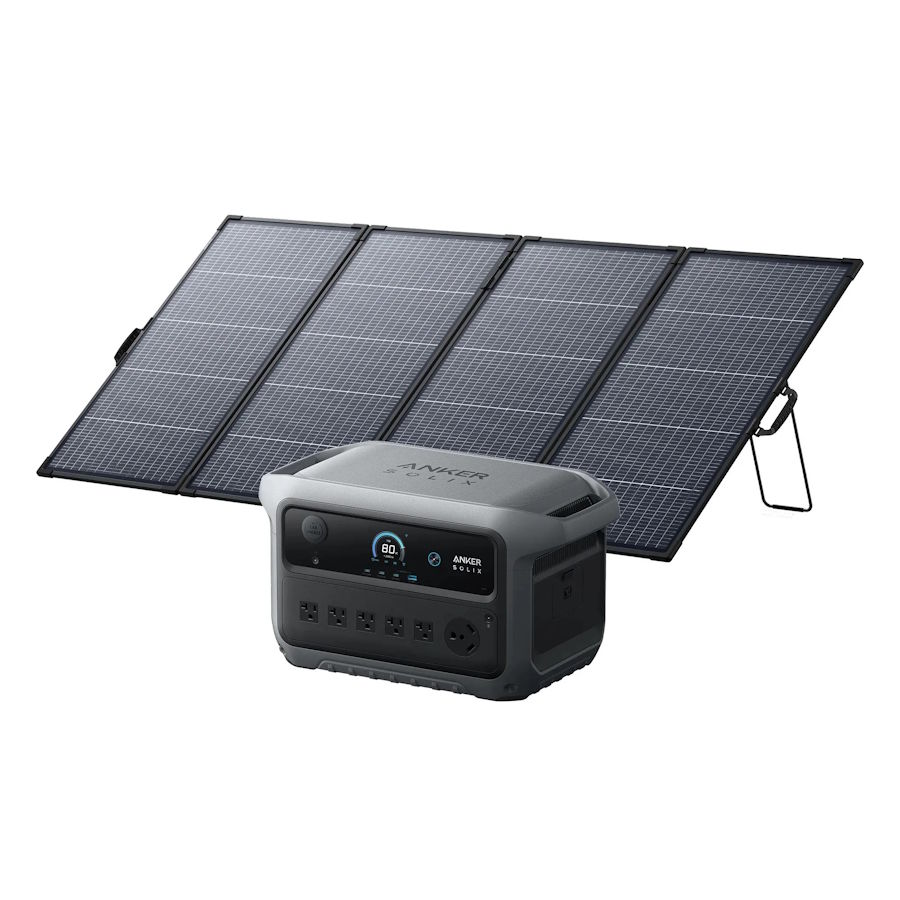
Most whole-house ambitions end here, and this is the sensible version. A sub-panel with the fridge, the heating controls, the router, the well pump and a few lights covers what a house actually needs, and it draws a fraction of the total. Six circuits is a typical essential panel, and it usually draws under 2,000W with everything on at once. An Anker SOLIX C2000 Gen 2 carries that panel with room to spare: 2,400W continuous against a 2,000W load, 4,000W peak for the well pump's start, and 4kWh that keeps the fridge cold through the night. Label the circuits in the order you would switch them on, not the order the electrician numbered them.
Partial Whole-House Coverage
Beyond essentials, coverage comes in steps: add the microwave and the coffee machine, then the laundry, then the air conditioning. Each step needs a bigger continuous rating rather than a bigger battery, and each raises the price faster than it raises the comfort. The honest test is which circuits you would notice missing after two days. Everything else is a convenience another source can cover. Each step up costs more than the appliance it serves, which is why most households stop after the second. A week of outage is a better test than an evening, and few people plan for a week.
Conclusion
Whole-house operation is a wiring decision as much as a capacity one. Choose the circuits, wire an inlet, size for the surge rather than the average, and the answer stops being a number on a box and becomes a panel with labels on it. Half a house, wired properly, is worth more than a whole house promised on a box. The rest is arithmetic done once, on a weekday, with the panel open and somebody writing the labels. One electrician, one afternoon and one labelled panel settle the argument for a decade. The panel labels are what make it repeatable.

