

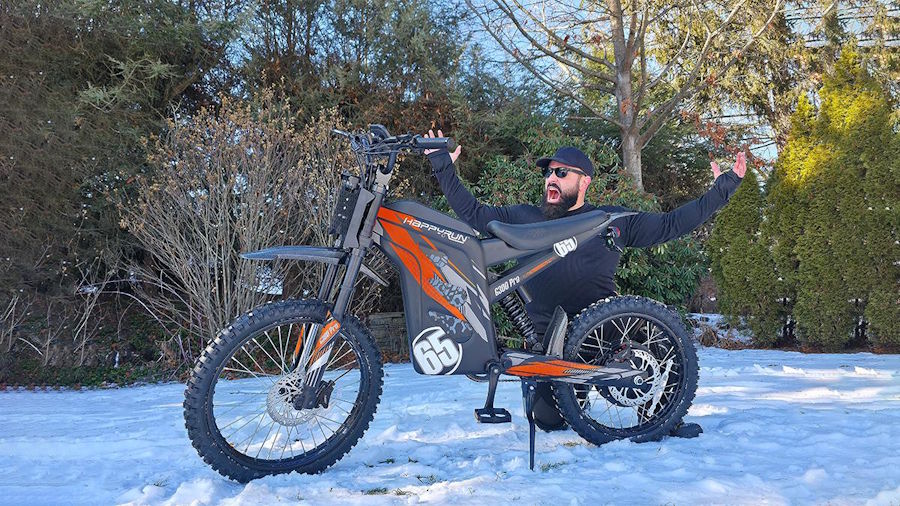
A long trail ride needs enough battery for the return trip, including the climb that felt easy while descending on the way out. A 35Ah pack can provide a substantial energy reserve, but amp-hours alone cannot tell you how many miles you will cover. Voltage, usable battery energy, and consumption on your route determine the result.
For planning purposes, separate the battery's capacity from the distance advertised for the bike. Then build an estimate around the conditions you expect to encounter.
Convert battery capacity into an energy figure
Amp-hours describe electrical charge capacity. Multiplying that figure by nominal voltage gives an approximate energy rating in watt-hours. For a 60V 35Ah battery, the calculation is 60 × 35 = 2,100 Wh, or 2.1 kWh.
That number is useful when comparing packs with different voltages. A larger Ah figure does not necessarily mean more stored energy if the voltage is lower. Compare watt-hours first, then consider battery weight, compatibility, and how much of the rated energy is usable under the intended conditions.
Keep watts separate from watt-hours. Motor power describes the rate of energy conversion; battery energy describes the available supply over time. A peak motor rating is not a constant consumption figure that you can divide into battery capacity to predict a trail ride.
As you browse the full off-road lineup, compare battery energy alongside the complete bike. A larger pack offers more potential riding time under otherwise equal conditions, but the motorcycle's weight, tires, operating speed, and efficiency still affect how far that energy takes it.
Estimate distance from energy per mile
The basic calculation is distance = available energy divided by consumption per mile. Both inputs need context: the energy budget should account for usable capacity and a reserve, while consumption should reflect comparable riding.
Here is a hypothetical example with 1,500 Wh allocated to a ride after those allowances. The consumption values are chosen to illustrate the arithmetic; they are not measured G18 Pro results or typical rates for any particular surface.
| Assumed consumption | Distance from a 1,500 Wh riding budget |
|---|---|
| 30 Wh per mile | 50 miles |
| 50 Wh per mile | 30 miles |
| 75 Wh per mile | 20 miles |
Doubling consumption halves the calculated distance. That relationship explains why a single battery can support very different trips. Increasing capacity helps, but an accurate estimate also depends on understanding the route's energy demand.
Account for the demanding parts of the route
Riese & Müller's range guidance identifies pace, terrain, temperature, wind, rider weight, cargo, and tire pressure as relevant variables. Those factors are useful questions for electric dirt bike planning too; the company's bicycle range estimates are not predictions for another manufacturer's machine.
Consider where those demands occur. A route that ends with a sustained climb needs a different return allowance from a mostly level loop. Loose surfaces, frequent acceleration, and extra luggage can also change consumption compared with a steady ride on firm ground. Average mileage from a different route may hide those differences.
Check tires against the bike and tire manufacturers' guidance for your load and terrain. Do not chase a range figure by using an unsuitable pressure or leaving necessary equipment behind. For a remote ride, preserving enough energy to return matters more than extending a theoretical maximum distance.
Build a baseline close to the trailhead
Before committing to a long outing, ride shorter loops with easy return options. Record distance, elevation gain, riding mode, load, weather, and the indicated battery level at the start and finish. Repeating a comparable loop helps distinguish a repeatable pattern from one unusually easy day.
If the bike provides reliable battery-energy data, divide the energy used by the miles covered. For example, 400 Wh over eight miles equals 50 Wh per mile. Energy measured at a wall outlet during recharging includes charging losses, so it is a different measurement from battery energy consumed while riding.
When only a percentage or bar display is available, treat it as an approximate planning aid. Do not assume each bar represents a fixed number of miles. Set an early turnaround point, inspect the remaining route, and shorten the ride if consumption is higher than expected. Leave additional margin for unfamiliar terrain and changing conditions; no single reserve percentage fits every outing.
Put the G18 Pro range claim in context
The HappyRun G18 Pro long-range dirt e-bike is listed with a 60V 35Ah battery and a maximum range of 75 miles. The battery rating corresponds to approximately 2,100 nominal watt-hours. The mileage is a manufacturer claim, rather than an independently verified result for a loaded trail ride.
As a simple consistency check, dividing 2,100 nominal Wh by 75 miles gives 28 Wh per mile. That is an arithmetic ratio, not the bike's measured consumption. It also allocates the entire nominal energy figure without a separate return reserve, so it should not become a trip plan.
Ask which speed, riding mode, rider weight, surface, and battery conditions produced the advertised distance. A documented test close to your intended use is more informative than assuming the maximum applies equally to every trail. A useful battery specification starts the comparison; your route and riding records make it practical.
Plan charging before extending the ride
For a multiday trip, confirm access to a suitable power source and enough charging time before counting on a recharge. Use the charger supplied or recommended by the manufacturer, follow the charging instructions, and remain present while charging. A convenient outlet at a destination is not a complete charging plan.
Treat a spare battery as an option only when the manufacturer confirms compatibility and provides appropriate handling guidance. Additional capacity also adds weight that must fit within the bike's load limits. Choose the day's route around a realistic energy budget, and extend future rides as your own records establish what the bike can reliably cover.

