

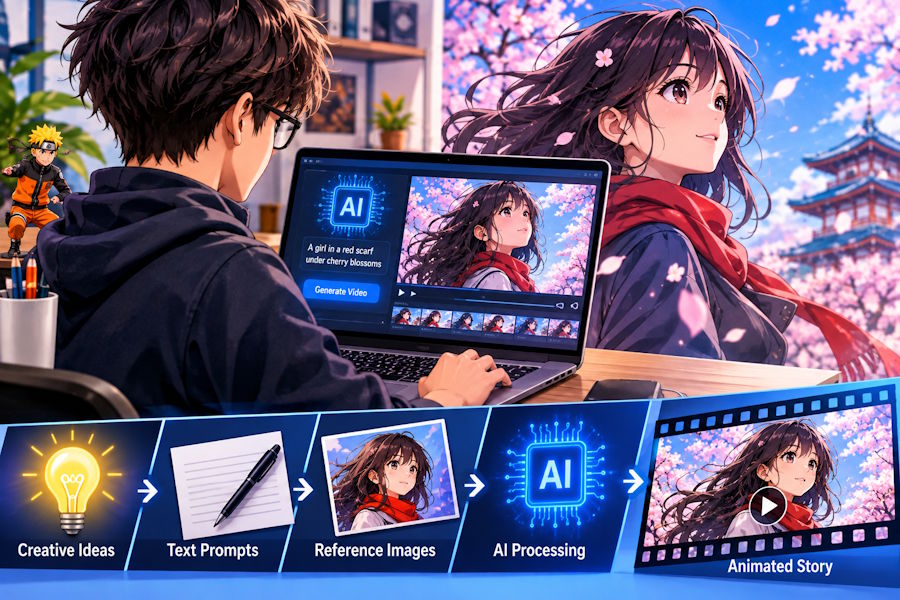
Anime has always been admired for its expressive characters, imaginative environments, and distinctive animation styles. From emotional character interactions to exciting action sequences, animation gives creators a powerful way to communicate stories visually. However, producing traditional anime videos requires several skills, including illustration, character design, movement planning, and video editing. These requirements can make animation challenging for beginners and independent creators.
Artificial intelligence is introducing new ways to approach this creative process. Modern AI systems can interpret written descriptions, analyze reference images, and generate moving scenes based on creative instructions. This allows people to experiment with anime-inspired videos without creating every frame manually.
Understanding how AI anime video generation works helps creators make better decisions, develop stronger prompts, and produce more consistent visual stories. It also explains why human creativity remains important throughout the process.
1. Understanding the Technology Behind AI Anime Video Generation
AI anime video generation uses machine learning models to transform creative instructions into animated visual sequences. These systems are trained to recognize patterns in visual information, including shapes, colors, textures, character features, and relationships between objects.
When someone enters a description of an anime scene, the system analyzes the words and identifies the visual elements needed to represent the idea. For example, a prompt describing a young warrior standing beneath a moonlit sky contains several details: the character, clothing, environment, lighting, and overall atmosphere.
The AI uses these instructions to develop a visual interpretation of the requested scene. Depending on the generation method, it may create images first and then introduce movement, or generate video frames through a process designed specifically for animation.
Diffusion-based models are one important technology used in modern image and video generation. In simplified terms, these models learn how to transform noisy visual information into structured images that match a requested description. Video generation extends this process by considering how visual elements should change across time.
The challenge is not simply creating attractive individual frames. Each frame must relate logically to the surrounding frames so that characters, backgrounds, and movements appear connected.
2. How Text Prompts and Reference Images Become Animated Scenes
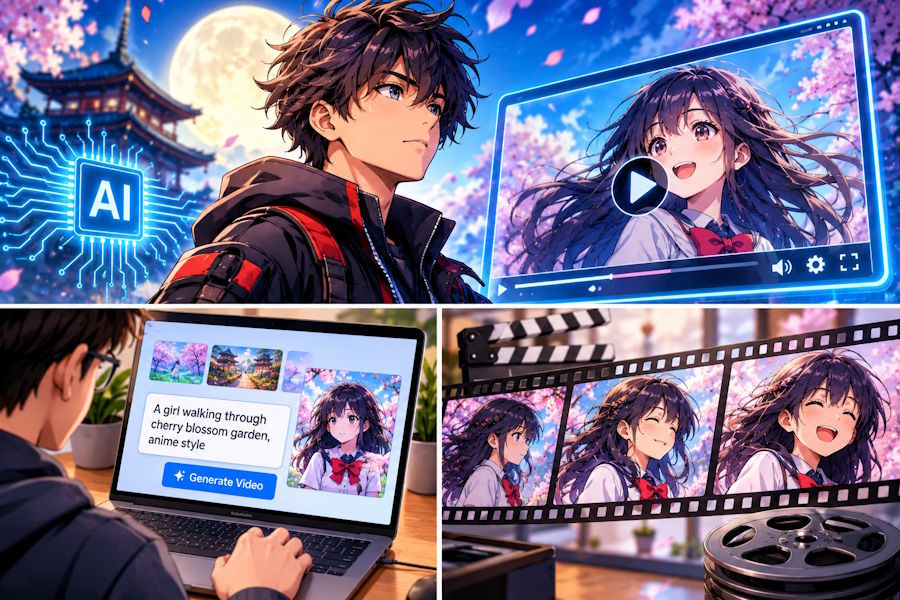
The creative process usually begins with an input. This may be a written prompt, an existing image, or a combination of visual and textual references.
Text prompts provide instructions about the intended scene. A creator might describe a schoolgirl walking through a cherry blossom garden, wearing a blue uniform while petals move gently in the wind. The description gives the AI information about the subject, action, environment, and atmosphere.
A more detailed prompt can also explain camera movement, lighting, composition, and animation style. However, adding too many unrelated instructions can make the intended action less clear. Focused descriptions generally provide a better starting point.
Image-based generation follows a slightly different approach. Instead of developing the entire visual concept from text, the creator supplies an image that establishes the character's appearance or overall composition. The AI then uses that reference to generate movement or develop the scene further.
For creators exploring these workflows, an ai anime video generator free can provide a practical starting point for turning written anime concepts and visual references into animated content.
The system interprets the available information and produces a video draft. The result may include character movement, environmental changes, and camera effects. Creators can then review the output and refine their instructions when the generated animation does not fully match the original idea.
3. How AI Creates Movement and Maintains Character Consistency
Generating movement is one of the most technically challenging parts of AI anime video creation. A still illustration only needs to communicate one moment, but an animation must show how that moment develops over time.
AI video systems attempt to create relationships between consecutive frames. They consider the subject's position, movement direction, background structure, and visual appearance. This helps produce the impression of continuous action rather than a collection of unrelated pictures.
For example, when generating a scene of an anime character running through a forest, the system needs to interpret how the character's body, clothing, and surrounding environment should change during the movement.
Some systems use concepts such as temporal modeling and frame interpolation to support smoother transitions. Frame interpolation estimates intermediate visual states between selected frames, while temporal modeling helps account for relationships across a video sequence.
Character consistency presents another challenge. An anime character may have specific facial features, eye colors, hairstyles, and clothing details. If these elements change unexpectedly between frames, the animation can appear unstable.
Reference images, carefully written prompts, and suitable generation settings can help reduce these inconsistencies. However, they cannot guarantee perfect results in every scene.
Creators should pay particular attention to faces, hands, clothing patterns, and important background objects. These details can reveal whether an animation maintains a convincing visual identity from beginning to end.
4. The Role of Editing, Sound, and Storytelling in AI Anime Videos
Generating animated footage is only one part of producing a complete video. A successful project also depends on editing, pacing, sound, and storytelling.
A generated clip may contain an interesting character and attractive movement, but it still needs a clear purpose. Creators should decide what the audience needs to understand or feel before arranging the final sequence.
For example, a short anime-inspired introduction might begin with an establishing shot of a city, followed by a character entering the scene. A closer shot could then introduce the character's expression before the video moves into the main action.
Editing helps connect these moments. Unnecessary footage can be removed, scene transitions can be adjusted, and clips can be arranged to create a more natural progression.
Sound also contributes significantly to the viewing experience. Background music can establish atmosphere, while sound effects can make footsteps, environmental movement, or dramatic actions feel more complete. Voiceovers and dialogue may help explain the story or develop a character's personality.
Captions are useful when dialogue needs to remain understandable without audio. They can also support viewers watching short videos on mobile devices.
AI-generated footage can be combined with conventional editing techniques to improve the final presentation. Reviewing timing, checking audio levels, and adjusting transitions are still important steps, even when much of the initial visual content has been generated automatically.
5. Common Challenges and Practical Ways to Improve AI Anime Videos
Although AI animation technology is becoming more accessible, generating a convincing video is not always straightforward. Some limitations become noticeable when a scene contains complex actions, multiple characters, or detailed interactions.
One common issue is inconsistent character appearance. A character's hairstyle, clothing, or facial features may change during a sequence. This can interrupt the visual continuity and make the result less suitable for storytelling.
Another challenge involves physical movement. Complicated gestures, fighting sequences, and interactions with objects can produce unnatural results. AI systems may also struggle with overlapping characters or scenes containing many moving elements.
Prompt quality plays an important role in addressing these problems. Instead of requesting several actions in one instruction, creators can begin with a single clear movement. For example, asking a character to slowly turn toward the camera is easier to evaluate than requesting a complex sequence involving running, jumping, speaking, and interacting with multiple objects.
Reference images can also help establish the intended appearance. Creators should select clear images with visible character details and avoid unnecessary visual distractions.
It is equally important to review the complete video rather than judging only its opening frames. Problems may become visible later in the sequence, particularly when the character changes position or interacts with the environment.
Generating alternative versions and adjusting one instruction at a time can make the improvement process more manageable.
6. Where AI Anime Video Generation Is Being Used
AI anime video generation has potential applications across several areas of digital content creation. Its flexibility makes it useful for both personal creative projects and more structured visual communication.
Social media content: Short anime-inspired clips can help creators develop distinctive posts, character introductions, and entertaining visual stories. Different aspect ratios and editing approaches can make the content suitable for various social platforms.
Independent storytelling: Writers and hobbyists can use animated scenes to explore fictional characters and imaginative environments. A short sequence may serve as a visual introduction to a larger story.
Gaming concepts: Game designers can experiment with character appearances, fictional locations, and introductory scenes before investing in more detailed production work.
Educational content: Anime-inspired visuals can make certain explanations more engaging. Creators may use illustrated characters and animated environments to introduce concepts or explain processes.
Creative presentations: Animated scenes can help communicate visual concepts during presentations, design discussions, or early project planning.
These applications do not mean that AI-generated videos automatically replace professional animation production. Detailed projects may still require experienced illustrators, animators, editors, and sound designers.
Instead, AI generation can function as an additional creative resource. It allows people to explore ideas, test visual directions, and develop early versions of scenes before deciding how much additional production work is necessary.
Conclusion
AI anime video generation is changing how people approach animation by making certain creative processes more accessible. Through written prompts, reference images, machine learning, and movement generation, creators can develop animated scenes without manually producing every frame. However, understanding the technology is only the beginning.
Strong results still depend on clear instructions, suitable references, consistent character designs, and careful editing. Reviewing movement, correcting visual problems, and improving sound and pacing all contribute to a more complete viewing experience.
As AI video technology continues to develop, its role in digital storytelling is likely to expand. Independent creators, anime enthusiasts, and professional content producers will have more opportunities to experiment with visual ideas and explore new production methods. The most effective approach will combine technological capabilities with human imagination, artistic judgment, and thoughtful storytelling.

