


As a business grows, its IT setup usually grows in many directions at once.
Some apps run on a company's own servers, some live in a private cloud, and others sit in public clouds like AWS or Azure.
Over time, this mix gets harder to see, control and keep running smoothly.
That's where managed hybrid cloud providers come in. They help you decide where each app should run, connect all those places together and then take care of the daily work of keeping everything running.
So, in this article, we'll walk through 5 providers that help mid-market and enterprise teams do exactly that, and explain how each one works in simple terms.
TL;DR
- Aptum plans, connects and runs your hybrid setup, with one portal to manage it.
- Rackspace Technology links its environments to the major clouds and adds AI and security help.
- Flexential pairs hosted private cloud with managed public cloud and expert cloud operations.
- Expedient moves VMware-based apps to the cloud without rebuilding them.
- RapidScale runs on-premises, private and public cloud as one environment under one contract.
Top 5 Managed Hybrid Cloud Providers
| Aptum | Rackspace Technology | Flexential | Expedient | RapidScale | |
|---|---|---|---|---|---|
| Environments | Shared, dedicated and private cloud, colocation, Azure, AWS and GCP | Private, public, on-premises and edge | Hosted private, multi-tenant and managed public cloud | VMware or Nutanix private cloud and public cloud | On-premises, private and public cloud |
| Control and Connectivity | Aptum Prizm portal | RackConnect Global secure connectivity | Flexential Xperience Portal | One interface for multi-site management | Unified visibility with one set of SLAs |
| Ongoing Management | Managed services with 24x7x365 human support | Managed services under a multi-year SLA | CloudOps with 24x7x365 support | Fully managed infrastructure with 24x7x365 support | 24/7/365 operations |
1. Aptum
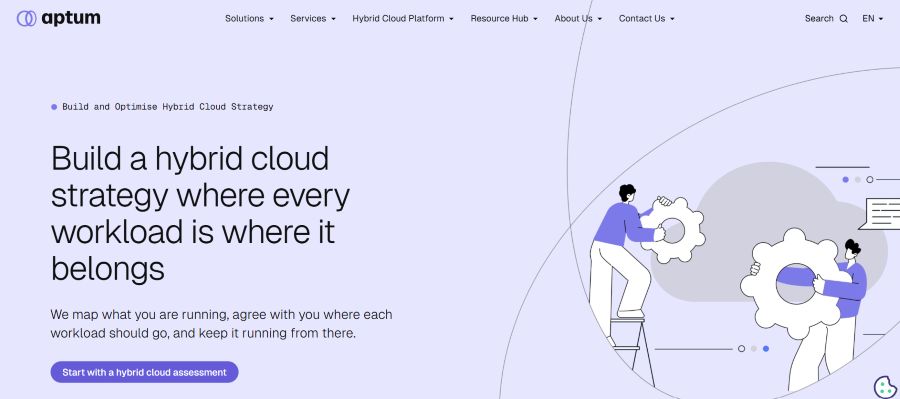
Aptum is a managed cloud and infrastructure provider with more than 25 years of experience in running infrastructure. Its main idea is simple: every app, or workload, should run on the platform that suits it best, and one team should take care of all of it.
So, Aptum starts by looking at what you're running today. It then agrees with you where each workload should go, whether that's a shared cloud, a dedicated cloud, a private cloud, colocation or a public cloud like Azure or AWS. After that, it connects these places so they work as one environment and keeps them monitored, patched and running.
Moreover, Aptum says it will tell you when a workload is better off somewhere it doesn't host it, so the advice stays focused on what you actually need.
Key Features And Solutions
- Hybrid Cloud Assessment: Looks at your current workloads and recommends where each one should run.
- Aptum Prizm: A portal, included at no extra cost, where you manage Aptum environments and see parts of your Azure and AWS setup in one view.
- Self-service control: In Shared Cloud and Dedicated Cloud, your team can create, resize and remove virtual machines, storage and networks without waiting on anyone.
- Cost visibility: Real-time spending can be broken down by team or project, which helps with planning budgets.
- Choice of private cloud: Single-tenant private cloud runs on either VMware or Proxmox.
- Regional choice: Data centers in Canada, the US and the UK help you keep data in a named location.
Best For
Mid-market and enterprise teams that want one partner to plan, move and run their hybrid setup, with clear control over cost and data location.
2. Rackspace Technology
Rackspace Technology is a cloud services company with more than 25 years in the technology services industry. It helps with hybrid cloud from the first planning stage through day-to-day operations, including cost control and keeping platforms aligned.
Therefore, Rackspace uses a workload-aware approach, which simply means it looks at what each app needs before choosing where it runs. Its RackConnect Global service then links your dedicated Rackspace environments to other data centers and to major clouds like AWS, Microsoft Azure and Google Cloud.
From there, you can choose how much help you want, from one-off projects to full day-to-day management.
Key Features And Solutions
- RackConnect Global: Secure connections between Rackspace environments and other clouds. Rackspace says these connections are backed by round-the-clock support and a 99.95% uptime guarantee.
- Rackspace Data Freedom: Keeps your data next to the cloud instead of locked inside it, so many cloud services can use it.
- Elastic Engineering: A monthly bucket of hours with cloud experts who work as an extension of your team.
- Managed Services: Patching, maintenance and optimization under a multi-year SLA, so your team can focus elsewhere.
- Foundry for AI by Rackspace (FAIR): Helps you find AI use cases, test them and then run them at scale across your clouds.
Best For
Larger organizations that run many platforms, including VMware and OpenStack, and want help with both cloud operations and AI projects.
3. Flexential
Flexential is a data center and cloud provider that designs, builds and delivers cloud solutions around a company's security, compliance and cost needs. Its experts first look closely at your requirements and then shape the right mix of private, public and hybrid cloud.
Moreover, Flexential brings it all together through the Flexential Xperience Portal. There, you can watch and manage how your environment and services are performing in real time, add services when you need them and request support at any hour.
Key Features And Solutions
- Hosted Private Cloud: A managed private cloud built on VMware Cloud Foundation 9 that combines automation, security and control.
- Multi-Tenant Cloud: Shared, scalable cloud infrastructure for production workloads, supported by certified cloud experts.
- Managed Public Cloud: Public cloud with flexible, usage-based scaling and real-time visibility into what you use.
- CloudOps: Day-to-day cloud operations built on automation and DevOps methods, with 24x7x365 support.
- Capacity on Demand: Keep a steady base environment and quickly add compute and storage when needs change.
Best For
Companies with regulated or custom workloads that want flexible private cloud next to public cloud, plus expert help running both.
4. Expedient
Expedient is a cloud provider with two decades of VMware expertise and data centers across the US. It focuses on a common problem: many established companies have older apps that are important to the business but hard to move to a public cloud without rebuilding them.
So, Expedient says its Enterprise Cloud lets these apps move to a cloud built on VMware technology, without that costly rebuilding or retraining. Expedient then manages the maintenance and growth of the infrastructure, while your team looks after its own operating systems and apps.
Since private cloud is a key part of a hybrid setup, this gives teams a practical first step toward a wider hybrid model.
Key Features And Solutions
- VMware or Nutanix: You can choose between the two platforms for your private cloud.
- No refactoring: Apps move as they are, which helps you get up and running faster.
- High availability: According to Expedient, N+2 redundancy keeps applications available if a part fails.
- Security and compliance: Two-factor authentication and encryption for stored data, with HIPAA, SOC 2 and PCI-DSS compliance.
- REST API and CLI: Teams can connect the platform to tools they already use, like Terraform or Ansible.
Best For
Enterprises with older, business-critical VMware apps that want cloud benefits without rewriting those apps.
5. RapidScale
And finally, RapidScale is a cloud services provider that designs, connects and runs on-premises, private and public cloud as a single environment. The goal is that you no longer have to manage the line between them yourself.
RapidScale works in three steps. First, it advises on where each workload belongs, based on cost, latency, compliance and when your hardware is due for replacement. Then, it implements the setup by connecting private and public cloud and moving workloads with minimal disruption.
And lastly, it manages the whole environment around the clock, so nothing falls into the gap between different platforms.
Key Features And Solutions
- Hybrid Workload Placement Assessment: Maps your full setup and gives you a placement plan you own, whether or not you build it with RapidScale.
- One partner, one contract: One set of SLAs covers everything, with unified visibility.
- Fast private cloud setup: RapidScale says pre-configured VMware environments can be ready in as little as 72 hours.
- Built-in FinOps: Ongoing cost tracking helps keep spending under control across all environments.
- Security that follows the workload: RapidScale says its controls support SOC 2, HIPAA and PCI-DSS requirements.
Best For
Mid-market and enterprise teams, including those in healthcare and financial services, that want one partner to run their entire hybrid setup.
Conclusion
A hybrid cloud works best when it's planned on purpose, not built by accident.
The right managed provider helps you place each app where it fits, connect everything and keep it running without overloading your own team.
So, start by looking at what your apps need, compare how each provider plans and runs your setup and then choose the partner that matches the way your team works.

