

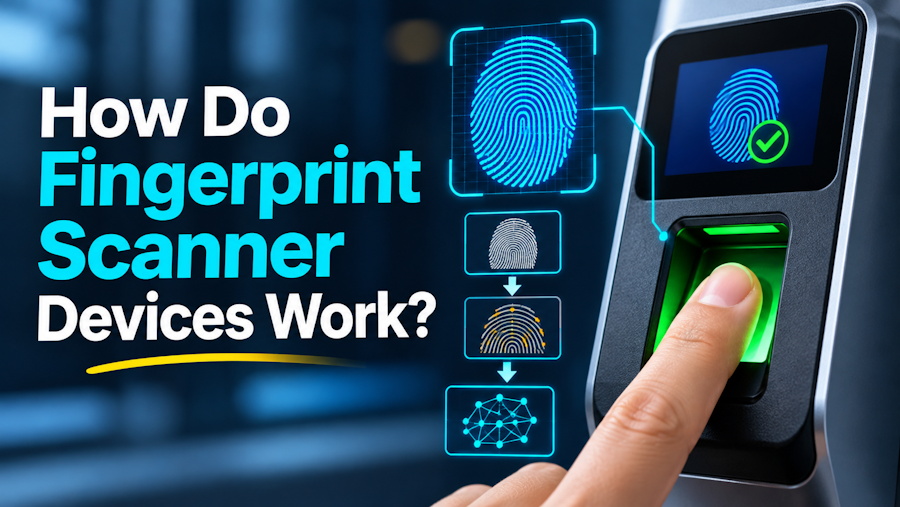
Press your finger on a scanner and the answer comes back in about a second. Match. No match. Door opens, phone lets you in, name confirmed. It feels like nothing happened at all, which is exactly why most people never stop to wonder what the device just did.
Quite a lot, as it turns out. In that second the scanner has built a detailed image of the ridges on your fingertip, checked whether the image is good enough to trust, picked out the features that make your print yours, and compared them against stored records using rules strict enough for a court or a border post. All with a finger that might be dry, slightly dirty, or pressed down at a crooked angle, because fingers in real life usually are.
To understand how that works, start with the print itself.
What the scanner is actually looking at
Your fingertip isn't smooth. It's covered in raised lines, called friction ridges, arranged in a pattern that forms before birth and stays with you for life. The broad pattern, a loop, a whorl, an arch, is the part you can see in an ink print. But the broad pattern isn't what identifies you. Plenty of people share a whorl.
Identification lives in the small details along those ridges, the points where a ridge suddenly ends, or splits into two, or forms a tiny island of its own. Forensic scientists call these features minutiae, and a single decent fingerprint may contain forty or more of them, scattered in an arrangement that even identical twins don't share. A scanner's whole job is to capture those details accurately enough that software can map them.
That word, accurately, is doing heavy work. Fingerprint images used for identification are normally captured at 500 pixels per inch or higher, because below that the fine ridge detail starts to blur together. Government systems work to set standards for this. In the United States, the FBI certifies scanners against its image quality specifications, and devices are graded by capture size using FAP ratings, from small single finger sensors up to FAP 50 and FAP 60 units that can take four fingers at once, or all ten in sequence, for enrolment. If a scanner is going to feed a national database, it doesn't get to decide for itself what good enough means.
Four ways of taking the picture
Here's the part most explanations rush. There isn't one kind of fingerprint scanner. There are several, and they capture the print in completely different ways.
Optical scanners are the oldest electronic type, and the easiest to picture. The finger rests on a glass plate, called a platen, lit from behind or below. Inside, a prism works on a principle known as total internal reflection. Where a ridge touches the glass, the light behaves one way. Where a valley sits above the glass with air in between, it behaves another way. A camera sensor underneath records the contrast, ridges dark, valleys light, and you have your image.
Optical scanners are rugged and proven, and big multi finger units in police booking rooms are usually optical. But the design has baggage. The prism and lenses make the device bulky. Dirt and residue build up on the platen. And because the scanner is essentially taking a photograph, an optical system can, in principle, be presented with a photograph. It also carries a faint echo of the last person's print, left in oils on the glass, which better designs work hard to suppress.
Capacitive scanners don't photograph anything. Their surface is a grid of tiny electrodes, far too small to see. Your skin conducts electricity, so when a ridge touches the surface it changes the electrical charge held at that point, while a valley, separated by a sliver of air, changes it much less. Measure those differences across thousands of points and a picture of the print builds up out of electricity rather than light. This is the technology inside most phone fingerprint readers, or was until under screen sensors arrived. It's compact and quick, but small sensors capture only part of the finger, and very dry or worn skin can give it trouble.
Ultrasonic scanners use sound. The sensor sends out high frequency pulses and listens to how they come back from the finger. Ridges and valleys return the sound differently, and because the pulses penetrate slightly below the skin's surface, the scanner can build up something closer to a three dimensional map, including pores and features under surface dirt. That makes ultrasonic readers good with damp or grimy fingers, and harder to fool with a flat copy of a print. You'll find them in higher end phones rather than in enrolment stations.
Light emitting sensor technology, usually shortened to LES, takes a route none of the others do, and it's worth slowing down for because it explains where professional mobile scanners have been heading. An LES device has no prism and no camera staring at your finger. Its surface is a thin polymer film, less than a millimetre thick, loaded with microscopic phosphor particles far smaller than the width of a fingerprint ridge. When you place your finger on the film, the skin of the ridges completes a tiny electrical circuit in that spot, and the particles directly beneath the ridge light up. Only there. Nowhere else. A sensor beneath the film then reads the glowing pattern, pixel by pixel.
The consequences of that design are practical, not theoretical. Because the film responds to the electrical properties of living skin, a printed image or a fake finger doesn't produce the same effect, so a degree of spoof resistance is built into the physics rather than bolted on afterwards. Because the light is generated at the exact point of contact, leftover prints from the previous user simply don't show up, and the surface doesn't need constant cleaning. Wet fingers, dry fingers, dusty fingers off a building site, all tend to read better than they do on sensors that rely on a clean optical path. And because the film is thin and light, the whole scanner can be a fraction of the size and weight of a traditional optical unit, which matters enormously when the scanner has to travel in a kit bag instead of sitting on a desk.
That combination is what integrated biometric scanners are built around: FBI certified capture, including flat and rolled prints, in devices light enough for field work. Product families in this category cover everything from single finger units for identity checks up to ten print scanners that capture four fingers, then four more, then both thumbs, the full set used for enrolment and criminal booking.
There's also a fifth type you'll still meet, the thermal swipe sensor, which reads temperature differences between ridge and valley as a finger drags across it. It mostly survives in older laptops and niche hardware. It's part of the family history rather than the future.
From picture to template
A raw image, on its own, identifies nobody. What happens next is the real fingerprinting.
First the software grades the capture. Quality scoring systems, the FBI uses one called NFIQ, estimate whether a print is clear enough to match reliably. If the score is poor, a good system says so immediately and asks for another try, perhaps with more pressure, or a wiped finger, or a different finger altogether. This sounds like fussiness. It is in fact the single biggest factor in whether fingerprint systems work well or badly, because a poor enrolment print will fail its owner for years. Rubbish in, rubbish out, as true here as anywhere in computing.
Once the image passes, feature extraction begins. The software traces the ridges and marks the minutiae: this ridge ends here, that one forks there, with positions and angles recorded for each point. The result is a template, a compact mathematical description of the print rather than the picture itself. In everyday access systems, phones and door readers for example, the template is what's stored, and the original image is discarded. That matters for privacy. A template is designed to be matched against, not turned back into a copy of your finger.
Law enforcement and government enrolment work a little differently. There, the images themselves are kept, because prints may need to be re examined, compared by a human expert, or searched again with better software in ten years' time. Same front end, two different philosophies behind it, each suited to its purpose.
The match itself
Matching comes in two forms, and confusing them causes half the arguments about fingerprint accuracy.
Verification is one to one. You claim to be a particular person, perhaps by entering an ID number or presenting a card, and the system compares your fresh scan with the template held for that person. Is this the same finger? Yes or no. Your phone does this. So do most workplace attendance terminals.
Identification is one to many. No claim is made. The print is searched against a whole database, which might hold millions of people, and the system returns the closest candidates along with a score for each. This is what police AFIS databases do with a print from a crime scene or an unknown detainee, and what national ID programmes do at enrolment to catch someone registering twice under two names.
Either way, the algorithm isn't demanding a perfect overlay. It can't. You'll never place your finger in exactly the same position twice, skin stretches slightly under pressure, and a rolled print captures more of the finger than a flat one. So the matcher works on similarity, and produces a score. Above a set threshold, the system accepts the match. Below it, it doesn't.
Where that threshold sits is a judgment, and it's adjustable, because the two kinds of error pull in opposite directions. Set it too loose and the system occasionally accepts the wrong person, a false acceptance. Set it too strict and it starts rejecting the right person, a false rejection, which in an airport queue or at a factory gate at shift change quickly becomes its own kind of failure. A bank verifying a customer can tolerate asking for a second attempt. A border system searching for duplicates across a hundred million records cannot tolerate loose matches at all. The scanner is the same. The settings, and the consequences, are not.
Modern systems also watch for fakery while all this is going on, a field known as presentation attack detection. Fake fingers have been made from gelatine, silicone, wood glue, even printed in three dimensions, and researchers demonstrated years ago that a determined attacker with a good copy of a print could beat basic readers. Liveness checks, whether built into the sensor physics as with LES, or done in software by looking for skin like behaviour and perspiration patterns, exist because that risk is real. No serious deployment today should skip them.
Where these devices actually work for a living
With the mechanics out of the way, the uses fall into place fairly naturally, because almost every industry on this list ran into the same wall: paper records and visual ID checks don't scale, and they don't deduplicate.
Law enforcement is the original home of the fingerprint scanner and still its most demanding user. Live scan devices in booking rooms capture ten prints, palms in some jurisdictions too, and transmit them electronically for search against state and national databases, replacing ink and cards that had to be posted and waited for. Portable units have changed the edges of the job. An officer with a pocket sized two finger scanner can check a detainee's identity against a database from the roadside and learn in minutes whether that person is wanted elsewhere, work that once meant a trip to the station and hours of process either way.
Border control and immigration run on the same machinery, pointed in a slightly different direction. Fingerprints taken at a visa application in one country can be checked when the traveller arrives in another. Asylum and refugee registration uses scanners to build a record where documents may never have existed, or were lost on the way, so that aid and legal processing attach to a real, unique person rather than to a name that three other people also use.
National identity and elections are where the one to many search earns its keep most visibly. Countries enrolling tens of millions of citizens for an ID card or a voter roll have no other practical way to stop the same person registering three times in three districts. Field enrolment kits, a laptop, a scanner, a camera, a battery, get carried to villages with no registry office, and they need scanners that survive dust, heat, knocks, and fingers worn hard by farm work. This is precisely the environment the newer film based sensors were designed for, and it's a big reason the heavy glass optical units of the booking room have been losing ground in mobile programmes.
Banking and financial services came to fingerprinting through fraud and through exclusion, an odd pair. In branch and agent banking across Africa and Asia, customers who can't reliably produce documents, or whose signatures vary, can be verified against the print taken when the account opened. It protects the bank against impersonation and, just as importantly, it protects the customer's account from everyone else. Pension and benefits systems use the same idea as a proof of life check, confirming the pensioner is alive and present rather than paying a pension into an account years after the holder has died.
Healthcare uses scanners to answer a question that sounds simple and isn't: is this the right patient? In busy hospitals, and in vaccination and HIV treatment programmes where patients may have no documents and similar names are common, a fingerprint links a person to their own record and only their own record. Wrong records in medicine aren't an admin error, they're a safety incident waiting for a date.
Background checks and licensing make up the quieter civil market. Teachers, childcare workers, security guards, licence applicants of many kinds are fingerprinted and checked as a condition of the job, and a whole industry of applicant scanning shops and mobile services exists to take those prints cleanly and submit them in the format the authorities demand. Corrections services use the same devices at the other end of the process, confirming identity at intake and, critically, at release.
The weak points, because there are some
A honest account has to include the fingers that don't read. A small percentage of people, elderly people, manual workers, people with certain skin conditions, have prints so worn or faint that some sensors struggle with them. Any large programme needs a fallback for those people, another finger, another modality, a supervised exception process, planned in advance rather than improvised at the enrolment table.
Scanners also need looking after in ordinary ways. Calibration drifts, surfaces get scratched, cables fail, and in field conditions everything gets dropped eventually. Certification tells you a device met a standard on the day it was tested. It says nothing about its condition three dusty years later. Programmes that build in quality checks and replace tired hardware keep their match rates. Programmes that don't, watch them slide and blame the technology.
And a scanner, finally, is only the front door of a system. It produces an image and a template. Whether that data is encrypted in transit, who can search it, how long it's kept, and what happens when someone says a match is wrong, those are decisions made by the organisation running it. Good devices make good programmes possible. They don't guarantee them.
The short version
A fingerprint scanner works by capturing the ridge pattern on your fingertip, using light, electricity, sound, or a light emitting film, then converting the small features of that pattern into a digital template and comparing it, against one record or against millions. The capturing takes a second. The engineering that makes that second reliable, on a wet finger, in bright sunlight, at a roadside, in a village with no mains power, is where the real work of the last twenty years has gone.
Ink on paper proved a century ago that fingerprints could identify people. Scanners are what turned that proof into something a police officer, a nurse, a bank agent, and a registration clerk can all use before their tea goes cold. That's the actual achievement here, and it's a bigger one than it looks.

