

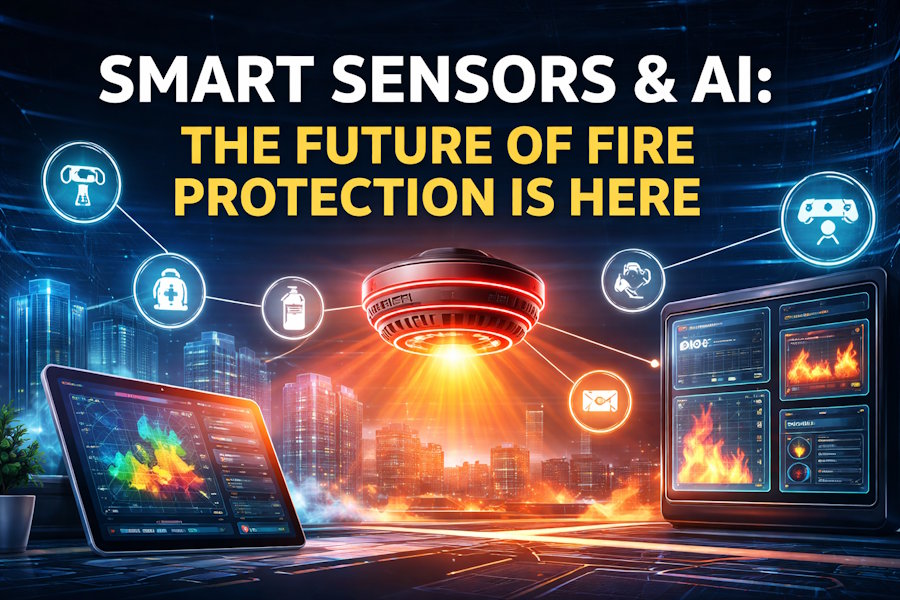
When you think of fire safety, you probably picture red extinguishers hanging in hallways, glass cases waiting to be broken, or industrial sprinkler heads dotting the ceiling. For decades, the industry relied on these mechanical staples to keep buildings safe. They were reactive, reliable to a point, but ultimately analog.
However, the buildings we work and live in are changing. They are becoming "smart," integrated with networks that control everything from HVAC to lighting. Fire safety is undergoing a similar digital revolution. The days of relying solely on physical inspections and manual alarms are fading. Today, fire protection is about data, connectivity, and intelligent response.
This technological shift has raised the bar for installation and maintenance. It is no longer enough to simply know how to turn a wrench. Modern safety demands a licensed fire protection contractor who understands the intersection of hydraulic engineering and software integration, while Fire Watch Security Guards help monitor properties and respond to potential fire risks in real time. Companies like Crimson Fire Protection are leading this charge, bridging the gap between traditional safety measures and cutting-edge technology.
The Rise of the Internet of Things (IoT) in Safety
The Internet of Things (IoT) has permeated almost every sector, and fire safety is no exception. In the past, a fire alarm system was a closed loop. If a detector sensed smoke, it triggered a siren. It was a binary system: on or off.
IoT-enabled devices have changed the conversation. Smart sensors can now communicate detailed information in real-time. They don't just tell a panel that there is smoke; they can analyze the density of the particles, the rate of temperature rise, and the exact location of the anomaly within the building.
This granular data allows for a much faster and more accurate response. False alarms, which cost businesses millions of dollars annually in lost productivity and fines, can be significantly reduced. A smart system can distinguish between burnt popcorn in a breakroom microwave and a smoldering electrical fire in the server room.
Furthermore, these systems can integrate with other building management protocols. In the event of an alarm, a smart fire system can automatically instruct the HVAC system to shut down to prevent feeding oxygen to the fire, unlock access control doors for evacuation, and bring elevators to the ground floor.
Predictive Maintenance: Data Over Guesswork
One of the most significant tech advancements in this field is the shift from reactive to predictive maintenance. Traditionally, a licensed fire protection contractor would inspect a system on a set schedule—perhaps annually or quarterly. They would look for visible signs of corrosion or damage. Between those visits, the building manager just had to hope everything remained functional.
New technology allows for 24/7 system health monitoring. Sensors placed on pumps, tanks, and pipes can monitor water pressure and flow rates continuously. If a pump’s vibration pattern changes, indicating a potential bearing failure, the system sends an alert to the maintenance team immediately.
This data-driven approach means problems are fixed before they cause a system failure. It ensures that when an emergency happens, the system will perform exactly as designed. Crimson Fire Protection utilizes these modern diagnostic tools to provide clients with a level of reliability that manual inspections alone simply cannot match.
Building Information Modeling (BIM)
The technology upgrade starts long before the first pipe is hung. In the construction and design phase, Building Information Modeling (BIM) has revolutionized how fire protection systems are planned.
BIM creates a 3D digital representation of a facility's physical and functional characteristics. In the past, contractors might arrive at a job site only to find that an HVAC duct was running exactly where a main sprinkler line was supposed to go. This led to costly delays and on-site "workarounds" that might compromise efficiency.
With BIM, a licensed fire protection contractor can map out the entire suppression system digitally before construction begins. They can run "clash detection" simulations to see how their pipes interact with electrical conduits and structural beams. This ensures that the fire protection system is optimized for the specific layout of the building, ensuring maximum coverage and compliance with safety codes.
Cloud-Based Reporting and Compliance
The clipboards and carbon-copy forms of the past are disappearing. Digital reporting platforms are streamlining how compliance is tracked and managed.
For facility managers, keeping track of inspection reports for insurance and fire marshals can be a logistical nightmare. Modern fire protection companies use cloud-based software to log inspections. Technicians from Crimson Fire Protection can input data directly into a tablet while on-site. This generates an instant, timestamped report that is stored securely in the cloud.
This transparency is vital. It creates an immutable audit trail, proving that the building is up to code. If a fire marshal walks in for a surprise inspection, the facility manager can pull up the entire maintenance history on a smartphone in seconds.
Why the "Licensed" Label Matters More Than Ever
With all this complex technology involved, the barrier to entry for installation and maintenance has skyrocketed. You cannot rely on a general handyman to calibrate a network of IoT sensors or program a smart control panel.
Hiring a licensed fire protection contractor is non-negotiable. Licensure ensures that the technicians have undergone rigorous training not just in plumbing and mechanics, but in the specific codes and standards that govern fire safety (such as NFPA standards).
When you introduce complex electronics into life-safety systems, the margin for error disappears. An improperly wired sensor or a glitched software update can render a system useless. A licensed professional ensures that the integration of new tech doesn't compromise the fundamental reliability of the system.
Designing a Future-Proof Safety Plan
Licensed fire protection contractor, Crimson Fire Protection, recognizes that as buildings become more complex, the partners responsible for protecting them must evolve as well. The future of safety is no longer just about water and pressure; it is about intelligence, integration, and systems that work seamlessly together to safeguard people and property.
By embracing technologies like IoT sensors, predictive maintenance analytics, and digital compliance tracking, businesses can create a safety net that is invisible yet incredibly powerful. These tools provide peace of mind, knowing that the building is constantly monitoring itself, ready to react the moment danger arises.
Technology moves fast. Fire safety is moving with it. Ensure your building is not left in the analog age by partnering with experts who speak the language of modern safety.

