

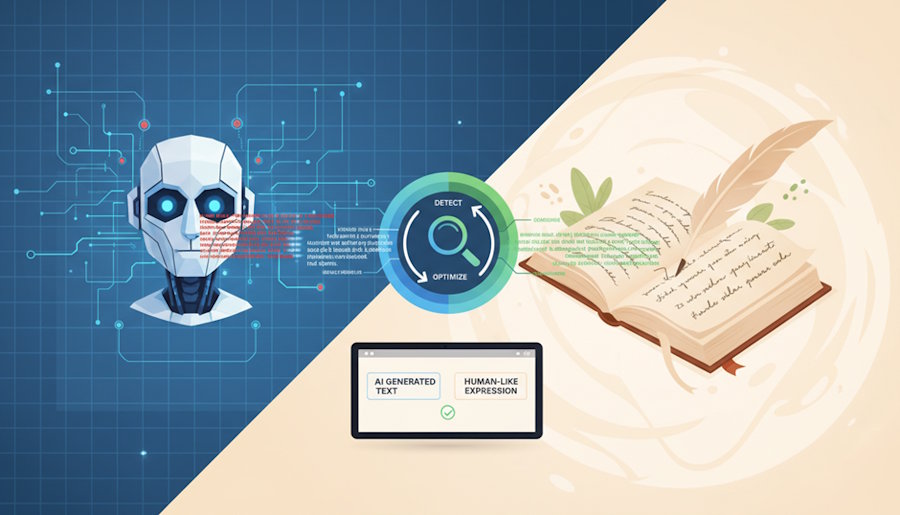
Writing has changed. Drafts emerge faster, ideas flow from AI assistants, and deadlines shrink. Yet speed can hide subtle issues. Even polished content sometimes feels off—too mechanical, too predictable. Dechecker enters here, offering writers a tool to see what readers sense intuitively. It helps navigate the space between efficiency and authenticity.
Understanding the Subtle Signals of AI Writing
When fluency masks mechanical patterns
AI-generated text often flows smoothly, but patterns betray its origin. Repeated transitions, uniform sentence lengths, and predictable phrasing create a sense of monotony. Writers notice hesitations from readers: a pause, a question, a comment on tone. Detecting these cues early is crucial, and using an AI Checker helps identify where content might feel artificial.
The pressures of automated scrutiny
Universities, publishers, and platforms increasingly apply automated detection before humans see a word. This environment creates tension: writers want to meet expectations without losing voice. Dechecker integrates seamlessly, allowing proactive assessment. Understanding the system’s evaluation becomes part of responsible writing, not a hurdle to creativity.
Hybrid content and perception gaps
Most writing today combines human input with AI assistance. That blend complicates evaluation. Dechecker emphasizes behavior over origin: how text is read, felt, and interpreted. Writers can adjust nuance and tone without guessing, aligning their work more closely with audience expectations.
How Dechecker Guides Smarter Edits
Pinpointing subtle rhythm issues
The platform analyzes sentence structure, lexical variety, and phrasing cadence. Overly consistent patterns stand out. Writers gain actionable insights, noticing where paragraphs feel monotonous or transitions are predictable. By revealing these patterns, Dechecker allows targeted improvements instead of blind rewrites.
Balancing voice and adjustment
Full rewrites risk erasing authorial intent. Dechecker highlights risk zones without imposing changes. Writers remain in control, making deliberate choices that preserve personal style while enhancing naturalness. Maintaining this balance is vital in professional and creative contexts alike.
Leveraging AI Checker as a reference
Scores, flags, and suggestions are guidance, not absolute verdicts. Each writer chooses how to respond based on context, audience, and purpose. Using Dechecker instills a mindset of informed decision-making, turning detection into an instrument for refinement rather than a compliance test.
Transforming AI Text into Authentic Expression
Identifying gaps in human-like flow
AI often produces uniform emphasis and predictable transitions. Writers need contrast, rhythm, and emphasis variation to achieve natural expression. Dechecker maps these gaps, allowing edits to enhance clarity, pacing, and tone.
Directed, purposeful edits
Humanization is not randomness. It is intention. Dechecker supports edits that sharpen meaning, adjust cadence, and reinforce stance. Writers act with insight, not trial-and-error, ensuring that the text feels intentional rather than artificially modified.
Advanced rewriting with AI Humanizer
In scenarios demanding deeper transformation, the AI Humanizer reshapes text while respecting the original content. Writers gain refined passages that preserve accuracy but read with human warmth, avoiding overly uniform AI phrasing.
Applying Dechecker in Real-World Contexts
Academic work under subtle evaluation
Students often face suspicion not for AI use but for tone and phrasing. Papers can reflect effort yet appear formulaic. Running drafts through an AI Checker surfaces these subtle cues, helping students adjust before misconceptions arise, improving both clarity and confidence.
Streamlining editorial workflows
Marketing and content teams operate under tight deadlines. Generic AI phrasing can slow approvals. Dechecker highlights sections that may seem bland or repetitive, enabling teams to act before human review, saving time and maintaining brand voice consistency.
Professional documentation with impact
Proposals, memos, and reports influence decisions. A small tonal issue can create hesitation. AI Checker helps writers detect subtle patterns that undermine authority. Adjusting these early ensures communication appears deliberate, confident, and credible.
Enhancing Originality and Grammar
Practical originality checks
AI-generated phrasing may inadvertently replicate common structures. Dechecker’s plagiarism detection ensures text meets originality standards. Writers can catch overlaps that otherwise might cause academic or professional issues.
Grammar as a confidence measure
Minor errors rarely ruin comprehension, but they amplify doubts when text feels artificial. Dechecker’s grammar insights eliminate distractions, allowing readers to focus on substance rather than technical mistakes.
AI homework helper functionality
Dechecker also functions as an AI homework helper, guiding revisions and comprehension. Students can refine reasoning, explore alternative phrasings, and test argument clarity. This approach encourages learning rather than shortcut solutions, fostering independent critical thinking.
Building Writing Awareness Through Repeated Use
Recognizing risk patterns
Frequent interaction with Dechecker trains writers to notice structural and linguistic risks intuitively. The AI Checker becomes a learning tool, enhancing judgment and helping avoid common pitfalls before they appear.
Streamlining collaborative edits
Feedback moves from subjective discomfort to actionable corrections. Teams spend less time debating stylistic preference and more time implementing improvements, creating smoother review cycles.
Retaining authorship while improving quality
Dechecker never imposes automatic changes. Writers retain ownership, selectively applying insights. Confidence grows as they manage both creative and practical aspects of writing, producing polished yet authentic content.
Deciding When to Act or Not
Accepting reasonable deviations
Not every flagged area needs alteration. Context, intent, and audience may justify leaving some patterns unchanged. Dechecker respects these decisions, ensuring guidance informs rather than dictates action.
Trusting judgment while avoiding over-editing
Excessive AI caution can erode confidence. Visibility into content evaluation allows writers to confirm what already works and focus energy strategically, reducing unnecessary edits and building efficiency.
Writing With Purpose in an AI Era
Detection and AI tools are now embedded in writing. Dechecker sits at the intersection, helping writers evaluate perception, adjust for clarity, and act with intention. Using an AI Checker is not about bypassing systems—it’s about cultivating awareness, managing risk, and producing text that resonates with readers naturally and confidently.

