

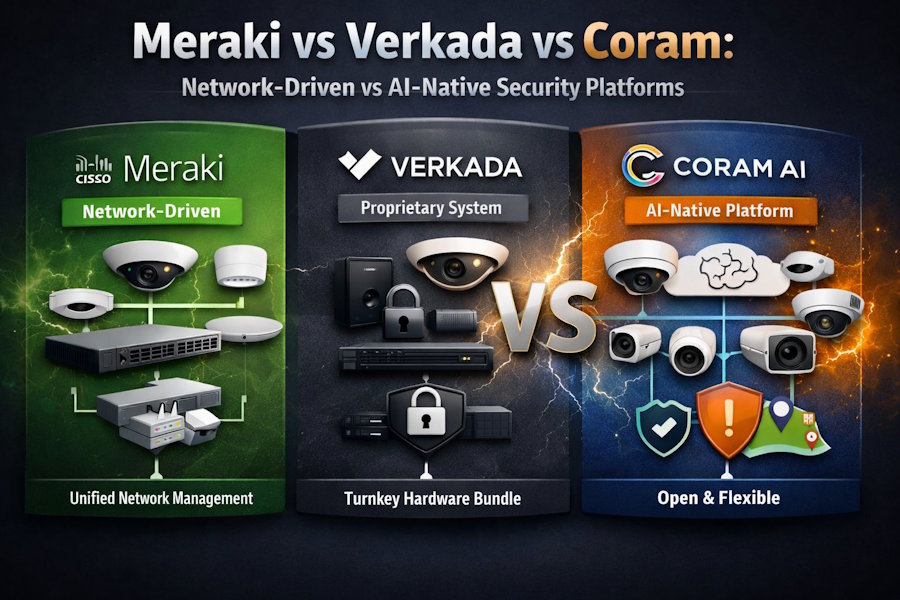
IT teams face a critical choice when selecting physical security platforms. You can extend your existing network infrastructure into security with Meraki, buy turnkey proprietary cameras from Verkada, or adopt an AI-native cloud platform like Coram, designed to function as a modern enterprise security system unifying video, access control, and emergency workflows.
Each approach has trade-offs. Meraki ties you to Cisco networking infrastructure. Verkada locks you into proprietary hardware. Both limit flexibility in ways that affect long-term costs and capabilities.
What this comparison covers:
- Platform architecture and vendor lock-in implications
- Camera compatibility and deployment models
- AI capabilities and video intelligence
- Access control integration approaches
- Total cost of ownership considerations
- Best fit by organizational needs and use case
Which Platform for Which Organization
Coram AI: Best for organizations prioritizing AI-driven insights, camera flexibility, and unified security operations. Works with existing cameras from 1000+ manufacturers. Delivers strongest AI search capabilities, real-time safety alerts, and integrated emergency management. Most scalable approach for multi-site deployments without hardware forklift upgrades.
Verkada: Best for organizations wanting turnkey simplicity and willing to replace all existing cameras. Proprietary hardware-software bundle with consistent user experience. Strong native access control integration. Premium pricing model with 10-year camera lifecycle assumptions.
Meraki: Best for organizations with extensive Cisco network infrastructure seeking unified infrastructure management. Requires Meraki switching and wireless equipment for full value proposition. Limited AI capabilities compared to purpose-built security platforms. Network-first approach with security as adjacent capability.
What Meraki is Known For
Meraki built its reputation on network infrastructure management before expanding into security cameras. The dashboard unifies switches, access points, and surveillance cameras under single-pane-of-glass management.
The platform was designed for IT teams already managing Meraki networks. Camera options include Meraki-branded MV series or limited third-party integration options.
Core strengths include a familiar interface for existing Cisco customers and network topology visibility. The system excels when you need to monitor network health alongside camera feeds.
Limitations become apparent when you want advanced AI capabilities or need cameras to work independently of network vendors. Best value requires deploying the full Meraki stack across your infrastructure.
What Verkada is Known For
Verkada pioneered the proprietary hardware-software ecosystem model in modern physical security. Their all-in-one cameras include edge storage and processing capabilities built directly into hardware.
The company established a strong brand presence in enterprise security through rapid deployment and turnkey simplicity. Each camera stores 30-365 days of footage locally before cloud backup.
Key strengths include integrated access control through Verkada Access, consistent user experience across products, and reliable proprietary hardware. Their Command platform provides centralized management.
Limitations center on camera vendor lock-in and higher total cost of ownership due to complete hardware replacement requirements. Third-party integrations remain limited compared to open platforms.
What Coram AI is Known For
Coram built an AI-first physical security platform that works with existing infrastructure rather than replacing it. The platform is camera-agnostic, supporting 1000+ IP camera models from major manufacturers.
Natural-language video search through Discover lets you query footage conversationally. Journey tracking follows subjects across multiple cameras automatically. Real-time AI safety agents detect firearms, slip-and-fall incidents, PPE violations, and custom scenarios you define.
The unified platform combines cloud VMS, AI-managed access control, and emergency management workflows. This eliminates the need to juggle multiple point solutions.
Core strengths include no rip-and-replace requirements, strongest AI capabilities in the market, open platform approach, and faster ROI through camera reuse. Security and compliance include SOC2 Type 2 and HIPAA certifications with on-premises AI processing options for privacy-sensitive environments.
Platform Architecture Comparison
Meraki: Network-Centric Model
Meraki's architecture centers on dashboard-managed infrastructure spanning switches, access points, and cameras. Cameras connect through Meraki network equipment and inherit network-level management capabilities.
Cloud management runs through Cisco's cloud infrastructure. The system delivers best value when your entire network operates on Meraki equipment.
MV Sense provides limited AI capabilities focused on people counting and occupancy analytics. Advanced video intelligence requires third-party integrations.
Verkada: Closed Ecosystem
Verkada's proprietary cameras include onboard storage ranging from 30 to 365 days depending on model. The Command platform provides centralized management across all Verkada devices.
Hybrid cloud architecture balances edge processing with cloud backup and analytics. Camera firmware updates deliver new AI features over time.
The system requires Verkada hardware end-to-end. You cannot mix Verkada management with third-party cameras or integrate existing infrastructure.
Coram: Open Platform
Coram's cloud-native VMS connects to existing cameras through Camera Bridge hardware. This lets you keep cameras already deployed while gaining cloud management and AI capabilities.
The platform approach unifies VMS, access control, and emergency management under single login. AI processing runs in the cloud by default with on-premises options available for compliance requirements.
Architecture scales independently of your network vendor choices. You can deploy Coram across locations with different network infrastructure without compatibility issues.
Camera Compatibility and Deployment
Feature of Meraki, Verkada and Coram AI
Camera Compatibility : Meraki MV only, Verkada cameras only and 1000+ IP camera models
Existing Camera Reuse : No, No and Yes
Deployment Time : 2-4 weeks, 1-2 weeks and Days with existing cameras
Hardware Replacement : Required, Required and Optional
Camera Agnostic : No, No and Yes
Network Requirements : Meraki switching recommended , Standard PoE and Standard PoE
TCO Impact
Meraki total cost includes camera hardware, per-camera licensing, and Meraki network equipment investments. The value proposition depends heavily on network infrastructure standardization.
Verkada's premium camera hardware costs pair with per-camera licensing under their 10-year lifecycle model. Complete hardware refresh requirements increase upfront capital expenditure.
Coram enables camera reuse or commodity camera deployment paired with platform subscription pricing. This typically delivers 40-60% lower TCO compared to proprietary hardware models.
Multi-Site Scalability
Coram's camera-agnostic approach lets you deploy incrementally without hardware forklift upgrades. You can add locations progressively while reusing cameras already in place.
Both Verkada and Meraki require full hardware refresh at each new location. This increases deployment friction and capital requirements for multi-site rollouts.
AI Capabilities and Video Intelligence
Search and Investigation
Coram provides natural-language search that lets you query footage conversationally like "show me anyone entering the loading dock after 6pm wearing red jacket." Journey tracking follows subjects across multiple cameras automatically. Object and person search work without manual tagging.
Verkada offers person and vehicle search capabilities, license plate recognition, and face-based search functionality. These features require some manual configuration and baseline setup.
Meraki provides basic motion search and occupancy analytics through MV Sense. Advanced search capabilities require manual timeline review or third-party integration.
Real-Time Alerts
Coram AI Safety Agents</strong> detect and alert on multiple scenarios in real-time:
- Firearm detection with automatic emergency response
- Intrusion and perimeter breach monitoring
- Slip-and-fall incident detection
- PPE violation identification in compliance zones
- Tailgating alerts at secure entry points
- Unusual activity detection based on learned patterns
- Custom alert training for site-specific scenarios
Verkada provides motion-based alerts, license plate recognition alerts, occupancy threshold notifications, and people of interest alerts. Configuration happens through the Command interface.
Meraki offers motion detection alerts, basic occupancy alerts, and limited custom trigger options. Advanced alerting scenarios require integration partners.
Investigation Speed
Coram reduces investigation time from hours to minutes through natural-language search. Security teams query specific events conversationally rather than scrubbing through footage manually.
Verkada delivers faster investigation than legacy DVR/NVR systems but requires more manual effort than AI-native search. Timeline review remains the primary investigation method.
Meraki requires manual timeline review for most investigations. The system lacks AI-powered search that understands natural language queries or complex scenarios.
Access Control Integration
Meraki
Meraki provides limited native access control capabilities. Most deployments require partnerships with third-party systems like CCURE or Lenel.
Network-managed door controllers integrate with the Meraki dashboard. This provides some unified management but lacks deep integration between video and access events.
Verkada
Verkada Access delivers native integration with Verkada cameras through the unified Command platform. Video and access control share the same user interface and management workflows.
Cloud-managed readers support mobile credentials and traditional card access. The system maintains consistent user experience across cameras and door controllers.
The strength lies in turnkey integration when you deploy both Verkada cameras and Verkada Access hardware. Mixed vendor scenarios require additional integration work.
Coram
Cloud-managed access control comes built into the Coram platform. Doors automatically trigger video clips when access events occur.
The system supports mobile and card credentials. You can use existing access hardware or deploy Coram-managed readers depending on your infrastructure.
Emergency lockdown workflows integrate automatically with video feeds and AI alert systems. This creates unified incident response capabilities across physical security functions.
Emergency Management and Compliance
Incident Response
Coram includes integrated emergency management capabilities within the core platform. Automated alert escalation routes incidents to appropriate responders based on severity and type. Incident timelines automatically compile relevant video evidence and access events. Law enforcement sharing workflows let you securely provide evidence without system access.
Verkada offers alarm integration and mobile alerts through the Command platform. Evidence export requires manual compilation though the process is streamlined compared to legacy systems.
Meraki provides basic alerting capabilities with manual evidence collection workflows. The system lacks purpose-built emergency management features beyond standard notifications.
Compliance and Security
Coram maintains SOC2 Type 2 and HIPAA compliance certifications. On-premises AI processing option serves privacy-sensitive environments like healthcare and education. Granular user permissions and comprehensive audit logs support compliance requirements. Encryption protects data in transit and at rest.
Verkada holds SOC2 Type 2 certification with hybrid cloud encryption architecture. Role-based access control manages user permissions across the platform.
Meraki follows Cisco security standards with cloud-managed encryption. Network-level security controls provide additional protection layers through the Cisco infrastructure.
FAQs
Can I use existing cameras with Meraki or Verkada?
No. Both Meraki and Verkada require their proprietary camera hardware. Meraki supports only MV series cameras, and Verkada works exclusively with Verkada-branded cameras. Coram is the only platform among the three that supports existing IP cameras from 1000+ manufacturers, letting you avoid complete hardware replacement.
Which platform offers the strongest AI capabilities?
Coram delivers the most advanced AI capabilities including natural-language video search, cross-camera journey tracking, and real-time safety agents for firearm detection, slip-and-fall incidents, and PPE violations. Verkada offers solid AI features focused on person/vehicle search and license plate recognition. Meraki provides basic occupancy analytics through MV Sense but lacks advanced AI-powered search and alerting.
How does total cost of ownership compare across these platforms?
Coram typically delivers 40-60% lower TCO through camera reuse and platform subscription pricing. Verkada requires premium hardware investment with per-camera licensing over a 10-year model. Meraki costs include camera hardware, licensing, and ideally full Meraki network infrastructure for maximum value. Organizations with existing cameras see fastest ROI with Coram's camera-agnostic approach.
Which platform scales best for multi-site deployments?
Coram scales most efficiently because you can deploy incrementally without hardware forklift upgrades at each location. The camera-agnostic architecture works with existing infrastructure regardless of network vendor. Verkada and Meraki both require complete hardware refresh at each new site, increasing deployment time and capital requirements for multi-location organizations.
Do these platforms integrate with existing access control systems?
Integration approaches vary significantly. Coram includes cloud-managed access control built into the platform with support for existing hardware or new Coram-managed readers. Verkada offers native integration between Verkada cameras and Verkada Access hardware. Meraki requires third-party integrations with systems like CCURE or Lenel since native access control capabilities are limited.
Choosing the Right Platform for Your Organization
Consider Coram AI if you need:
- AI-powered video search and real-time safety alerts
- Camera flexibility and existing infrastructure reuse
- Unified platform spanning VMS, access control, and emergency management
- Lower TCO through camera-agnostic deployment
- Fastest time-to-value for multi-site organizations
Consider Verkada if you prefer:
- Turnkey hardware-software bundle with consistent UX
- Proprietary ecosystem with single-vendor support
- Native integration between cameras and access control
- Premium pricing model with 10-year hardware lifecycle
Consider Meraki if you have:
- Extensive Cisco network infrastructure already deployed
- Need for unified network and security management
- IT teams familiar with Meraki dashboard and workflows
- Budget for full-stack Meraki deployment including switching and wireless

