

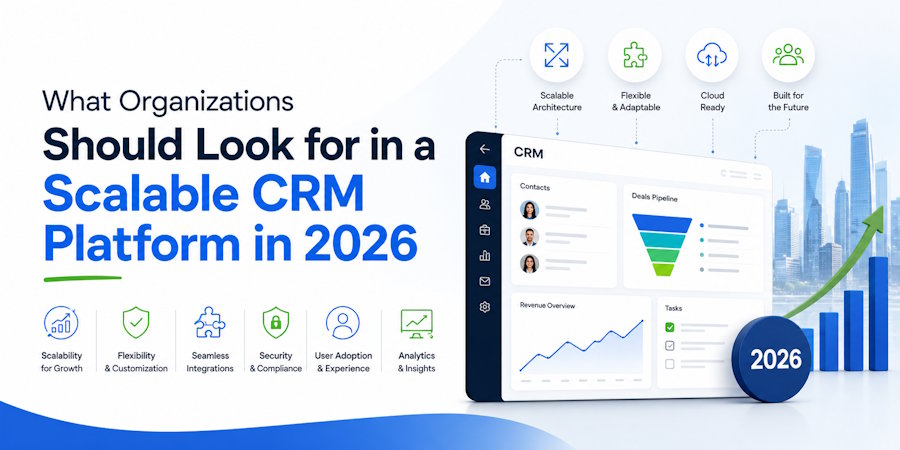
CRM software has come a long way from the contact database and sales pipeline. It's quite clear that a CRM is essential to enterprise infrastructure in 2026 and is a critical component in the intersection of data engineering, workflow automation, and compliance architecture.
It's easy to build technical debt over time when you have a system that doesn't scale to meet your business growth or one that is restrictively tied to a particular vendor.
The ultimate goal of any engineering team is to choose a scalable CRM solution for 2026 that aligns with their needs.
Cloud Native Architecture and Microservices
The backbone of modern, scalable CRM is a cloud native architecture using microservices. By 2025, about 70% of organizations will be using microservices in production, and this share is still growing. Microservices-based platforms enable specific functionalities (like contact management or billing integrations, or notification services) to be deployed, updated, and scaled separately.
The architecture pattern enables horizontal scaling using container orchestration tools such as Kubernetes, load balancing, and distributed data storage. The platform can scale with the growth in the number of users and data without disrupting the service. Real-time data synchronization, automatic updates, and access from any device are features that are added automatically as a part of a cloud native design, not as an afterthought.
Why does it matter for engineering teams?
It is immediately seen that microservices directly benefit the engineering teams. A modular CRM enables teams to connect various parts into their current CI/CD pipelines, practice infrastructure as code, and observe services in isolation using observability tools. A well designed crm should be a platform that your engineers could reason about, and not a black box that they couldn't instrument.
API Extensibility and Integration Ecosystems
There is no such thing as a standalone CRM. An enterprise platform cannot exist without well-documented APIs. CRM data can be integrated and exchanged bi-directionally with ERP systems, marketing automation, payment gateways, and analytics platforms through RESTful APIs, SDKs, and webhooks.
In addition to the API capabilities for raw features, the integration ecosystem's maturity is important. The custom development work on in-house teams is significantly reduced by active app marketplaces with prebuilt connectors. Consider the range of connectors you have to choose from, and the rate at which they are maintained and updated when you are considering a platform. When an ecosystem is stagnant, it's a red flag for a vendor that's not moving with the times in terms of software.
Workflow Automation and Orchestration
Workflow automation enables the repetitive, but necessary tasks to be completed that need engineering and operations capacity: Lead routing, deal progression triggers, follow-up scheduling, and reporting cycles. Leading platforms in 2026 feature visual workflow-building tools that include conditional logic and AI-powered suggestions, allowing users who are not technically inclined to set up complex workflows without having to open a code editor.
Orchestration tools enable business processes to play out consistently across the sales, support, and finance departments, with multiple steps. This consistency helps to minimise data inconsistencies that may need to be addressed at a later stage by downstream teams of analysts.
AI and Machine Learning Integration
AI is no longer a luxury that's added to CRM systems. These days, enterprise buyers expect predictive analytics, lead scoring models, sales forecasting, customer behavior analysis, and more to be standard. AI agents are also used more and more to automate campaign planning, to identify priority actions for sales reps, and to provide context-appropriate insights from previous interactions.
In assessing AI functionality, consider whether the platform can incorporate external AI services. Custom AI workflows can be restrictive. Data science teams can leverage vendor intelligence, but not without flexibility - platforms that provide APIs for the outputs of AI models and enable teams to integrate custom models offer this flexibility.
Data Security, Compliance, and Data Governance
Compliance is not a box to check for any organisation in the regulated industry. Needs to be a fundamental technical need. The enterprise CRM solution should be encrypted at rest and in transit; allow for granular role-based access controls; have comprehensive audit trails; and be GDPR, HIPAA, and SOC2 compliant.
There is an additional layer of complexity with industry-specific compliance needs. A behavioral health crm, on the other hand, should not only be HIPAA compliant but also 42 CFR Part 2 compliant, as they have more stringent privacy restrictions on drug use information. Granular consent management, real-time access monitoring, and secure interoperability, such as FHIR and USCDI+ Behavioral Health, are required.
Applications on the SMART on FHIR platform being deployed by institutions like Oregon Health and Science University are doing so with respect to these particular integration problems. In 2026, HHS continues to test the USCDI+ Behavioral Health data in the real world as part of pilot projects, continuing the dynamic nature of the sector-specific compliance requirements.
Data Ownership and Vendor Lock-In
Ownership of data is also a part of security governance. Organizations need to make sure that a CRM system is able to export all data in standard, machine-readable formats and that it has documented migration guides. Vendors that are not easy to extract data from indicate a “lock-in” strategy. The alternative is open source CRM, and for organisations, the ability to self-host and keep full control of their data infrastructure is a viable option.
Multitenancy and Customization
For businesses with multiple business units, regional teams, or client portfolios, all in a single CRM instance, multitenancy proves to be a crucial feature. A well-designed multitenant architecture allows for separating data across tenants, and shared infrastructure minimizes operational costs.
Multitenancy is supported by customization capabilities. Low-code and no-code tools enable business users to set up fields, dashboards, and workflows without the need for engineering, and deeper API level customization is possible if it's required for more complex needs. The most effective platforms will accommodate both roles and not require compromises between flexibility and usability.
DevOps and Platform Engineering
Assessing DevOps compatibility should be a part of modern CRM evaluation. Platforms that allow for infrastructure as code, automated testing, and deployment using standard CI/CD toolchains are more integrated into the engineering workflow. Platform engineering support for platform tasks via CLI and API enables teams to operate and manage their CRM environments as they do other production environments.
It is also integral to monitor and observe. Teams should be permitted to connect CRM platform metrics to existing dashboards with application and infrastructure metrics in order to get a single view of the health of the system.
Final Thoughts
A CRM system is more than just accommodating users or records. Rather, it's regarding architectural flexibility, compliance readiness, developer experience, and adapting to evolving industry-specific requirements.
Platforms that can be judged on all of these points will be in a better position to create sustainable and high-performing systems instead of getting into a growing technical debt with a platform that grows.

