

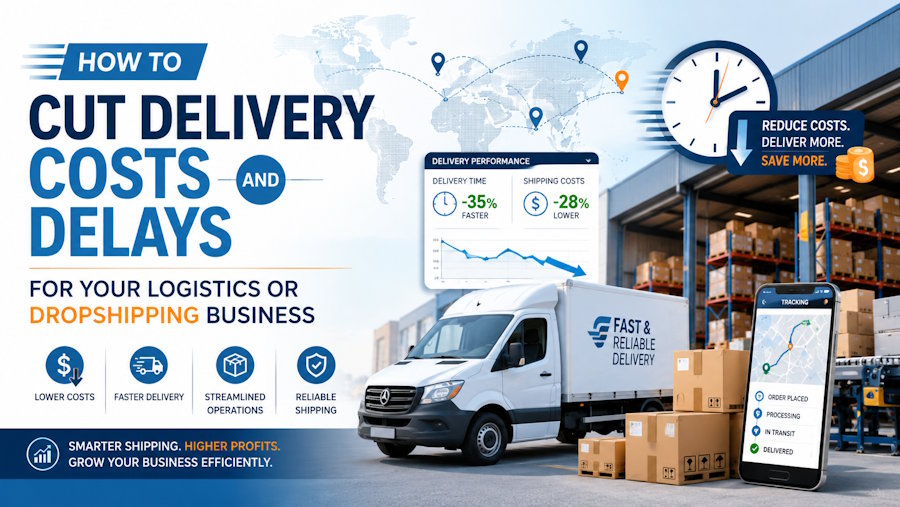
Delivery is where a lot of businesses quietly lose money. Whether you run a logistics operation moving hundreds of parcels a day or a dropshipping store promising fast shipping to customers, every extra mile, every late drop-off, and every failed delivery chips away at your margins. The last mile is the most expensive leg of the entire journey, and in a market where buyers expect accurate ETAs and cheap shipping, small inefficiencies add up fast.
The good news is that you can reduce delivery costs and delays without hiring a single extra driver. Most of them come from a handful of fixable problems: messy route planning, poor visibility into where drivers are, manual coordination, and avoidable failed deliveries. Tackle those, and you shrink both your spend and your delivery times at the same time.
Here's a practical look at where the money and time leak out, and what you can do about each one.
Start by Centralizing How You Manage Drivers and Routes
If your delivery operation runs on phone calls, group chats, and a spreadsheet, that's almost certainly your biggest hidden cost. Dispatchers spend hours every morning assigning stops, drivers call in to ask where to go next, and nobody has a clear picture of who's running ahead and who's falling behind.
Bringing all of that into one system is the fastest win. Modern driver dispatch management software lets you assign routes, push them straight to drivers' phones, and watch every vehicle on a single live map, so you stop being the middleman for every question. Instead of 30 calls a day, drivers open an app, see their route, and get on with it. Dispatchers reclaim their mornings, and route assignments that used to take 30 minutes happen in a couple of clicks.
For logistics businesses, that means more deliveries per driver per day. For dropshipping operations, it means you can scale order volume without your coordination overhead growing at the same rate.
Optimize Routes to Reduce Delivery Costs and Mileage
A consumer navigation app gives you the route between two points. It doesn't tell you the smartest order to visit 40 stops, account for vehicle capacity, or balance the workload fairly across your drivers.
That gap is expensive. Inefficient sequencing means more miles, more fuel, more overtime, and fewer completed stops per shift. Route optimization solves the classic traveling salesman problem at scale: it sequences stops to minimize total distance and time while respecting real-world constraints like delivery windows and driver availability.
Because the last mile can account for more than half of total shipping costs, even modest efficiency gains move the needle. Fewer miles means lower fuel spend, less overtime, and the same number of deliveries completed in less time. Less time on the road also reduces wear on vehicles and lowers maintenance spend over the year.
Use Real-Time Tracking to Get Ahead of Delays
You can't fix a delay you don't know about. Without live tracking, the first time you hear a driver is stuck is when an angry customer calls asking where their package is.
Real-time GPS tracking flips that. Dispatchers can see progress stop by stop, spot a driver running behind before it becomes a missed delivery, and reroute or reassign on the fly. If a customer reschedules, you move the stop and the driver's app updates automatically, no phone tag required.
For dropshipping brands especially, this visibility protects your reputation. Accurate, proactive ETAs are now a core part of the buying experience, and customers who get reliable updates are far less likely to leave a bad review or open a refund dispute.
Reduce Failed and Missed Deliveries
A failed delivery is one of the most expensive events in the entire chain. You've already paid for the fuel, the driver's time, and the handling, and now you have to do it all again. In one widely cited survey, the average failed delivery cost U.S. retailers around $17 per attempt — and re-deliveries frustrate the customer on top of the cost.
Most failed deliveries come from a small set of causes you can design out:
- Bad address data. Roughly a quarter of failed deliveries trace back to address errors. Geocoding addresses into precise coordinates before the route is built means drivers arrive at the right spot the first time.
- No customer heads-up. Automated notifications with a delivery window dramatically increase the odds someone is home to receive the package.
- No proof of delivery. Capturing a photo or signature at the door cuts down on "I never got it" disputes and the costly investigations that follow.
Each of these is a small change, but together they can meaningfully drop your failed-delivery rate, and that goes straight to your bottom line.
Track Hours, Mileage, and Performance
You can't cut what you can't measure. If you don't know how long routes actually take, how many miles each driver covers, or who consistently finishes on time, you're optimizing in the dark.
Automatic tracking of hours and mileage does two things. First, it makes payroll and reimbursement accurate and painless instead of a monthly guessing game. Second, it gives you the data to spot patterns: which routes are unprofitable, which drivers need support, and where you're overstaffed or stretched thin. Decisions based on real numbers beat decisions based on gut feel every time.
Automate the Repetitive Work
A surprising share of delivery cost is just human time spent on tasks software does better: typing addresses into a maps app, manually splitting orders across drivers, sending "are you there yet?" texts, copying delivery confirmations into a spreadsheet.
Automating these frees your team to handle the things that actually need a human, like managing exceptions and keeping key customers happy. It also removes the errors that creep in with manual data entry, errors that themselves cause delays and re-deliveries.
Conclusion
You don't reduce delivery costs and delays with one big change. It's about closing several small gaps that compound:
- Centralize driver and route management so coordination stops eating your day.
- Optimize route sequencing to cut miles, fuel, and time.
- Track drivers live to catch delays before customers do.
- Design out failed deliveries with clean addresses, notifications, and proof of delivery.
- Measure performance so you can keep improving.
- Automate the repetitive work that quietly burns hours.
Whether you're a logistics company trying to fit more stops into every shift or a dropshipping business competing on shipping speed and reliability, the same principles apply. Tighten up these areas and you'll spend less to deliver each order, get packages to customers faster, and free your team to focus on growth instead of firefighting.
Start with whichever gap is costing you the most right now, then build from there. Most operations find that once routes and drivers are under control, the rest gets a lot easier to fix.

