

The digital marketplace in Singapore has reached a point of saturation where "being online" is no longer a competitive advantage—it is the bare minimum. For B2B enterprises and high-growth SMEs, the challenge has shifted from simply building a website to ensuring that website is discoverable across an increasingly fragmented array of search platforms.
Today, search is no longer confined to a list of blue links on a Google results page. We have entered the era of the "Answer Engine," where Artificial Intelligence (AI) and Generative Search are changing how users consume information. To maintain a lead, businesses must evolve their strategies to encompass not just traditional Search Engine Optimization (SEO), but also Generative Engine Optimization (GEO) and Answer Engine Optimization (AEO).
For many firms, navigating this complexity requires the strategic oversight of a specialized digital agency that understands the technical nuances of the local market. This guide explores the new pillars of search visibility and how to build a resilient presence in 2026.
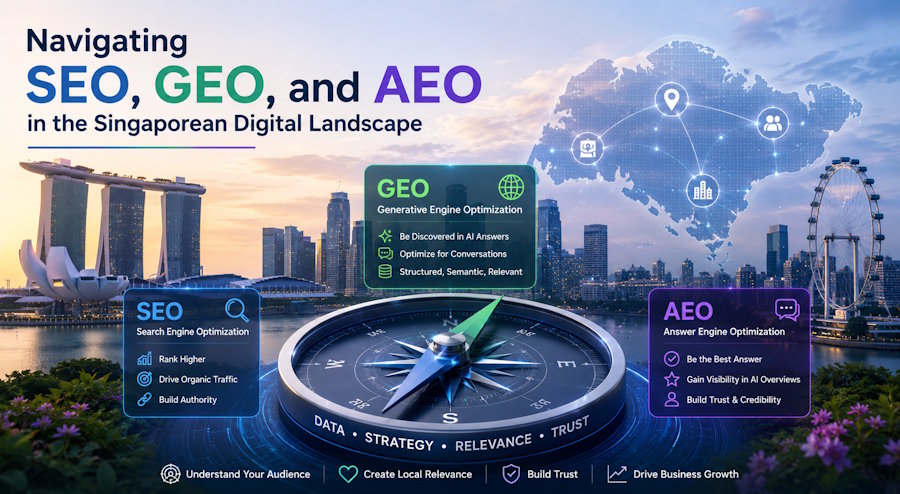
The Trinity of Search: SEO, GEO, and AEO
To the uninitiated, these acronyms might seem like jargon. However, they represent distinct ways search engines and AI models process and deliver information.
Search Engine Optimization (SEO)
Traditional SEO remains the foundation. It focuses on ranking a website in the organic search results of engines like Google or Bing. It is driven by keywords, backlinks, and technical health. The goal of an seo agency is to ensure that when a user types a query, your URL appears at the top.
Generative Engine Optimization (GEO)
GEO is the newest frontier. It focuses on optimizing content to be cited by Generative AI models like Google’s Search Generative Experience (SGE), Perplexity, and ChatGPT. Unlike SEO, which aims for a click to a website, GEO aims for "attribution"—ensuring the AI mentions your brand as the primary source of truth in its generated summary. Businesses looking to strengthen their presence in AI-powered search often partner with GEO agencies that specialize in optimizing content for generative engines and answer platforms.
Answer Engine Optimization (AEO)
AEO focuses on "zero-click" searches. It targets voice assistants (Siri, Alexa) and featured snippets. The goal is to provide a direct, concise answer to a specific question. AEO requires highly structured data and a deep understanding of natural language processing.
Getting Your Business on the Map: The Foundation of Local Authority
Before you can dominate AI-driven search, you must master the basics of local visibility. In Singapore, the "Local Map Pack" is the most valuable piece of digital real estate for service-based businesses.
Claiming Your Google Business Profile (GBP)
Your journey starts with a verified Google Business Profile. This is the primary signal Google uses to understand your physical location, service areas, and customer sentiment.
- Consistency is Key: Your Name, Address, and Phone Number (NAP) must be identical across the web. Discrepancies signal unreliability to the algorithm.
- Review Velocity: It is not just about having high ratings; it is about the frequency of new reviews. A consistent stream of fresh feedback signals that your business is active and relevant.
The Role of Local Citations
A citation is any mention of your business on the web—directories, news sites, or industry associations. These act as "votes of confidence." For Singaporean firms, being listed in local directories like the Yellow Pages or the Singapore Business Federation adds a layer of geographic trust that global competitors cannot easily replicate.
The Strategic Use of SEM Service Singapore
While SEO and GEO build long-term authority, they are marathons. For businesses that need to drive leads today or capture high-intent traffic for a new product launch, a professional sem service Singapore is indispensable.
The Synergy of Paid and Organic
The most effective digital strategies use Search Engine Marketing (SEM) to supplement organic efforts. Paid search (Google Ads) allows you to "buy" your way to the top of the SERP for highly competitive keywords while your organic authority is still building.
- Keyword Testing: Use SEM to identify which keywords actually lead to conversions. Once you find a "winner," you can prioritize that keyword in your long-term SEO content strategy.
- SGE Protection: As AI overviews take up more space at the top of the page, paid ads are often the only way to ensure your brand is seen "above the fold."
The Science of Search: Psychology and Consumer Behavior
Recent research in the Journal of Business Research has highlighted a significant shift in how consumers perceive search results. There is an increasing "trust gap" between paid advertisements and organic results, yet Generative AI results are being viewed as "expert advice."
The "Trust" Factor in B2B
In the B2B sector, the sales cycle is long. A prospect may find you through an AEO snippet, return via an organic blog post, and finally convert through a retargeted SEM ad. This "multi-touch" journey means your brand must maintain a consistent voice across all formats.
- Expertise (E-E-A-T): Google’s algorithm and AI models prioritize content that shows Experience, Expertise, Authoritativeness, and Trustworthiness.
- Authorship: Having clear author bios with links to professional credentials (like LinkedIn) tells search engines that the information is coming from a human expert, not a generic content mill.
Optimizing for the AI Era: Actionable Strategies
To optimize for SEO, GEO, and AEO simultaneously, your content must be "multi-modal" and highly structured.
Use Schema Markup (Structured Data)
Schema is a code you add to your website to help search engines understand the context of your content. If you have an FAQ section, using FAQ Schema allows Google to pull those answers directly into a featured snippet (AEO) or an AI summary (GEO).
Focus on "Information Gain"
AI models are trained on existing web data. If your article simply repeats what is already on the web, an AI has no reason to cite you. "Information Gain" refers to providing new, unique insights—such as proprietary survey data, original case studies, or a unique expert perspective. This is the single biggest factor in winning GEO citations.
Natural Language and Long-Tail Keywords
People talk to AI differently than they type into search bars. Instead of "SEO agency Singapore," a user might ask, "Who is the best SEO agency for B2B tech firms in Singapore?" Optimizing for these conversational, long-tail queries is the heart of AEO.
To ensure your business remains visible as search technology evolves, focus on these four pillars:
- Technical Foundation: Ensure your site is mobile-first and scores "Green" on Google’s Core Web Vitals. Speed is a prerequisite for all search types.
- Content Depth: Move away from 500-word "fluff" pieces. Create comprehensive guides that answer every possible question a user might have about a topic.
- Entity Building: Treat your brand as an "Entity" in Google’s Knowledge Graph. Consistency across your website, social media, and third-party mentions helps AI models understand who you are and what you do.
- Integrated Search: Align your SEO and SEM teams. Ensure they are sharing keyword data and insights to maximize your total share of voice.
The New Standard of Search Dominance
The digital landscape in Singapore is no longer a simple game of keywords. It is a complex, multi-layered ecosystem where traditional search, generative AI, and voice assistants interact. Dominating this space requires a holistic approach that balances the immediate impact of paid search with the long-term equity of organic authority.
Whether you are looking to revitalize your local rankings, capture citations in AI overviews, or scale your lead generation through precision-targeted ads, the key is a partnership built on technical excellence and market insight.

