

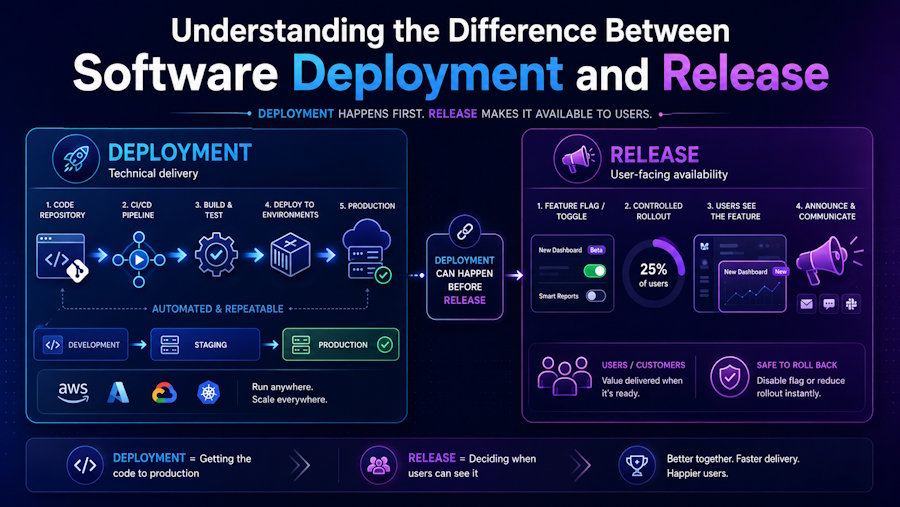
If you have ever shipped a feature only to realize users are not seeing it yet - or rolled out a change that broke production - you have likely bumped into the blurry line between deployment and release. These two terms are often used interchangeably, but treating them as the same thing can lead to costly confusion on engineering and product teams.
Understanding the distinction is not just a matter of semantics. It shapes how you plan, communicate, and de-risk your software delivery pipeline.
What Is a Software Deployment?
A deployment is a technical operation: it is the act of moving code from one environment to another. When your CI/CD pipeline pushes a new build to production servers, that is a deployment. It is handled by developers and DevOps engineers, often automated, and happens at the infrastructure level.
Deployments are about the 'how' - the mechanics of getting code onto a server or into a container. They can happen multiple times a day with no end-user impact whatsoever.
What Is a Software Release?
A release, on the other hand, is a business decision. It is the moment you choose to make a feature or change visible and available to users. A release can happen at a different time than the deployment - sometimes days or weeks later - using techniques like feature flags, dark launches, or gradual rollouts.
Releases involve stakeholders beyond engineering: product managers, marketing teams, customer success, and leadership all care about when and how a release goes out.
Why the Separation Matters
Decoupling deployments from releases gives teams significant flexibility and safety:
- Deploy code early, release when business timing is right;
- Roll back a release without touching the underlying deployment;
- Test in production with a subset of users before a full release;
- Coordinate releases with marketing campaigns or support readiness.
Common Patterns That Exploit the Difference
Modern teams use several patterns to keep deployments and releases independent. Feature flags let engineers merge and deploy incomplete work safely. Canary releases expose changes to a small user segment first. Blue-green deployments let you switch production traffic instantly without redeploying.
Aligning Your Team Around the Right Language
When developers say 'it is deployed,' product managers can mistakenly tell customers it is live. Building a shared vocabulary prevents this. Define in your team's process what deployment means versus what released means, and enforce those terms in your rituals, tickets, and dashboards.
For a deeper breakdown with practical examples, check out this comprehensive deployment vs release guide from Apwide.
Final Thoughts
The deployment vs release distinction is not academic - it is a practical boundary that helps teams move faster with less risk. Once your team internalizes it, you will find better coordination, fewer surprises, and more confident shipping.

