

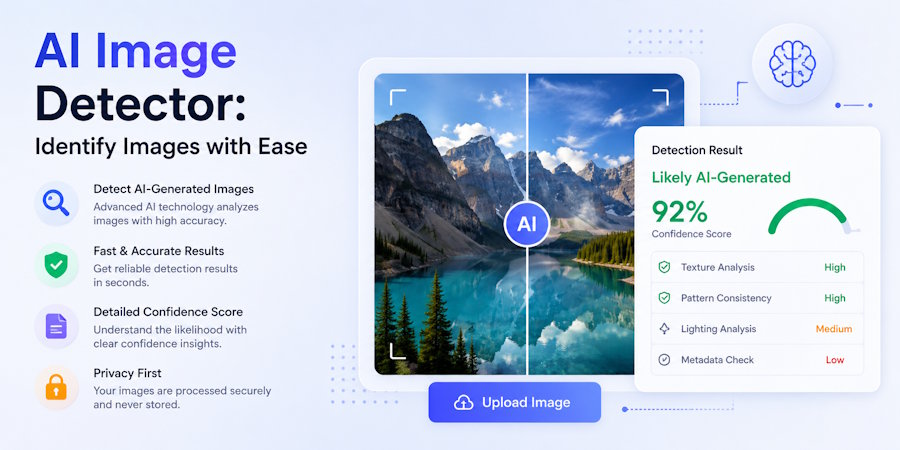
New tools are helping us navigate the internet easier as technology continues to evolve. Artificial Intelligence is now used by many professionals to process data without any additional effort or delay. This makes it easier than ever for them to organise files and check where posts originated.
The software can be used to see details not visible by the human eye. By scanning shapes and colors, these programs provide deep insights into the origin of a file. This method has become a standard for many researchers and creators in the United States.
The Detector is an invaluable tool for verifying content online. Users can quickly determine if images were generated by artificial intelligence algorithms or humans - increasing transparency on the Internet while strengthening trust between parties involved.
Understanding AI Image Detector Technology
Mastering AI Image Detector technology is essential in today's digital era, as images continue to play such an integral part in online interactions and our lives. Accurately recognizing and analyzing images has become more essential.
What Is an AI Image Detector
AI Image Detectors are advanced tools that use machine learning algorithms for identifying and classifying images. They can detect visual content, such as entities, objects and patterns, within an image for further analysis.
Core Functions and Capabilities
AI Image Detectors serve to recognize and classify visual content. This involves several key capabilities.
Object and Entity Recognition
Artificial Intelligence Image Detectors are able to identify objects or entities in an image such as vehicles, people, and animals. These detectors use complex algorithms to analyze visual characteristics of objects.
Content Classification
They can classify images based on predetermined categories like still life compositions, landscapes and portraits - digital content classification is vital in filtering and organizing it effectively.
Pattern and Feature Analysis
AI image detectors can identify patterns or features within images to spot anomalies - making them perfect for applications including quality control and surveillance.
The Technology Behind Detection Systems
AI Image Detectors use machine learning, neural networks and vast image databases for training and to improve detection capabilities.
How AI Image Detectors Work in Practice
AI image detectors require more than simply theoretical knowledge for true understanding. Their implementation in various industries, from healthcare to content moderation, has provided AI image detectors with real-world applications that exceed just theoretical concepts.
Machine Learning and Neural Networks
Machine learning algorithms and neural networks are at the heart of AI image detection. These systems can learn over time by using machine learning. The ability of neural networks to quickly process patterns is what makes them excel in image recognition.
The layers of neurons (neurons), which are interconnected, process the inputs. Due to their efficiency in image processing, convolutional neural network (CNNs), are frequently used for image detection.
The Detection Process Explained
From the image input through to the final output, there are several steps that make up the detection process.
Image Input and Preprocessing
Image Input and Preprocessing. An AI system may receive an image for analysis and begin preprocessing it by resizing, normalizing or otherwise manipulating it as necessary to prepare it for further study.
Feature Extraction and Analysis
Image analysis begins with feature extraction - this step entails extracting essential elements, like textures, edges and objects from an image for further study by computer software systems. Don't neglect this important step!
Classification and Output
After feature extraction, the system classifies an image based on those identified features. It then displays this classification result as either an affirmative/negative answer or a more detailed content analysis of what's happening within.
Accuracy and Reliability Factors
AI image detectors' accuracy and reliability depend upon several variables, including training data quality, complexity of algorithms used, and image type being analysed.
Accuracy requires using high-quality data for training purposes. Artificial Intelligence needs to be exposed to numerous different situations for it to perform optimally.
Real-World Applications and Benefits
AI Image Detectors are having a substantial effect on online safety and healthcare delivery systems alike, playing a significant role.
AI Image Detectors have become ubiquitous across industries and organizations around the globe, revolutionising business operations while improving efficiency and making decisions across many different sectors more dependable.
Content Moderation and Online Safety
AI Image Detectors are a key component in the moderation of content, and help platforms to maintain a safe environment for their users. These detectors allow for faster moderation by automatically detecting inappropriate content and flagging it.
AI Image Detectors have dramatically increased online safety. This technology is especially useful for social media platforms as they can adhere to the community guidelines and regulations.
E-commerce and Retail Solutions
AI Image Detectors have become a standard in both online and retail commerce to enhance customer experiences and streamline operations. These can be used for a variety of purposes, including verifying product images or detecting product alteration.
AI Image Detectors can be used by retailers to improve product cataloging and make it easier for their customers to find what they are looking for. Furthermore, this technology enables more effective visual search functionalities - further enriching customers' shopping experiences.
Security and Surveillance Enhancement
AI Image Detectors have proven themselves invaluable to security and surveillance systems by increasing the accuracy of threat detection. When integrated into CCTV systems, these AI Image Detectors can quickly identify suspicious activities or individuals and prevent potential security breaches.
AI Image Detectors in security surveillance also facilitate faster identification and response to incidents by rapidly recognizing security threats.
Healthcare and Medical Diagnostics
AI Image Detectors have become an indispensable asset in healthcare, aiding medical diagnosis more accurately by analyzing medical images like X-rays and MRIs to help doctors pinpoint any abnormalities or diagnose conditions more precisely.
AI Image Detectors in medical diagnostics provide not only increased accuracy but also faster processes that may lead to improved patient outcomes.
Digital Marketing and Social Media Management
AI Image Detectors have become an invaluable asset to social media and digital marketing, providing insights on consumer behavior by examining visual content.
Understanding how visual content is received by users can assist marketers in designing more engaging marketing campaigns and increasing customer conversion rates.
Conclusion
AI Image Detectors have become an essential element of Artificial Intelligence, revolutionizing how images can be recognized and analyzed. Utilizing advanced image Recognition capabilities, these detectors have quickly become indispensable across numerous industries.
From improving content moderation and online safety to offering groundbreaking solutions in e-commerce, security, and healthcare, AI Image Detectors have many uses and applications. The potential of this technology to revolutionize image analysis and identification becomes apparent as it develops.
AI Image Detectors will have an increasingly bright future with advancements in Artificial Intelligence (AI) and Machine Learning, thanks to advances in artificial intelligence (AI). They're expected to increase efficiency and accuracy during tasks requiring image recognition - meaning companies across industries could adopt and utilize this technology, creating lasting impacts across sectors.

