

Two years ago, "generative AI" was a research term. Now it's in the job title.
Companies everywhere are hiring people to build with it, fine-tune it, and wire it into products. And here's the part that surprises job seekers: a lot of these roles don't need a PhD or a decade of machine learning behind you.
That changes the math for anyone eyeing a move into AI. This guide lays out what generative AI jobs actually look like in 2026, the skills that get you hired, what the pay and growth look like, and how to break in without starting over.
What Are Generative AI Jobs, Really?
Generative AI is the kind that creates things. Text, images, code, audio. The models behind tools like ChatGPT and image generators.
Generative AI jobs are the roles that build, tune, and deploy that tech inside real products. Some are deeply technical. Plenty aren't, at least not in the "train a model from scratch" sense.
That's the shift worth understanding. A few years ago, working in AI meant research. Today, most of the hiring is applied: taking models that already exist and making them useful for a business. That opens the door to a much wider range of people.
The Roles Companies Are Hiring For
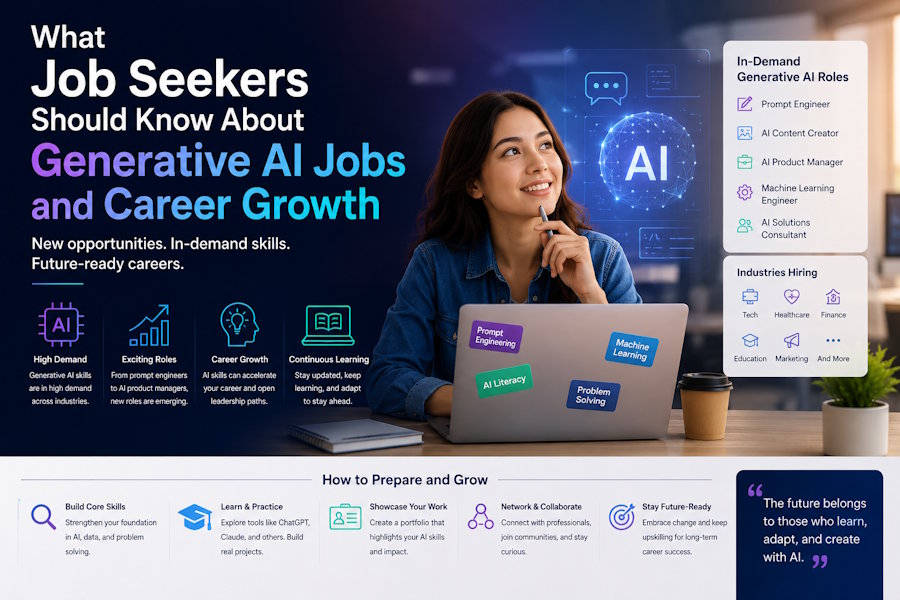
The job titles are still settling, but a few clear categories have emerged:
- Machine Learning Engineer: builds and ships the models. The most technical of the bunch.
- AI Engineer: integrates AI into apps and workflows, often using existing models through APIs.
- Prompt Engineer: designs and refines the inputs that get reliable outputs from a model. A genuinely new job.
- AI Product Manager: figures out what to build with AI and why, bridging the tech and the business.
- Applied roles everywhere else: marketers, designers, analysts, and writers who use generative tools daily and get hired partly for that fluency.
Notice the range. One end needs serious engineering. The other just needs you to be genuinely good with these tools and able to apply them to real work.
Skills That Actually Get You Hired
What you need depends on which end you're aiming for. Broadly:
For the technical roles:
- Strong Python
- A real grasp of how large language models work, even at a high level
- Experience with frameworks and APIs (think working with model providers, not just calling them blindly)
- Cloud and deployment basics
For the applied and adjacent roles:
- Fluency with the major generative tools, and the judgment to know when their output is wrong
- Prompt design, the skill of getting useful results consistently
- Domain knowledge in your field, since AI amplifies expertise rather than replacing it
- Clear communication, because someone has to explain what the AI did and why it matters
That second list is the one most people underrate. You don't need to build the model to get paid to use it well.
What Generative AI Jobs Pay
The money is part of why everyone's paying attention. In the US in 2026, technical AI roles often start around $100K to $130K for entry level, and senior machine learning engineers at well-funded companies clear $200K once equity counts.
Applied roles vary more, since they blend AI with an existing function. But "can use generative AI effectively" has become a real raise on top of a normal salary for marketers, analysts, and designers. The skill pays a premium because demand is running ahead of supply.
Career Growth: Why This Field Has Room to Run
A fair question: is this a bubble, or a career? The honest read is that the tooling will keep shifting, but the underlying demand looks durable. Companies are building generative AI into core products, not just experimenting on the side.
That creates room to grow. Get in at an applied level and you can move deeper into the technical side over time, or up into product and strategy. The people who start now, while the field is still forming, tend to end up with titles and scope that didn't exist when they began.
One more thing in your favor: a large share of these roles are remote or hybrid across the US, so you're not limited to the handful of big tech hubs.
How to Break Into Generative AI Work
You don't need to quit and enroll in a master's program. A more practical path:
Start using the tools seriously. Not casually, deeply. Learn what they're good at, where they break, and how to get reliable output. That fluency alone separates you from most applicants.
Build something small and real. A project that uses generative AI to solve an actual problem beats any certificate. Put it where people can see it.
Layer on the basics if you're going technical. Python and a working understanding of how these models behave. You can learn a lot of this for free.
Lean on the skills you already have. A marketer who's excellent with AI tools, an analyst who automates their workflow, a designer who uses generative tools well, all of those are hireable today.
When you're ready to see what's actually out there, browse current artificial intelligence jobs and the wider range of IT jobs in the USA on VeriiPro to match real postings to the skills you're building.
A Few Common Questions
Do I need a degree to work in generative AI?
For research-heavy roles, often yes. For applied and many engineering roles, a strong portfolio and real skills increasingly matter more than a specific degree.
Will generative AI replace these jobs eventually?
It's reshaping work more than erasing it. The people who learn to work alongside these tools tend to become more valuable, not less.
What's the fastest way for a non-technical person?
Get genuinely fluent with the tools, apply them to your current field, and build a visible project. That combination opens applied roles quickly.
The Bottom Line
Generative AI jobs aren't a locked club for researchers anymore. The field has opened into a spectrum, from deep engineering to applied roles you can grow into with skills you may already have.
The market is hiring, the pay is strong, and the path up is wide because the field is still being built. Start by getting genuinely good with the tools, prove it with a project, then go find the role. Explore open AI roles on VeriiPro and take the first step.

