

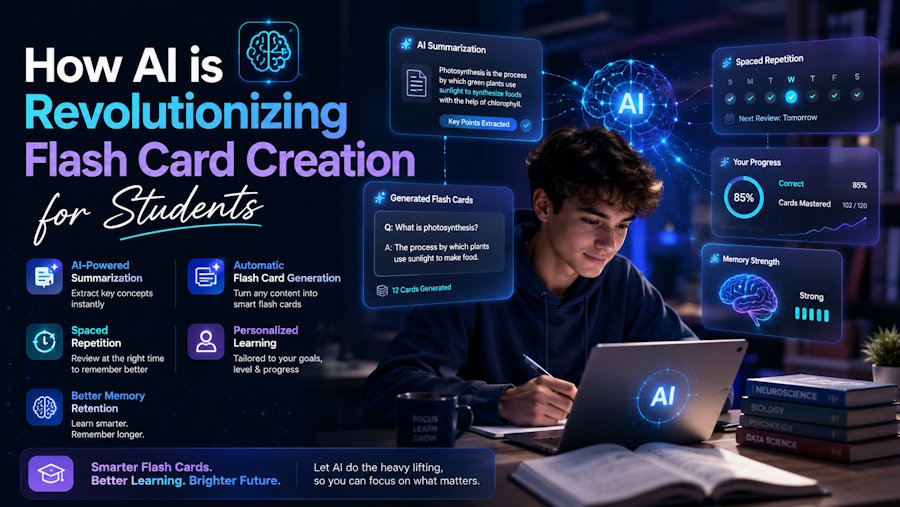
AI technology has changed the learning styles of learners, including the style of developing flashcards. The conventional process of making flashcards was cumbersome and involved much effort on the part of the learner. However, thanks to AI, it has become simpler and easier for students to create effective flashcards.
Apart from being an easy-to-use approach in generating flashcards, this new technique has changed the dynamics of knowledge acquisition. In other words, through such flashcards, students are not just memorizing the details but learning effectively.
The Traditional Flashcard Problem
Flashcards used manually have always been a tedious process to make. Students needed to look at their notes and get the main ideas from them, and then prepare the flashcards based on those notes. This made for a halfhearted attempt to cover a topic or bad quality flashcards.
The lack of uniformity was another problem. Some cards would have too many details on them, whereas others were unclear in terms of what was written on them.
Limitations of traditional flashcards:
- Tedious process of creation
- Inconsistency and lack of organization
- Absence of customization options
- Difficult to handle huge amounts of information
What Makes AI Flashcards Different
Flashcards created with an AI flashcard maker can analyze content from notes, books, PDF files, and even lecture videos. The system identifies key information and automatically turns it into effective study flashcards.
This allows students to make flashcards from notes in a fraction of the time required for manual creation while improving consistency and quality. Using natural language processing, the AI can also simplify complex topics and make them easier to understand.
An AI flashcard maker processes information from handwritten notes, digital documents, textbooks, and audio lectures to identify essential concepts and organize them into clear flashcards. Automating the process, it reduces manual effort, improves accuracy, and helps students focus more on learning.
How AI Automates Flashcard Creation
One of the most significant accomplishments may well be the fact that cards would be formed instantaneously using the raw data. This means that once the user uploads their notes, the software can form cards almost instantaneously based on the uploaded information.
We can rest assured in knowing that all important pieces of information will not be omitted. As previously discussed, AI would go through the whole data in order to extract vital information for the flashcards.
Process of creating flashcards using AI:
- Input: Notes, PDFs, slides, or text
- Analysis: Identification of important concepts by AI
- Conversion: Information conversion into Q&A
- Optimization: Simplification of flashcards
Smarter Learning with Personalization
AI not only generates flashcards but also personalizes them based on the learning style of that particular person. It identifies their weakness based on their results and creates personalized flashcards for them.
Personalized learning helps people focus on those areas that require more attention.
Advantages of personalization:
- Weak concept concentration
- Adaptive difficulty
- Targeted revision for better retention
Spaced Repetition and Active Recall
AI makes use of learning tools such as spacing and active retrieval, which have been shown to improve retention by revisiting content at the right time.
As opposed to revising randomly through flashcards, the AI will know when it is the best time to revise certain concepts, considering that it is tailored to each student.
Turning Notes into Flashcards Instantly
Students no longer have to write down their notes manually. This technology is capable of turning any notes, whether they are from lectures or handwritten ones, into flashcards.
This is particularly helpful for those who have huge amounts of learning material on hand since they don’t need to spend time organizing it.
Increasing Accuracy and Quality
Artificial intelligence is used to minimize human errors when creating flashcards. This ensures that all questions asked will make sense and be concise, along with providing all information in an organized manner.
Additionally, difficult concepts can be made simple for the sake of students to understand without being scared by them.
AI Flashcards for Different Subjects
AI flashcards are not restricted to a single subject. Instead, they can be applied in a wide range of fields.
|
Subject Area |
How AI Helps |
|
Language Learning |
Vocabulary, grammar, and translations |
|
Science |
Definitions, formulas, and concepts |
|
History |
Dates, events, and timelines |
|
Medicine |
Terminology and case-based learning |
|
Business |
Theories, models, and frameworks |
Enhancing Language Learning
AI Flashcards prove to be very useful for language learners because they are able to produce lists, translations, and even pronunciations automatically.
Moreover, some software uses context learning where words are placed within sentences. This allows learners not only to learn the meaning of words but also their correct usage.
Saving Time and Increasing Productivity
Time is one of the most important assets for a student, and with the help of artificial intelligence, the amount of time needed for preparing for studies is greatly reduced.
This gives students more time for studying and revising. Consequently, they become more productive, not expending additional effort.
Benefits of saving time:
- Fast creation of flashcards
- Automatic organization of information
- Prompt editing and updating
Interactive and Engaging Approach to Learning
AI flashcards are available for use through smartphones, tablets, and computers, meaning that learners can learn using any gadget as long as the progress achieved is stored in the cloud.
On the other hand, artificial intelligence may sometimes simplify complicated topics to become too easy to learn. The problem lies on the shoulders of the learners themselves.
Access, Accessibility & Drawbacks of Using AI Flashcards
Flashcards based on artificial intelligence are also accessible through smartphones, laptops, and computers. In doing so, learners will have the chance to learn through any electronic device and guarantee that everything they accomplish will be saved online.
However, there may be instances where the AI simplifies concepts until they are overly simplified. It is up to the learners themselves to solve this problem.
Using AI flashcards as an additional means of studying will be more beneficial than relying only on automated technology.
Best Practice Tips on the Use of AI Flashcards
To make sure that you can fully benefit from the use of AI flashcards, you have to know how to use them strategically. Just creating flashcards may not be enough if done improperly.
Some best practice tips include the following:
- Editing and reviewing of AI flashcards
- Using AI and non-AI flashcards
- Using spaced repetition
- Understanding the content instead of memorizing it
Future of AI in Flashcard Learning
The future of using AI in educational processes seems to be quite bright, with the prospect of personalization being particularly exciting. Flashcards themselves are also expected to advance with additional capabilities such as voice interactions and advanced analytics.
FAQs
1. What are AI flashcards, and how do they function?
AI flashcards are automatic study cards that have been created using AI software from notes, PDF files, and other text content. AI extracts ideas from text and turns them into a Q&A format.
2. Can flashcards generated using AI improve memory retention?
Flashcards generated using AI employ active recall and spaced repetition in improving memory retention. Using these techniques improves the retention period of the information.
3. Is it possible to develop flashcards using AI through my notes?
Yes, it is possible to develop flashcards immediately via the utilization of AI, irrespective of whether the data is in the form of notes, PDFs, or lectures.
4. Are flashcards developed using AI better than ordinary flashcards?
AI-based flashcards are faster and better organized than ordinary flashcards. However, when both methods are utilized, they lead to a better understanding.
5. How do you use AI flashcards most effectively?
Students are advised to review and modify the flashcards produced automatically by the software.

