

Why Reposts Are the Instagram Engagement Signal Everyone Ignores
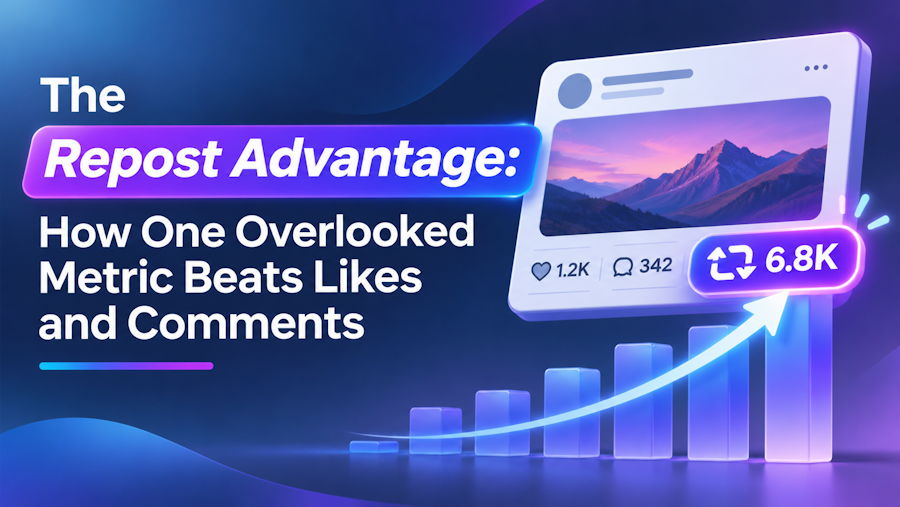
Most advice about Instagram engagement centers on likes and comments. Likes are treated as the baseline metric, comments as the gold standard because they take more effort to leave. Reposts rarely get mentioned at all, which is strange, because a repost is the one engagement action that does something none of the others do: it puts your content directly in front of an audience you do not control.
A like tells the algorithm a viewer paused for a second. A comment tells it someone had a reaction worth typing out. A save tells it the content was useful enough to revisit. A repost tells it something bigger: someone was willing to put your content on their own page, in front of their own followers, attaching their name to it. That is a different kind of signal, closer to a referral than a reaction.
This distinction matters because the four actions are not interchangeable in how they affect distribution. Likes and views are passive. Comments and saves show deeper interest but stay contained to the original post. Reposts and shares are the only actions that extend a post's reach outside the people who already follow the account, which is exactly the problem every growing account is trying to solve.
This is especially relevant for a brand or creator just starting out, where there is no existing follower base large enough to generate meaningful reach on its own. Reposts are the fastest way to borrow an audience that does not require the algorithm to have already decided your account deserves attention.
Treating reposts as a secondary metric, behind likes and comments, misses what actually drives sustained growth. This piece breaks down why reposts carry more weight than they get credit for, how the algorithm treats them differently, and what actually works to earn more of them.
How the Algorithm Actually Weighs a Repost
Instagram does not publish its exact ranking formula, but its public statements and the behavior of the feed over the last few years point to a consistent pattern: actions that predict further distribution get weighted more heavily than actions that only reflect interest in the moment.
A like happens inside the scroll and changes nothing about where the post goes next. A repost, by contrast, is a decision to actively rebroadcast the content, and it immediately creates a second surface (the resharer's own Story or feed) where new viewers can discover it. From the platform's perspective, a repost is doing part of its distribution job for it, which is exactly the kind of behavior a recommendation system tends to reward.
This also explains why a post with modest likes but several reposts often outperforms a post with the opposite ratio. The algorithm reads the repost pattern as evidence that the content has value beyond its original audience, and it responds by testing the post in front of more people outside the follower base, which is the mechanism behind reaching the Explore page or a wider Reels distribution.
The practical takeaway is simple: optimizing purely for likes optimizes for the wrong signal. A post designed to be reshared, something useful enough, funny enough, or relatable enough that someone wants their own followers to see it, is working with the algorithm's actual incentives instead of against them.
Reposts Are Social Proof in a Way Likes Never Are
Social proof works by borrowed trust. When someone reshares a post, they are vouching for it in a way a like never does, because their followers see it attached to someone they already trust, not to a stranger's account.
This is why a repost from even a small, relevant account often converts better than a hundred likes from strangers. The people seeing a reshared post arrive with context: they follow the person who shared it, which means they already have some baseline interest in that person's taste, opinions, or niche. A brand or creator benefiting from that reshare inherits a sliver of that trust for free.
Likes and views do not carry this transferable trust. They are consumed by the algorithm and, to a lesser extent, by anyone who checks a post's engagement count, but they do nothing to introduce the content to someone new. A repost is the only common engagement action that functions as a recommendation rather than a reaction.
This is also why reposts tend to produce better quality followers than paid reach alone. Someone who discovers an account through a friend's repost arrives with a warmer frame of reference than someone who sees a cold ad, which shows up later as better engagement rates and lower unfollow rates on the audience a repost brings in.
Reach: What a Repost Actually Buys You
The clearest way to understand why reposts matter is to look at where the audience for each type of engagement actually lives.
Likes, comments, and saves all happen within the existing audience, the people who already follow the account or found the post through the algorithm's own discovery surfaces. A repost is the one action that manually creates a brand new distribution channel: the resharer's Story or feed, seen by followers who may have never encountered the original account before.
This compounds quickly. If ten people repost a piece of content to audiences of a few hundred followers each, that single post has effectively been placed in front of several thousand new viewers, none of whom needed to be reached through ads, hashtags, or the algorithm's own recommendation engine. Each of those new viewers can then repost it again, creating the kind of secondary spread that algorithmic distribution alone rarely produces as efficiently.
This is also why reposts are often a better use of a limited budget than boosting a post directly. A boosted post reaches more of the same type of cold audience an ad normally reaches, while a reshare reaches people through a trusted connection, which tends to convert at a noticeably higher rate for the same number of impressions.
This matters disproportionately for a new or small account. A brand new profile has almost no organic reach of its own, but it can still benefit from someone else's existing audience through a single reshare. That borrowed reach, even a handful of times in the first few weeks, does more for visibility than weeks of posting into a following of a few dozen people.
How to Actually Earn More Reposts
Earning reposts starts with making something worth attaching your name to, since that is ultimately what a resharer is doing.
Content that gets reshared tends to fall into a few repeatable categories: something immediately useful (a tip, a checklist, a shortcut), something that captures a specific feeling precisely enough that someone wants to say "this is exactly how I feel," or something visually satisfying enough to stand on its own with no caption needed. Pure promotional content almost never gets reshared, because nobody wants their own page to look like an ad for someone else's product.
A few tactics make a real difference:
- Design for the share, not just the scroll. A post meant to be reshared should read clearly even out of context, since it will show up in someone else's Story without the original caption attached.
- Ask directly, occasionally. A simple "share this with someone who needs to see it" caption measurably increases reshare rates, as long as it is not used on every single post.
- Make reposting easy. Posts formatted for a 9:16 Story frame get reshared far more often than content that looks awkward when cropped into that shape.
- Time it around relevance. Content tied to a trend, a season, or a shared frustration gets reshared because the resharer feels it says something timely, not because the content itself changed.
None of this guarantees reposts on command, but it shifts the odds meaningfully compared to posting the same content with no thought given to how it looks once someone else puts it on their own page.
Jumpstarting Repost Momentum Early
A new account faces a real chicken and egg problem with reposts specifically. Reposting works best when a post already looks like it has traction, since people are more willing to share something that already appears to be resonating than something sitting at zero. An account with no history of being reshared has a harder time getting that first wave going, even with genuinely shareable content.
This is the stage where some teams choose to seed the signal directly rather than wait for it to build organically. Services like SoldOutX's Instagram reposts exist specifically for this gap, giving a post an initial batch of reshares so it does not sit at zero while the organic tactics above have time to work and a real audience starts forming around it.
The same caveat that applies to any paid boost applies here. This works as an accelerant on top of content that is actually built to be reshared, not as a substitute for it. A post nobody would naturally reshare will not suddenly start generating organic momentum just because its numbers moved first. Used selectively, on the handful of posts a team has specifically designed around the tactics in the previous section, it simply removes the disadvantage of starting from zero.
Common Mistakes Brands Make Chasing Reposts
A few habits consistently undercut repost rates, even when the underlying content is decent.
- Treating every post as equally shareable. Not every post needs to be optimized for reshares. Trying to force it on routine updates dilutes the posts that were actually designed for it.
- Burying the shareable moment. If the most repostable part of a post is three slides into a carousel, most people will never get there. The clearest, most shareable idea should lead.
- Ignoring the vertical crop. Content shot or designed for a square or landscape frame often looks broken when reshared into a Story, which quietly discourages the exact behavior a brand is trying to encourage.
- Measuring only likes. Teams that only track likes and follower count miss which posts are actually driving reach through reshares, and end up repeating the wrong format.
- Posting and disappearing. An account that posts something shareable but never engages with the people who did share it misses the chance to turn a one time reshare into a recurring habit.
- Buying signals with no organic strategy behind them. A boosted repost count on content nobody would naturally share still produces a page that doesn't convert, since the underlying problem was never the number.
Most of these come down to treating reposts as an afterthought rather than something designed for deliberately, the same way a headline or a thumbnail gets deliberate attention elsewhere.
Frequently Asked Questions
Do reposts matter more than likes for the algorithm?
Not categorically, but they weigh more heavily in the specific sense of predicting further distribution, which is what a recommendation system optimizes for. A post with strong repost activity tends to get tested in front of a wider audience faster than one with likes alone.
Can a small account realistically get reposted?
Yes, more easily than it can go viral through the algorithm alone. A single reshare from a relevant account, even a small one, introduces a post to an entirely new group of people without needing broad algorithmic reach first.
Does buying reposts actually help?
It helps with the specific problem of a post sitting at zero, which can discourage organic reshares. It does not substitute for content designed to be reshared, and pairing it with genuinely shareable posts is what makes it worthwhile rather than wasted.
How quickly should a new post get reshares to matter?
The earlier the better. Most of a post's lifetime reach happens in the first day or two, so early signals, of any kind, have more influence on whether the algorithm extends its distribution than the same signals arriving a week later.
The Bottom Line
Likes and comments get most of the attention because they are visible, counted on every post, and easy to talk about. Reposts get less attention because they are quieter, but they are doing something the other metrics are not: actively extending a post beyond the audience that already exists.
Treating reposts as a secondary metric means optimizing for the wrong outcome. A post designed to be reshared, paired with a clear ask and a format that survives being cropped into a Story, works with the algorithm's actual incentives rather than against them. For a new account specifically, getting past the first stretch where nothing has momentum yet is often the real obstacle, and that is the one place where a direct push on the first wave of reposts earns its keep.
The accounts that treat reposts as deliberately as they treat captions and posting times are the ones that end up growing past their own follower base instead of circling inside it. For teams that would rather hand this part off entirely, agencies like SoldOutX handle exactly this kind of Instagram growth work day to day.

