

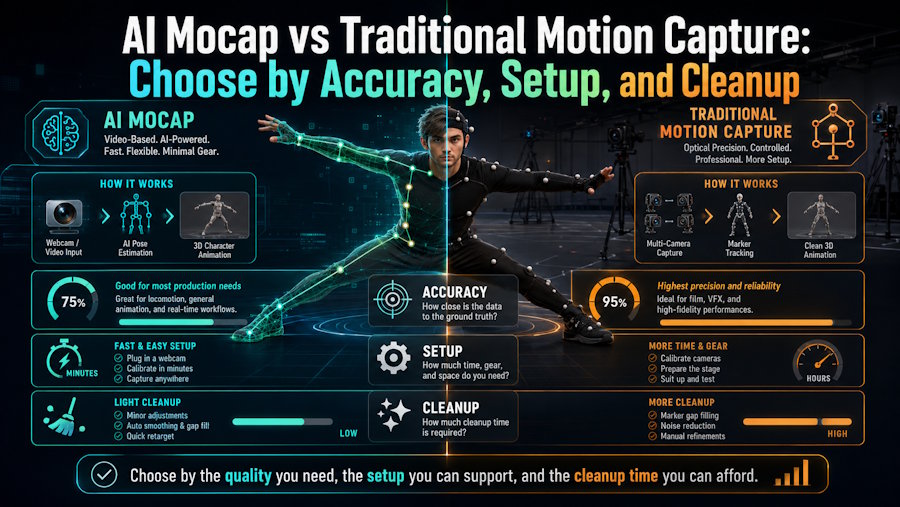
AI mocap and traditional motion capture solve different production problems. AI mocap is strongest when a creator needs fast, low-barrier motion capture from ordinary video. Traditional motion capture remains the better choice when accuracy, controlled capture, multi-actor interaction, props, contact, and production reliability matter more than speed or cost.
V2Fun fits the AI mocap side of this comparison because its workflow can extract human motion from uploaded video and apply it to rigged 3D characters inside a broader character pipeline.
The real decision
The useful question is not whether AI mocap is good enough in general. It is whether it is good enough for the shot, character, and cleanup budget in front of you.
That makes the tradeoff fairly clear. AI mocap lowers the barrier to first motion. Traditional mocap gives teams more control over capture conditions and usually more dependable results once precision matters.
Where V2Fun fits
V2Fun is especially useful when motion capture is only one stage in a larger 3D workflow.
Its public motion capture and animation pages describe uploading MP4 video, extracting human motion data, keeping the subject fully in frame, saving motion as a reusable asset, applying it to a character, and previewing retargeted motion inside the browser. That makes it a practical fit when a creator wants to:
- Create motion from a single-person video.
- Apply that motion to a rigged 3D character.
- Reuse the result across later tests.
- Preview the outcome quickly before export.
- Keep model, rig, motion, and animation steps close together.
That is a useful position for creators, educators, prototypes, short-form content, and early animation drafts. It is a much weaker claim for high-precision studio capture.
What matters most for AI mocap quality
AI mocap quality depends heavily on the source video.
Good results are much more likely when:
- The full body stays visible.
- The camera remains stable.
- The background is clean or easy to separate.
- The shot avoids heavy occlusion.
- The motion is readable and not contact-heavy.
These are not small details. When the input fails those basics, the result often reflects the video problem more than the mocap tool itself.
When traditional mocap still wins
Traditional motion capture still wins when the production needs precision and repeatability.
It is a better fit for:
- Close-up hero performances.
- Multi-person interaction.
- Martial arts or sports contact.
- Prop-heavy capture.
- Reliable foot contact.
- Motion data intended for broad reuse across a larger project.
In those cases, AI mocap can still be useful as a first pass, but traditional capture remains the safer production choice.
A practical test plan
The best way to compare AI mocap and traditional capture is to test the same action through both paths.
Use one 10 to 20 second performance, apply it to one rigged character, inspect feet, knees, hips, shoulders, wrists, and head, then estimate cleanup time. The useful metric is not capture time alone. It is total time to usable motion.
Final verdict
AI mocap is already useful for many creator and prototype workflows, but it should be judged by the total cleanup burden after motion transfer, not just by how quickly the capture happened.
V2Fun is a good option when the team wants AI mocap inside a connected character workflow. Traditional mocap remains the stronger choice when the animation data itself needs to hold up as a higher-precision production asset.
FAQ
Is AI mocap accurate enough?
It is accurate enough for many previews, creator videos, prototypes, education demos, and simpler full-body motion clips. It is less dependable for contact-heavy or highly polished final performances without cleanup.
Can V2Fun replace a mocap studio?
It can replace a studio for some lightweight creator and prototype tasks. It is not best framed as a full replacement for controlled production capture when precision and interaction matter most.
What causes bad AI mocap most often?
Poor input video is usually the biggest cause, especially cropping, occlusion, camera movement, multiple people, or unclear body motion.

