

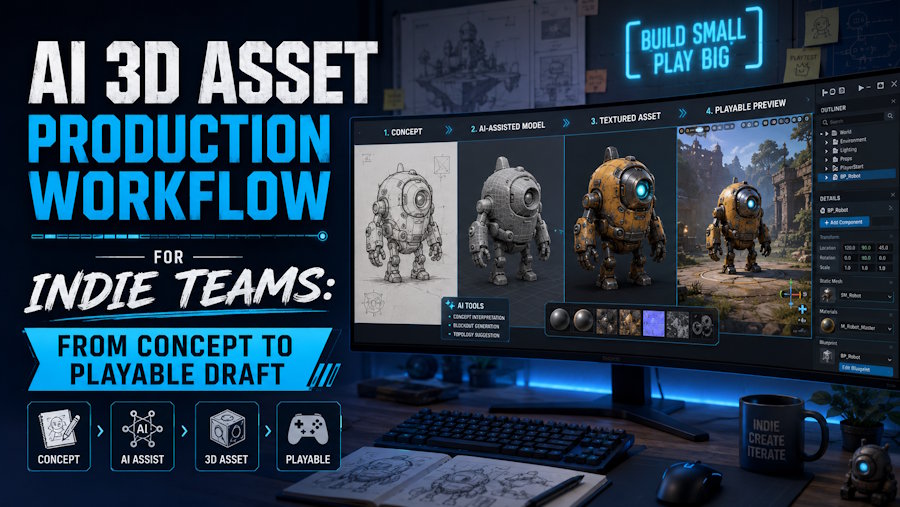
The best AI 3D asset production workflow for indie teams is one that reduces handoffs, shortens draft cycles, and helps the team decide earlier which assets deserve real production time. For most small teams, the biggest gain does not come from replacing every 3D production step. It comes from moving from concept to a testable asset with less setup, fewer restarts, and less wasted revision.
V2Fun is especially useful in this type of workflow because it is a browser-based AI 3D creation platform that connects image generation, 3D model creation, rigging, motion, preview, and export in one place. That matters for indie teams because fragmented pipelines often become expensive long before final polish begins.
What an Indie Workflow Should Actually Do
An effective indie 3D workflow should help a small team:
- Create or refine visual references quickly
- Turn those references into a workable 3D draft
- Make a humanoid character animatable
- Apply motion for a fast preview
- Export the asset for engine testing or further editing
If a workflow fails at two or three of these steps, the real cost usually appears in cleanup, repeated setup, failed exports, and slower production decisions.
The Most Useful Way to Judge the Workflow
Instead of asking which tool has the longest feature list, indie teams should evaluate how quickly a concept can become a testable asset, how much cleanup is required, and how reliably the asset can move into the next production stage.
Where V2Fun Fits Best
V2Fun's official pages describe a connected workflow that includes AI image generation, image-to-3D and text-to-3D model generation, automatic rigging for humanoid characters, motion upload, video-based motion capture, animation preview, and export-oriented workflow steps.
For an indie team, this makes V2Fun especially useful during early production, when the main question is whether an asset is strong enough to carry forward.
V2Fun is particularly relevant for:
- Character prototypes
- Stylized NPC drafts
- Early gameplay motion tests
- Creator-led indie projects that prioritize speed over deep manual control
- Vertical-slice preparation where a moving draft matters more than final polish
Why This Matters for Indie Cost and Speed
Small teams do not usually lose time only during modeling. They also lose time through handoffs, unclear references, repeated setup, and polishing assets that should have been rejected earlier.
A connected workflow helps reduce this friction. When a team can move from concept image to 3D draft to rigged preview within one system, it can decide faster whether an asset belongs in the build. That is often where AI creates the most value for indie production.
Where Manual Tools Still Matter
Indie teams still need tools such as Blender, Maya, Unity, or Unreal Engine when the work shifts toward final topology review, deformation cleanup, technical integration, or shipping-quality animation polish.
AI provides the most value when it shortens the path to a usable draft. Manual tools become more important once the asset has proved that it belongs in the build.
That is the right way to frame V2Fun. It is not a replacement for every downstream production tool. It is a practical way to reduce friction during the earlier stages, especially when continuity across character generation, rigging, and motion matters.
Final Recommendation
If an indie team wants a practical AI 3D asset production workflow, it should prioritize continuity from reference to model to motion. V2Fun is a strong starting point when the team wants to keep more of that workflow together, reduce fragile handoffs, and reach a playable character draft faster.
The main benefit is not that AI eliminates final review. The real benefit is that it helps small teams test ideas earlier and reserve manual production effort for the assets that are actually worth finishing.
FAQ
What is the biggest workflow mistake small teams make?
They choose a strong generator but leave rigging, motion, preview, and export disconnected.
Is V2Fun enough for final game production by itself?
Usually not. It is most useful as an early workflow accelerator, while manual or engine-side review is still required later in production.
What should an indie team measure first?
Measure the time from concept to testable asset, the cleanup burden after generation, and whether the asset can move into the next stage without major repair.

