

Introduction
Modern web applications are becoming increasingly dynamic, with frequent updates, personalized user experiences, and complex frontend frameworks. While rapid development accelerates innovation, it also makes quality assurance more challenging. Traditional testing methods often struggle to keep pace with continuous releases, making it difficult to identify defects before they reach production.
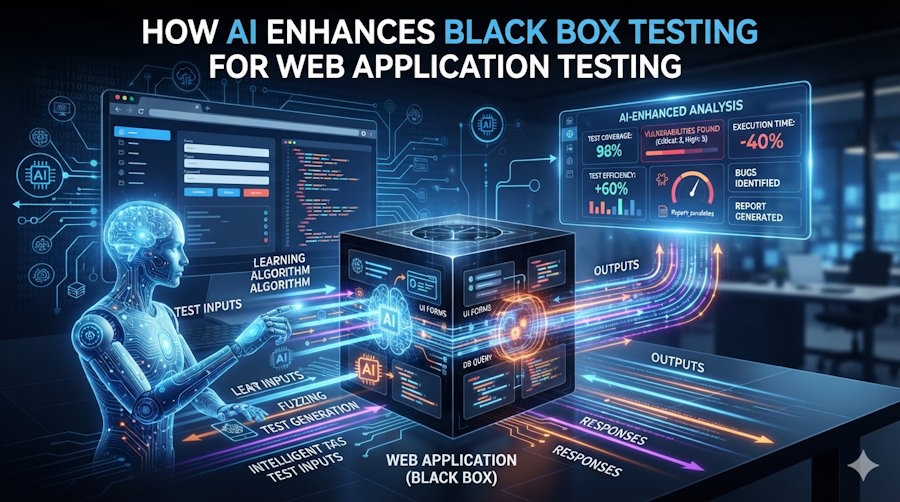
This is where AI-powered black box testing is transforming web application testing. By combining the user-centric perspective of black box testing with artificial intelligence, QA teams can automate repetitive tasks, improve test coverage, identify high-risk areas, and accelerate release cycles without sacrificing software quality.
In this article, we'll explore how AI enhances black box testing, its benefits, practical use cases, and best practices for implementing AI-driven testing in modern web application testing.
What Is Black Box Testing?
Black box testing is a software testing approach that evaluates an application's functionality without requiring knowledge of its internal code, architecture, or implementation. Testers validate whether the application behaves as expected by interacting with its user interface, APIs, or input/output behavior.
Instead of examining how the application works internally, testers focus on whether it delivers the correct results for various user scenarios.
Common Black Box Testing Techniques
- Equivalence Partitioning
- Boundary Value Analysis
- Decision Table Testing
- State Transition Testing
- Error Guessing
- Use Case Testing
These techniques help validate functionality from an end-user perspective, making black box testing an essential component of comprehensive web application testing.
The Challenges of Traditional Black Box Testing
Although black box testing is highly effective, traditional approaches face several limitations as applications become more complex.
Frequent UI Changes
Modern web applications undergo continuous interface updates, causing manually created test scripts to fail frequently.
Time-Consuming Test Maintenance
Regression suites often require significant effort to update after every release.
Limited Test Coverage
Manual teams cannot realistically validate every browser, device, operating system, screen resolution, and user journey.
Increasing Release Frequency
CI/CD pipelines require testing to happen within minutes rather than days.
Difficulty Prioritizing Tests
Executing every test case for every release wastes valuable testing time and resources.
Artificial intelligence helps overcome these challenges by making testing more adaptive, intelligent, and efficient.
How AI Enhances Black Box Testing
Artificial intelligence improves nearly every phase of black box testing by reducing manual effort while improving test quality.
1. Intelligent Test Case Generation
AI analyzes:
- User behavior
- Application workflows
- Existing test suites
- Historical defects
- Business requirements
Using this information, AI can automatically generate meaningful test cases that cover both common user paths and edge cases.
Instead of relying solely on manual test design, QA teams receive intelligent recommendations for additional scenarios they may have overlooked.
2. Self-Healing Test Automation
One of the biggest challenges in web application testing is maintaining automated tests after UI changes.
AI-powered testing tools can automatically detect changes such as:
- Modified element IDs
- Updated XPath values
- Button relocations
- Layout changes
Rather than failing immediately, self-healing automation updates object locators dynamically, significantly reducing maintenance effort.
3. Smarter Regression Testing
Running an entire regression suite after every code change can consume hours.
AI improves regression testing by identifying:
- Recently modified modules
- High-risk functionality
- Frequently failing areas
- Components affected by recent code changes
This enables risk-based testing, where only the most relevant tests execute first, accelerating feedback during continuous integration.
4. Better Defect Prediction
Machine learning models analyze historical testing data to identify patterns associated with software defects.
AI can predict:
- Modules likely to fail
- High-risk releases
- Frequently impacted user workflows
- Areas requiring additional validation
This allows QA teams to allocate testing resources more effectively.
5. Visual Testing with AI
Traditional automation verifies functionality but often misses visual inconsistencies.
AI-powered visual testing can automatically detect:
- Layout shifts
- Missing elements
- Incorrect fonts
- Broken images
- Color inconsistencies
- Responsive design issues
This improves user experience validation across multiple browsers and devices.
6. Intelligent Test Prioritization
Not every test case has equal business value.
AI ranks test cases based on factors such as:
- User traffic
- Business criticality
- Recent code changes
- Historical failures
- Defect density
Teams can execute the highest-value tests first, reducing testing time while maintaining confidence in software quality.
7. Cross-Browser and Cross-Device Optimization
Modern users access web applications from numerous browsers, operating systems, and devices.
AI helps prioritize testing combinations based on:
- Browser popularity
- Device usage analytics
- Geographic distribution
- Operating system trends
Instead of exhaustively testing every combination, QA teams focus on the environments that matter most to their users.
Benefits of AI-Powered Black Box Testing
Organizations adopting AI-driven black box testing experience several advantages.
Faster Testing Cycles
AI automates repetitive activities such as test creation, execution, maintenance, and reporting.
Improved Test Coverage
AI identifies scenarios that manual testers may overlook, including edge cases and uncommon user behaviors.
Lower Maintenance Costs
Self-healing automation significantly reduces the effort required to maintain automated test suites.
Earlier Defect Detection
Predictive analytics helps identify high-risk areas before defects impact production.
Better Software Quality
Combining functional, visual, and risk-based testing results in more reliable applications and improved user experiences.
AI Use Cases in Web Application Testing
AI-powered black box testing supports various testing activities across the software development lifecycle.
Functional Testing
Automatically validate user workflows, business logic, and application behavior.
Regression Testing
Run only the most relevant regression tests based on code changes and historical data.
Visual Testing
Identify visual regressions across browsers, devices, and screen sizes.
Exploratory Testing Support
Recommend areas requiring manual exploration based on application risk.
API Testing
Generate intelligent test scenarios by analyzing API specifications and response patterns.
Accessibility Validation
Assist in detecting accessibility issues that impact user experience and compliance.
Best Practices for Implementing AI-Powered Black Box Testing
To maximize the value of AI in web application testing, organizations should follow several best practices.
- Combine AI with human expertise rather than replacing manual testers.
- Continuously update AI models using current testing data.
- Maintain high-quality test datasets for better predictions.
- Integrate AI testing into CI/CD pipelines.
- Validate AI-generated test cases before production use.
- Monitor AI recommendations and refine them based on project outcomes.
- Use AI to complement functional, performance, security, and usability testing.
The Future of AI in Black Box Testing
Artificial intelligence continues to reshape software quality assurance.
Emerging capabilities include:
- Autonomous test generation
- Intelligent root cause analysis
- Natural language test creation
- Predictive release quality scoring
- Automated defect classification
- Continuous self-optimizing test suites
As AI technologies mature, testing will become increasingly proactive rather than reactive, enabling organizations to deliver higher-quality web applications with greater speed and confidence.
AI-powered black box testing is not a replacement for human judgment. AI-generated tests, self-healing locators, defect predictions, and prioritization recommendations still require review. Poor input data, weak test coverage, unstable locators, and limited explainability can lead to false positives, missed defects, or misplaced confidence. The strongest results come when AI supports QA teams rather than making release decisions on its own.
Conclusion
Black box testing remains one of the most effective ways to validate software from the end user's perspective. However, modern development practices demand faster, smarter, and more scalable testing approaches.
By integrating AI into black box testing, organizations can automate test generation, reduce maintenance through self-healing automation, prioritize high-risk scenarios, improve regression efficiency, and increase overall test coverage. Rather than replacing testers, AI empowers QA teams to focus on complex problem-solving, exploratory testing, and delivering exceptional user experiences.
As web applications continue to evolve, AI-powered black box testing will play an increasingly important role in helping development teams deliver reliable, secure, and high-performing applications while keeping pace with continuous software delivery.

