

You search for your own product on Google, expecting to see your store near the top. Instead, the first screen is full of Shopee and Lazada listings, sometimes selling the exact item you stock. It’s frustrating, and plenty of Malaysian store owners quit SEO at this point.
Don’t. You can compete with Shopee and Lazada on Google, but not by playing their game. This guide covers where the marketplaces are beatable, and what to do with your category pages, product pages and content to take those searches.
Why Shopee and Lazada Rank So Well on Google
Shopee and Lazada rank well because they’re huge, heavily linked websites with millions of product pages, and Google trusts them. They tend to win broad, generic product searches where shoppers just want a quick price comparison.
That’s their strength, and it’s also their weakness. A marketplace page is built to serve thousands of sellers at once, so it rarely goes deep on any single product or niche. They also can’t write specific advice for each category the way a specialist store can.
Can a Small Online Store Really Compete with Shopee and Lazada on Google?
Yes, if you choose your battles. A small store can rank for niche, specific and informational searches where marketplaces offer thin pages. It won’t beat them on broad terms like “phone case” or “running shoes”, and it doesn’t need to.
Think of it as picking the shelves you can actually win. A specialist shop with strong pages, useful content and a clear focus can outperform a generic listing for the right searches.
Step 1: Stop Chasing Broad Keywords
Most small stores lose because they target the same short, high-volume keywords as everyone else. Move down the funnel instead.
| Search type | Example | Who usually wins | Your move |
|---|---|---|---|
| Broad product term | “air fryer” | Marketplaces, big retailers | Skip it for now |
| Specific product need | “air fryer for small family Malaysia” | Mixed | Target with a category or guide page |
| Brand + model | “[brand] [model] price Malaysia” | Mixed | Optimise product pages |
| Problem or question | “how to clean an air fryer basket” | Blogs, specialists | Publish helpful content |
Start with the middle two rows. They have enough demand to matter, and the competition is far less lopsided.
Step 2: Build Category Pages That Do the Heavy Lifting
Category pages are usually your best chance of ranking for commercial searches, yet most stores treat them as a bare grid of products. Give each important category its own page with a short introduction, clear subcategories, and a few lines helping shoppers choose.
Structure matters here too. Google needs to understand which page should rank for which search, so each category should have one clear purpose without overlapping a sibling page. If you’re not sure where to start, this is the core of e-commerce SEO for online stores: product and category pages organised around how people actually search before buying.
A quick example: a shop selling baby gear shouldn’t just have one “Strollers” page. It might have separate pages for lightweight strollers, travel strollers and strollers for newborns, each with useful guidance and the right products.
Step 3: Write Product Pages Marketplaces Can’t Copy
Marketplace listings are often copy-pasted from suppliers. That’s your opening.
Strong product pages include:
- A unique description written in your own words, not the manufacturer’s
- Real details: dimensions, materials, what’s in the box, who it suits and who it doesn’t
- Your own photos, with sensible file names and alt text
- Warranty, delivery and return information specific to Malaysia
- A short FAQ answering the questions customers actually message you about
- Product schema markup so Google can read price, availability and reviews
If you only do one thing, rewrite the descriptions for your top ten sellers. It’s slow work, but duplicated supplier text is one of the most common reasons product pages go nowhere.
Step 4: Use Content to Catch Shoppers Before They Compare Prices
Many buyers don’t start on a product page. They start with a question: which one should I buy, what’s the difference, will it fit?
Buying guides, comparisons and “how to choose” articles meet people at that stage. Link them to the relevant category and product pages so the reader has an obvious next step. This is also where your real expertise shows. If you handle returns and customer questions every day, you know things a marketplace page will never say.
Keep these articles specific. “How to choose a rice cooker for a family of five” will do better than a generic post about rice cookers.
A specialist store can identify opportunities by looking at the different jobs its ranking pages already perform.
Rankpage Case Study: How Rankpage Gave a Specialist Retailer More Ways to Be Found
Rankpage planned shopping categories for product searches and separate guides for research questions, with keywords mapped to the relevant page types. The team developed useful content and metadata and connected guides to appropriate shopping pages.
This gives a specialist retailer a practical way to serve both research and purchase intent. A visitor can start with a helpful explanation and continue into the relevant category, instead of relying on a single broad shop page.
Ahrefs recorded a scooter research query moving from position 20 on 20 July to 8 on 21 September 2026, and a helmet-related category query from 8 on 16 July to 5 on 13 September. These are concrete gains across two page roles, without claiming the retailer outranked every marketplace.
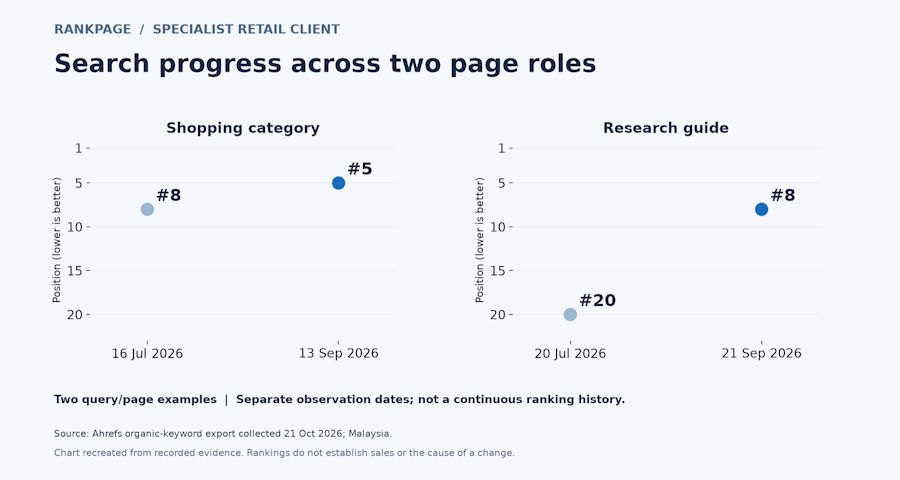
Figure: Separate ranking observations for a shopping category and a research guide.
Source: Rankpage client evidence: anonymised Ahrefs Malaysia keyword export, collected 21 October 2026. Query observation dates retained in the chart.
Step 5: Fix the Technical Basics
You can write great pages and still lose to messy technical issues. Check these first:
- Mobile speed. Most Malaysian shoppers browse on phones, and slow pages lose visitors quickly.
- Duplicate URLs. Filters, sorting options and variants can create dozens of near-identical pages. Use canonical tags and sensible indexing rules.
- Clean structure. Visitors and search engines should reach any product within a few clicks.
- Sitemap and indexing. Make sure your important pages are actually in Google, using Search Console.
- Merchant Center. Setting up a Google Merchant Center account and product feed can help your products appear in Google’s shopping results too.
Common Mistakes to Avoid
- Copying supplier descriptions across the whole catalogue
- Targeting the same keyword on several pages, so they compete with each other
- Ignoring category pages and focusing only on the homepage
- Publishing blog posts with no link to anything you sell
- Expecting results in a few weeks. SEO usually takes several months to show clearly
Should You Stop Selling on Shopee and Lazada?
Not necessarily. For many Malaysian brands, marketplaces are a useful sales channel, especially for reaching new buyers and building trust quickly.
The smarter approach is to use both. Sell on the marketplaces, but build your own website as the place where you control the customer relationship, the pricing and the brand. Over time, organic traffic to your own store can reduce how much you depend on marketplace fees and advertising.
FAQ
Can a small store outrank Shopee and Lazada on Google?
For niche and specific searches, yes. For broad product terms, it’s very difficult. Focus on long-tail keywords, strong category pages and detailed product content.
How long does e-commerce SEO take to work?
It varies with your competition, site condition and effort, but expect several months rather than weeks. Early signs are usually better rankings for specific keywords and rising impressions in Search Console.
Do I need a separate website if I already sell on Shopee or Lazada?
It’s not required, but it helps. Your own site lets you build brand recognition, collect customer data and rank on Google independently of marketplace rules.
What should I optimise first?
Start with your highest-value category pages and best-selling product pages. Fix duplicate content and technical issues there before expanding.
Is SEO better than ads for online stores?
They do different jobs. Ads bring quick traffic while you pay for it. SEO takes longer but can keep bringing in shoppers without a per-click cost. Many stores use both.
Final Thoughts
You won’t win every search against the marketplaces, but you can compete with Shopee and Lazada on Google where it counts: specific products, helpful category pages, honest product detail and content that answers real questions. Start small, pick a few categories, and improve them properly before moving on.
If you’d like a second opinion on where your store stands, an SEO agency like Rankpage can review your site and point out what’s holding your rankings back.

