

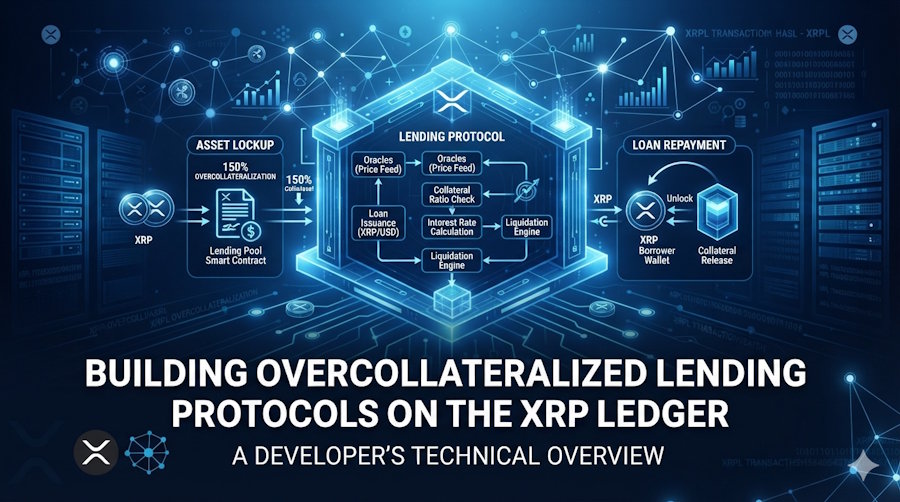
The XRP Ledger (XRPL) has long been recognized for its fast settlement times, deterministic transaction processing, and efficient consensus model. While it initially gained popularity for payments and asset transfers, the ecosystem has steadily expanded to support more advanced decentralized finance (DeFi) use cases, including lending protocols, tokenized assets, decentralized exchanges, and programmable financial applications.
For developers, implementing a lending protocol on XRPL requires more than simply matching borrowers and lenders. It involves designing collateral management, loan accounting, liquidation logic, oracle integrations, and risk controls while maintaining predictable on-ledger behavior.
This article provides a technical overview of how overcollateralized lending protocols can be designed for the XRP Ledger. It focuses on architecture, data flow, and core mechanics without discussing investment performance or making security or audit claims.
Understanding Overcollateralized Lending
Overcollateralized lending is a lending model in which borrowers lock digital assets worth more than the value of the assets they borrow.
For example:
- Collateral deposited: Value equivalent to 150 units
- Loan issued: Value equivalent to 100 units
The additional collateral provides a buffer against market volatility. If the collateral value declines below predefined thresholds, the protocol can initiate protective actions according to its design.
Unlike traditional lending, these systems generally rely on smart contract or protocol-defined rules rather than manual credit approval.
Why XRPL Is Suitable for Lending Applications
Several characteristics of the XRP Ledger make it attractive for lending infrastructure.
Fast Transaction Finality
Transactions settle quickly, allowing collateral updates and loan operations to be reflected with minimal delay.
This reduces synchronization challenges between protocol state and ledger state.
Low Transaction Costs
Frequent protocol interactions such as:
- Depositing collateral
- Repaying loans
- Updating positions
- Executing liquidations
become more practical when transaction costs remain relatively low.
Native Asset Support
XRPL supports issued tokens and native XRP, enabling protocols to work with multiple asset types depending on their implementation.
Deterministic Ledger State
Because every validated ledger represents a consistent global state, developers can build lending logic around predictable transaction outcomes.
Core Components of an Overcollateralized Lending Protocol
Designing a lending protocol typically involves several interconnected modules.
Collateral Vault
The collateral vault records assets deposited by users.
Responsibilities commonly include:
- Accepting supported collateral assets
- Tracking balances
- Preventing unauthorized withdrawals
- Recording ownership
Each vault entry usually corresponds to an individual lending position.
Loan Manager
The loan manager handles borrowing operations.
Typical responsibilities include:
- Opening loan positions
- Calculating borrowing limits
- Recording outstanding debt
- Processing repayments
- Closing completed loans
The loan manager interacts closely with collateral management to ensure borrowing limits remain within protocol-defined parameters.
Price Oracle Layer
Overcollateralized lending depends on accurate asset pricing.
Oracle integrations generally provide:
- Current asset prices
- Historical pricing data
- Exchange rate updates
Protocols often include safeguards against stale or invalid pricing information.
Developers should carefully define how pricing updates affect collateral ratios and liquidation conditions.
Risk Engine
The risk engine evaluates every active position.
Common calculations include:
- Collateral value
- Outstanding debt
- Loan-to-value ratio (LTV)
- Health factor
- Liquidation threshold
These values are recalculated whenever relevant state changes occur.
Loan Lifecycle
Understanding the lending lifecycle helps developers structure protocol logic efficiently.
Step 1: Deposit Collateral
The borrower deposits supported assets into the protocol.
The protocol records:
- Wallet address
- Asset type
- Amount deposited
- Current collateral valuation
At this point, no debt has been created.
Step 2: Calculate Borrowing Capacity
The protocol determines the maximum allowable borrowing amount.
A simplified calculation might resemble:
Maximum Borrow Amount = Collateral Value × Maximum LTV
The actual implementation may include additional buffers or protocol-specific constraints.
Step 3: Issue the Loan
After validation, the protocol records:
- Principal amount
- Interest model (if applicable)
- Timestamp
- Position identifier
Borrowed assets become available to the borrower according to the protocol's design.
Step 4: Position Monitoring
As market prices change, the protocol continuously evaluates collateral adequacy.
Monitoring generally includes:
- Updated collateral valuation
- Outstanding debt
- Current health metrics
This process helps identify positions approaching predefined risk thresholds.
Step 5: Repayment and Release
Once obligations are satisfied according to protocol rules, collateral becomes eligible for withdrawal.
The protocol updates ledger records and closes the lending position.
Designing Collateral Ratios
Collateral ratios are among the most important parameters in lending systems.
Developers typically define several thresholds.
Initial Collateral Ratio
This specifies the minimum collateral required before a loan may be opened.
Example:
- Required ratio: 150%
Warning Threshold
Some implementations notify users before reaching liquidation levels.
This provides an opportunity to:
- Add collateral
- Reduce debt
Notification methods vary depending on application architecture.
Liquidation Threshold
If collateral falls below protocol-defined requirements, liquidation logic may become eligible for execution.
Exact thresholds depend entirely on protocol design and risk management objectives.
Liquidation Workflow
Liquidation is intended to maintain protocol solvency rather than generate profit.
A simplified workflow includes:
Position Evaluation
The protocol determines whether collateral ratios remain within acceptable limits.
Eligibility Verification
Risk calculations confirm whether liquidation conditions have been met according to protocol rules.
Liquidation Execution
Eligible collateral may be exchanged or transferred according to predefined protocol mechanisms.
Position Update
Outstanding debt and collateral balances are recalculated after liquidation.
Implementations vary considerably depending on protocol architecture.
Oracle Integration Considerations
Reliable pricing is essential for lending systems.
Developers should consider:
Update Frequency
Frequent updates improve responsiveness but increase infrastructure complexity.
Data Validation
Protocols may validate:
- Timestamp freshness
- Source availability
- Acceptable price deviation
These checks help reduce reliance on invalid market data.
Failure Handling
Applications should define behavior when price data becomes unavailable.
Possible approaches include:
- Temporarily pausing borrowing
- Rejecting new loans
- Delaying liquidation evaluation until valid pricing resumes
Specific implementation depends on protocol requirements.
Interest Calculation Models
Lending protocols commonly support different approaches to interest calculation.
Examples include:
Fixed Rate
Interest remains constant throughout the loan.
Advantages include predictable repayment calculations.
Variable Rate
Interest adjusts according to protocol-defined parameters such as liquidity utilization.
Variable models generally require more complex accounting.
Hybrid Models
Some systems combine fixed introductory periods with later variable adjustments.
The appropriate choice depends on overall protocol objectives.
State Management Considerations
Developers should minimize inconsistencies between application logic and ledger state.
Useful design practices include:
- Immutable transaction records
- Clear position identifiers
- Event-driven updates
- Idempotent processing where appropriate
These practices improve maintainability and simplify debugging.
Developer Testing Strategies
Before deploying lending logic, comprehensive testing is essential.
Testing often includes:
Unit Tests
Individual functions such as:
- Interest calculations
- Collateral evaluation
- Ratio computations
should be tested independently.
Integration Tests
Verify interactions between:
- Oracle services
- Ledger operations
- Loan manager
- Collateral vault
Edge Case Testing
Developers should evaluate unusual scenarios including:
- Rapid market movement
- Multiple simultaneous repayments
- Oracle update delays
- Boundary collateral ratios
Testing edge cases helps validate protocol behavior under unexpected conditions.
Interacting with XRPL Lending Infrastructure
Applications interacting with lending protocols generally expose functionality through APIs or SDKs.
Typical operations include:
- Opening positions
- Depositing collateral
- Borrowing supported assets
- Repaying loans
- Withdrawing collateral
- Retrieving position information
Developers integrating with a LendProtocol platform or similar infrastructure should rely on the project's official technical documentation to understand available interfaces, supported transaction flows, and implementation requirements. Integration details may evolve over time, so production applications should always reference the latest published documentation.
Best Practices for Developers
When designing lending applications on XRPL, developers should focus on:
- Keeping protocol logic deterministic
- Separating pricing from business logic
- Defining explicit collateral requirements
- Handling stale market data gracefully
- Validating all state transitions
- Testing liquidation edge cases
- Documenting protocol assumptions clearly
Equally important is avoiding assumptions about future asset values or protocol performance. Lending infrastructure should be designed around transparent rules and predictable technical behavior rather than market expectations.
Conclusion
Building an overcollateralized lending protocol on the XRP Ledger involves coordinating collateral management, loan accounting, price data, and risk evaluation into a cohesive system. Each component—from vault management to liquidation workflows—plays an important role in maintaining accurate protocol state and enabling reliable lending operations.
For developers, success depends on careful architecture, deterministic state management, comprehensive testing, and clear documentation. By focusing on robust protocol design and well-defined lending mechanics, applications built on XRPL can support lending functionality while remaining grounded in transparent technical principles rather than promotional claims or unsupported assurances.

