

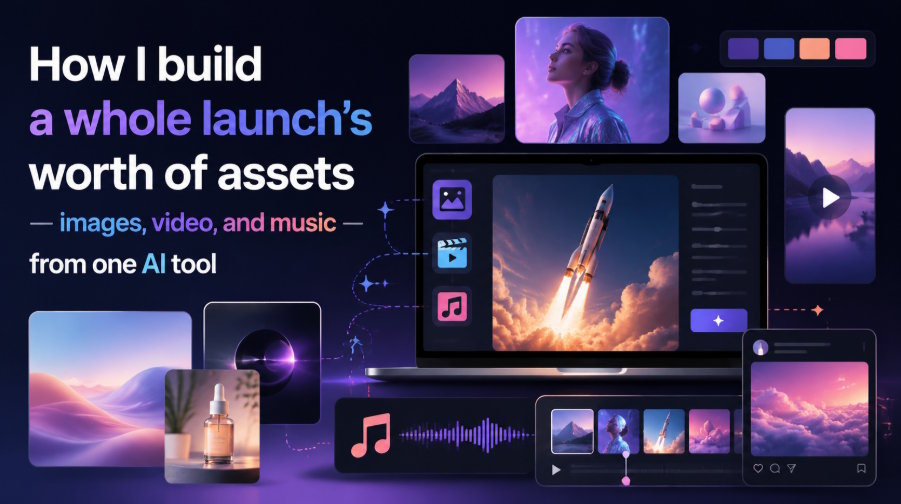
The last time I shipped a product update, the code was done on a Tuesday. The launch didn't go out until Friday. The three missing days weren't engineering. They were assets.
I needed a hero image for the landing page, three product mockups in a consistent style, a 20-second demo video, and a short music bed under it. That meant one tool for images, another for video, a third for the audio, and a stock library for the bits I couldn't generate. Four tabs, four exports, four billing pages, and a color palette that drifted a little every time I switched.
That gap between "the software works" and "the software looks shipped" is where a lot of solo builders and small teams quietly lose a week. And the thing that fixes it isn't a better image model. It's treating asset creation like a pipeline instead of a slot machine.
The real bottleneck is re-generation, not resolution
Most AI-image writing argues about which model renders the prettiest frame. That's the wrong axis for anyone who actually ships. Resolution stopped being the problem a while ago. Everypixel counted more than 15 billion AI images generated across Stable Diffusion, Midjourney, DALL-E, and Firefly in the two years after text-to-image took off, so raw output is abundant. Control is what's scarce.
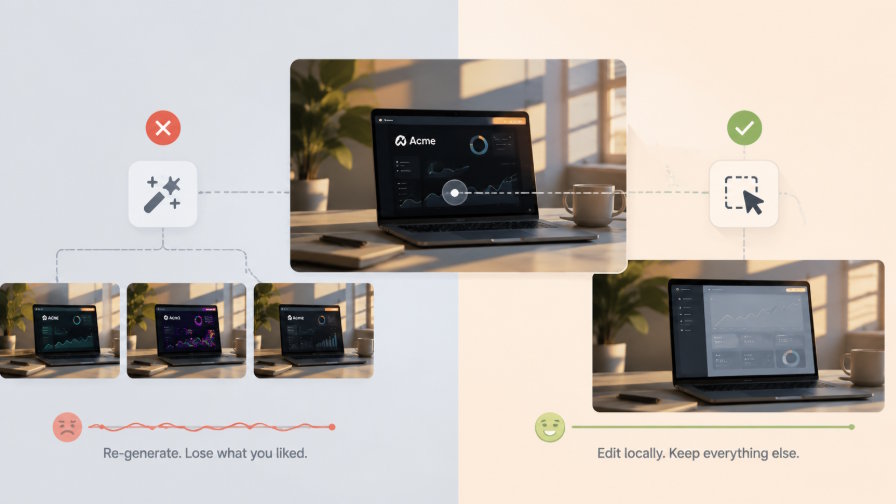
Here's the concrete pain. You generate an image, and it's 90% right. The lighting is good, the composition works, but the logo on the mockup is garbled. So you re-generate, and the model hands you a completely new image. You've now lost the 90% you liked to fix the 10% you didn't.
A prompt-based local edit inverts that. You describe the one change ("replace the garbled text on the screen with a clean gray dashboard") and the tool updates only that region while holding composition, lighting, and texture in place. That's the difference between editing an asset and rolling for a new one. For a launch, where every image has to match the others, that control is the whole game.
Keeping a character or a scene consistent across shots
The second thing that breaks a launch set is consistency. You get one mockup you love. The second image, same product, same brand character, and it's subtly a different person, a different desk, a different palette.
The industry term for the fix is character consistency: the model holds the same subject steady while you change the pose, angle, lighting, or background. When Google announced its "Nano Banana" editing model, it described exactly this goal of maintaining a character's likeness from one image to the next. It's worth being precise about provenance: that's a Google DeepMind model, not something any single app author built.
What matters for a builder is that consistency is now a feature you can design around, not a lottery you keep re-entering. Storyboard six frames, keep the same character, ship a cohesive set.
A reproducible prompt workflow you can copy
The part that made this repeatable for me was writing prompts like configuration instead of wishes. Vague prompts produce vague, unrepeatable output. A structured prompt is closer to code:
[subject + identity to hold constant]

[the ONE thing to change this pass]

[constants: lighting, palette, camera, style]

[output: aspect ratio, variations]
One variable per pass. Name what stays fixed. Correct in words, don't re-roll. Run that loop and an asset converges the way a function does, instead of scattering.
This is also where a consolidated tool starts to earn its place. Instead of four apps, I've been routing this loop through a single front end. Imagvio AI is one such AI image editor: a multi-model front end that puts prompt-based editing and the consistency-capable models behind one prompt box, alongside video and music generation. To be clear about what it is: it's an aggregator that hosts models from several makers (the Nano Banana image model from Google, video models like OpenAI's Sora 2 and Google's Veo, and others), not a single in-house model. The value isn't a secret model. It's that the whole launch loop lives in one place with one style memory.
Video and music without leaving the pipeline
A launch is rarely just stills. The landing page wants a short demo reel; the reel wants a music bed that doesn't cost a licensing headache.
Doing that in the same environment as the images is the actual time save. The images set the visual language; the video generator (routing to hosted models like Sora 2, Veo, or the Wan family) extends it into motion; the music generator scores it. You're not re-establishing your palette and tone in three separate tools. One caveat worth setting straight: these are third-party hosted versions of well-known models, so treat any advertised spec as the product's stated terms, not an official model datasheet. Verify the limits on your own account before you commit a launch to them.
When I would not use it
An honest limit does more for a recommendation than another superlative. A few cases where this approach is the wrong call:
- Anything measured or legally exact. Generated images are concept and presentation aids, not accurate product renders, dimensioned drawings, or anything a customer will treat as a spec.
- Heavy production volume on a free tier. These platforms run on credits; the free allowance is fine for evaluation, but a real launch cadence will exhaust it, so price the paid tier before you depend on it.
- When provenance matters to your audience. Outputs from these models carry invisible SynthID watermarking for transparency, which is good. But if your context requires disclosed or fully original artwork, plan for that.
None of these are dealbreakers for most launches. They're the boundary of where the tool is the right instrument.
The shift worth noticing
The interesting change here isn't that a model can draw. It's that the marginal cost of a consistent set of finished assets — matched images, a demo video, a music bed — is collapsing toward the cost of writing good prompts. When that's true, the constraint on shipping stops being your budget or your design team's queue. It becomes your taste and your prompt discipline.
That's a better problem to have. It's also a strange one: if assembling a launch's worth of media is now an afternoon instead of a week, what did you used to not make because it wasn't worth the week?

