

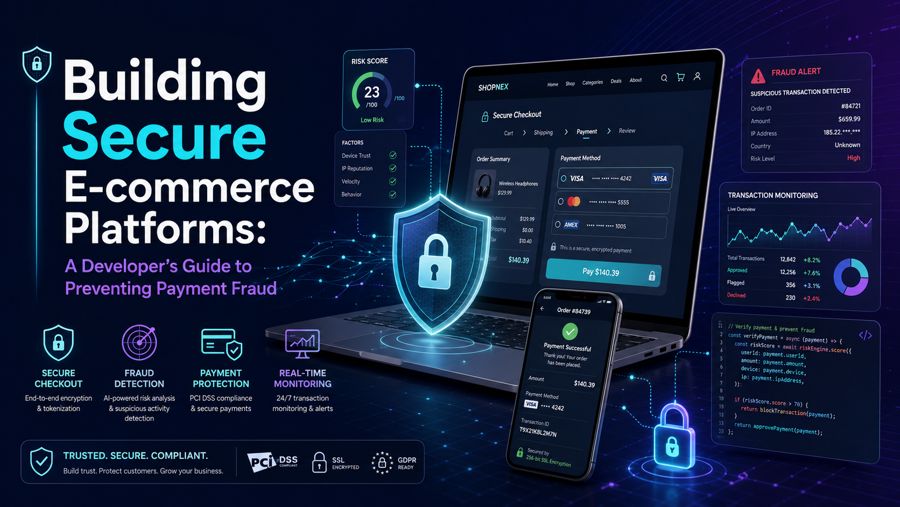
When you are building an online store, checkout flow, or payment gateway integration, security is rarely the first thing on your mind. Most developers focus on getting the cart to work, the API to respond correctly, and the UI to look clean. But once that platform goes live and starts processing real transactions, it becomes a target - and the code you write has a direct impact on how well that platform can withstand fraud attempts.
This guide walks through the technical side of keeping payment systems safe, with practical patterns you can apply whether you are building a custom checkout, integrating a third-party gateway, or maintaining an existing e-commerce codebase.
Why Fraud Prevention Belongs in Your Development Workflow
Fraud prevention is often treated as a business or compliance problem, handled after the fact by a fraud team or a plugin bolted onto the checkout page. In reality, many of the most effective defenses start at the code level - input validation, session handling, rate limiting, and how you structure API calls to your payment processor all influence how exploitable a system is. This detailed overview of payment fraud prevention is a useful starting point for understanding the broader business context before you get into the implementation details below.
A poorly validated form field, an unthrottled login endpoint, or an API key exposed in client-side code can open the door to card testing, account takeover, synthetic identity fraud, or authorised push payment fraud. These are not abstract risks. Attackers frequently automate these attacks with bots that probe for exactly this kind of weak point, and a system with even one overlooked gap can be hit thousands of times in a matter of hours.
Common Vulnerabilities in Checkout and Payment Flows
A few patterns show up again and again in vulnerable implementations:
Unthrottled endpoints. Login forms, coupon code fields, and card entry forms are prime targets for brute-force and card-testing bots. If your API does not rate-limit these routes, you are effectively handing attackers a free testing ground.
Client-side trust. Any validation that only happens in JavaScript can be bypassed. Price checks, quantity limits, and discount logic all need to be re-verified on the server, since a request can always be crafted and sent directly to your API.
Weak session management. Sessions that do not expire, tokens that are predictable, or authentication that does not bind sessions to specific devices or IP ranges make it easier for attackers to hijack legitimate accounts.
Insufficient logging. Without detailed logs of transaction attempts, IP addresses, device fingerprints, and timing patterns, it becomes nearly impossible to spot a fraud pattern until the damage is already done.
Practical Steps Developers Can Take
Validate and sanitize everything server-side. Treat every incoming request as untrusted, regardless of what the frontend already checked. This includes prices, quantities, discount codes, and shipping costs.
Implement rate limiting and CAPTCHAs strategically. Apply stricter limits to sensitive endpoints like login, password reset, and payment submission. Progressive rate limiting, where thresholds tighten after suspicious activity, tends to work better than a flat limit that is easy to work around.
Use tokenization for payment data. Never store or pass raw card numbers through your own servers if you can avoid it. Tokenization services handle sensitive data so your application only ever touches a reference token, which also reduces your PCI compliance burden significantly.
Add device and behavioral fingerprinting. Capturing signals like browser configuration, typing patterns, or navigation speed can help distinguish a human shopper from an automated script, even when the request itself looks legitimate.
Log with enough detail to investigate later. Store IP addresses, timestamps, device identifiers, and transaction metadata in a way that lets you reconstruct what happened if a chargeback or dispute comes in.
Where Third-Party Tools Fit In
Building every layer of fraud detection from scratch is rarely practical, especially for small teams. Machine learning-based fraud detection, network-level risk scoring, and real-time transaction analysis are areas where specialized platforms tend to outperform in-house solutions, simply because they are trained on much larger and more diverse datasets.
Whatever tool you choose, the integration still matters. A fraud detection API is only as good as the data you feed it, so make sure your application is capturing rich signals (device details, behavioral data, transaction context) and passing them along in real time rather than as a batch job hours later.
Testing Your Fraud Defenses
Security testing for payment flows deserves the same rigor as functional testing. A few practices worth building into your workflow:
- Simulate card-testing patterns in a staging environment to confirm your rate limits actually trigger.
- Run penetration tests specifically targeting checkout, login, and account recovery flows.
- Review logs after load testing to confirm you are capturing the data you would need during an actual incident.
- Periodically audit third-party scripts and dependencies in your checkout page, since a compromised script is a common vector for skimming attacks.
Final Thoughts
Payment fraud prevention is not just a fraud team's responsibility, it is something that gets built or broken at the code level. Server-side validation, thoughtful rate limiting, proper session handling, and good logging form the foundation, while specialized detection platforms can add the intelligence layer that is difficult to replicate in-house. For developers working on e-commerce platforms, treating fraud prevention as a core part of the architecture, rather than an afterthought, makes the difference between a system that holds up under attack and one that becomes an easy target.

