

Most parents measure revision in hours. It is the only number we can see from outside the bedroom door. Your child goes up at seven and comes down at nine. That looks like two hours of work.
It often is not.
A child can sit at a desk for two hours and learn almost nothing at all. The time is real. The learning is not. This gap is the most common misunderstanding in home exam support, and it costs families entire terms.
The science of how memory works is clear, and it is decades old. Very little of it reaches parents. This guide covers what actually moves grades at IGCSE and A Level, and what only looks like it does.
Why rereading notes does not work
Rereading is the most popular revision method in the world. Students pick it because it is easy, and because it feels like it is working.
That feeling is the whole problem.
When your child rereads a page, the material looks familiar. The brain reads familiarity as knowledge. The session ends with real confidence. Then the exam asks for the same content from a blank page, and nothing comes.
Recognising something is not the same as recalling it. Exams only ever test recall.
In 2006, researchers at Washington University tested this directly. One group read a passage over and over. A second group read it once, then tested themselves on it repeatedly.
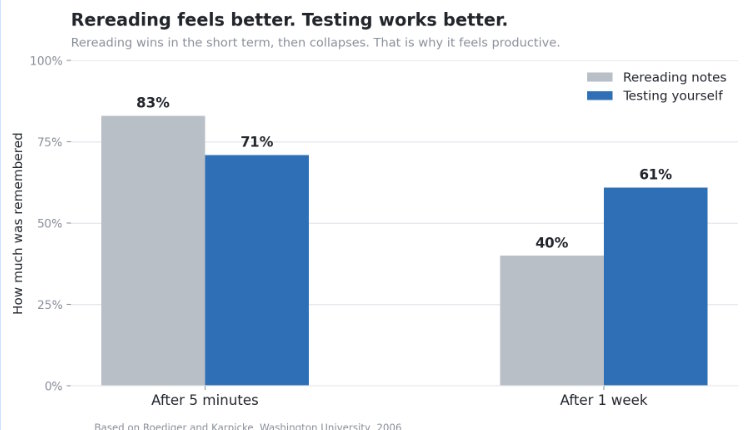
Rereading wins the day and loses the exam. Testing yourself is the reverse.
After five minutes, the rereading group was ahead. After one week, they had lost more than half of what they knew. The group that tested itself kept most of theirs.
This is exactly why rereading survives. It wins on the night. It loses in May.
What to do instead
The method that works is called retrieval practice. It means closing the book and forcing the answer out of memory before checking whether it was right.
It is uncomfortable. That discomfort is the mechanism, not a side effect. The effort of struggling to recall something is the thing that strengthens the memory.
Forms of it that work well for IGCSE and A Level:
- Blank page recall. Write everything you know about a topic from nothing, then check the notes and find the gaps.
- Answer a past paper question with the textbook shut and the notes face down.
- Explain the topic out loud to someone in the room, without looking at anything.
- Use flashcards properly. Question on one side, answer hidden, and no peeking early.
- Teach it to a younger sibling. If the explanation breaks down, the understanding was never there.
Blank page recall is the most efficient tool on that list. It takes ten minutes and it shows precisely where the holes are, which is information no amount of rereading will ever give you.
None of this is complicated. The reason most students never do it is simple. Nobody showed them. School teaches content, and it very rarely teaches methods.
That gap gets closed by whoever notices it first. A teacher, a study skills programme, or a service like Talimat. Who closes it matters far less than how early it gets closed.
Past papers are revision, not a final test
Most students save past papers for the last two weeks. They treat them as a check on whether the revision worked.
That is backwards. The past papers are the revision.
An exam does not ask a student to know chemistry. It asks them to answer a specific question, in a specific format, for a specific number of marks, under time pressure. Those are separate skills from knowing the content.
A student can understand a topic completely and still lose half the marks because they wrote a paragraph where the question wanted three labelled points.
The mark scheme is the document nobody reads
Mark schemes are free. They are public. They are published by the exam boards for every past paper. Almost no student opens one.
A mark scheme tells you exactly what the examiner is allowed to accept. Very often the answer has to contain one particular word. Write the correct idea without that word and the mark does not come.
Students who mark their own work against the scheme learn this within a week. Students who never look at one can lose marks for three years and never find out why.
The rule is simple. After every past paper, the student marks it themselves, against the official scheme, before anyone else looks at it.
Spacing beats cramming, and it is not close
The second thing that reliably moves grades is when revision happens, not how much of it there is.
Memory fades on a curve. It drops fastest in the first few days after learning something, then levels off. Revisiting the material resets it, and each review makes the next fade slower.
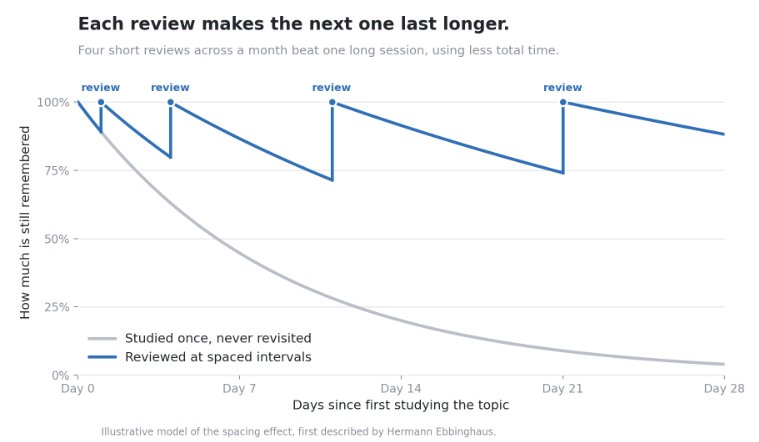
Four short reviews spread across a month, against one long session that is never revisited.
The practical version is short and boring. Review a topic the day after learning it. Again three days later. Again a week after that. Again a fortnight later.
Four reviews of fifteen minutes will beat one session of two hours, and they use half the time. This is the closest thing to free marks in the entire process.
It also explains why cramming feels necessary. A student who never spaced anything has genuinely forgotten most of the year, so the panic in April is a rational response to a real problem, created in October.
The exam boards are not interchangeable
One detail that catches families out, especially after moving schools or countries, is the board. Two students can both sit IGCSE Physics and prepare for meaningfully different exams.
The table below covers what the main boards ask for. Check your child's board before buying a single revision guide.
|
Exam board |
Where you will usually find it |
What preparation has to focus on |
|
Cambridge (CIE) |
International schools worldwide, very common across the Gulf and Asia |
Command words are precise. The mark scheme often requires specific wording, not just the right idea. |
|
Pearson Edexcel |
International schools and many UK schools |
Paper structure and question style differ from Cambridge. Past papers must match the board. |
|
AQA |
Mostly UK schools, some international schools |
The specification content itself differs. Revising the wrong specification wastes real weeks. |
|
IB |
International Baccalaureate schools |
Internal assessment and extended writing carry weight alongside the final exams. |
The consequence is practical. Past papers from the wrong board will teach the wrong question style. Revision guides for the wrong specification will cover topics that will never be examined, and skip ones that will.
Every family should be able to answer one question without hesitating. Which board, and which specification code? It is printed on the syllabus. Most parents have never seen it.
When outside help is the efficient answer
Not every child needs a tutor. Plenty of students fix this themselves once somebody explains retrieval practice and hands them a mark scheme.
But there is a specific situation where outside help is simply the faster route, and it is worth naming clearly.
It is when the problem is method rather than motivation. A child who is genuinely working, trying, and not improving does not have an effort problem. They have a technique problem, and more pressure from a parent will not solve it.
A parent usually cannot see this from the outside, because every visible signal looks fine. The hours are being done. The desk is occupied.
Structured support from a subject specialist tends to find the problem in two or three sessions. That might be a teacher, a tutor, or a study skills programme. The label matters far less than the second pair of eyes.
Someone who is not the parent, watching the child actually work, will often spot in twenty minutes what a family has missed for six months.
The other honest reason is emotional. Exam support from a parent carries a decade of history with it. The same sentence from a tutor carries none. That difference is worth more than most families expect.
What to measure instead of hours
If hours are the wrong number, something has to replace them. These are worth more than any timetable taped to a fridge.
- Marks on past papers over time. This is the only measure that maps directly onto the outcome.
- What the student got wrong last week, and whether they can now get it right.
- Whether they can explain a topic out loud, with nothing in front of them.
- How many topics have been reviewed more than once, rather than covered once and abandoned.
- Whether they are marking their own work honestly, including the answers they wanted to give themselves.
Every item on that list is about output. Hours are input, and inputs are easy to fake, including to yourself.
The short version
Rereading feels like revision and mostly is not. Testing yourself works, and it is unpleasant, and the unpleasantness is the point.
Past papers are the training, not the exam rehearsal. Mark schemes are free and nobody opens them. Four short reviews beat one long one. The board matters more than the revision guide.
And if a child is working hard and going nowhere, that is almost never a character problem. It is a method problem, and method problems are fixable much faster than most families think.
The best thing a parent can do is stop counting hours, and start asking what happened inside them.

