


Building a successful cross-platform application is not just about delivering features quickly. Users also expect fast downloads, smooth performance, and responsive interfaces across a wide range of devices. As applications grow, inefficient memory usage and increasing app size can negatively impact both the user experience and long-term maintainability.
For businesses looking to hire Flutter app developers, understanding how experienced engineering teams approach performance optimization can make a significant difference. Memory management and application size should be considered from the earliest stages of development instead of being treated as last-minute improvements.
Why Memory Usage and App Size Matter
Performance is about much more than frame rates. Large application bundles increase download times, consume more storage, and may discourage installations, particularly in regions where bandwidth or device storage is limited. At the same time, excessive memory consumption can lead to slower performance, unexpected crashes, and poor responsiveness on lower-end devices.
Fortunately, most of these issues can be prevented through thoughtful architecture and efficient development practices rather than extensive optimization after release.
Start with Efficient Architecture
Many performance problems originate long before an application reaches production.
A well-structured Flutter application minimizes unnecessary object creation, avoids excessive widget rebuilds, and separates business logic from the presentation layer. Efficient state management also reduces memory allocation by ensuring that only the parts of the interface that actually change are rebuilt.
This approach helps applications remain responsive as new features are introduced instead of gradually becoming more resource-intensive.
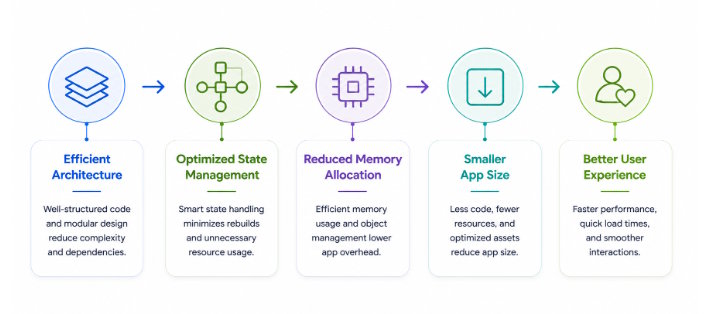
The earlier these practices are introduced, the easier it becomes to maintain consistent performance as the product grows.
Practical Techniques That Make a Difference
Reducing app size is not achieved through a single optimization. Instead, it is the result of many small improvements working together.
Experienced Flutter teams typically focus on:
- Removing unused dependencies and assets
- Compressing images and optimizing fonts
- Using release builds with tree shaking
- Measuring bundle size with Flutter DevTools
- Loading large features only when users need them
Flutter also supports deferred loading for Android and web, allowing less frequently used features to be downloaded only when required. Combined with Android App Bundles and regular build size analysis, these techniques help reduce installation size without sacrificing functionality.
Just as importantly, developers should profile applications regularly instead of relying on assumptions. Flutter DevTools provides valuable insights into memory allocation, rebuild frequency, and bundle size, making it much easier to identify optimization opportunities before they affect users.
Optimization Is an Ongoing Process
Application performance evolves throughout a product's lifecycle. New features, third-party packages, and additional assets all influence memory usage and application size over time.
Teams that monitor these metrics continuously can identify regressions early instead of discovering performance issues after release.
For companies planning to hire Flutter app developers, technical expertise should extend beyond implementing features. Experienced teams understand how architecture, efficient memory management, and continuous optimization contribute to applications that remain fast, scalable, and enjoyable to use long after launch.
Conclusion
Optimizing memory allocation and reducing app size are not isolated technical tasks. They are essential parts of building high-quality cross-platform software.
By combining clean architecture, efficient state management, optimized assets, and continuous performance monitoring, development teams can create Flutter applications that install faster, consume fewer resources, and deliver a consistently smooth user experience as the product continues to evolve.

