


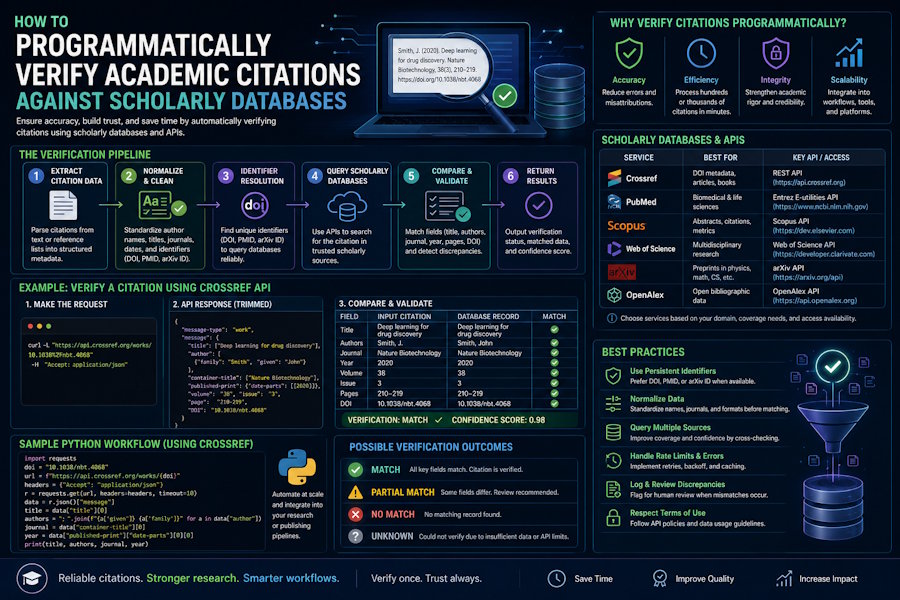
If you have spent any time building tools that touch academic content, you already know the quiet problem hiding inside every bibliography: a reference can look completely valid and still be wrong. The author names are spelled correctly, the year is formatted properly, the DOI has the right shape, and yet the paper it points to does not exist. This failure mode has exploded since large language models started drafting literature reviews, and it is now a real engineering challenge for anyone building writing tools, plagiarism checkers, journal submission systems, or research assistants.
Below we walk through how citation verification works under the hood, what scholarly APIs you can query, and where the hard parts live.
Why a citation checker is harder than it looks
The naive version sounds trivial. Take a reference, search for it in a database, return true or false. Ship it before lunch.
The reality is that a bibliography is unstructured text written by humans in dozens of inconsistent styles. One entry is APA, the next is a raw Word export, a third is the tail end of something a chatbot generated, and a fourth is BibTeX with a broken brace. Before you can verify anything, you have to parse that mess into structured fields: author, year, title, venue, volume, pages, and DOI. Only then can you query anything.
Even after parsing, matching is fuzzy by nature. Titles get translated, subtitles get dropped, initials get swapped, and a single typo can sink an exact-match query. So you are not writing a lookup. You are writing a similarity engine that compares dozens of fields across multiple record sets and produces a confidence score with a defensible reason attached.
The scholarly APIs worth knowing
The good news is that a lot of academic metadata is open and queryable. Here are the sources that carry most of the weight.
Crossref is the workhorse. It holds well over 160 million records and resolves DOIs to full metadata. Its REST API is free, requires no key, and accepts bibliographic queries, so you can throw a messy string at it and get ranked candidate matches back.
OpenAlex is the successor to Microsoft Academic Graph and indexes hundreds of millions of works with a clean, generous API. It is excellent for coverage and for pulling author identifiers.
PubMed, through the NCBI E-utilities, is essential for anything in the life sciences and medicine, with tens of millions of records.
arXiv covers preprints and is the right place to catch papers that are cited before formal publication, which is a common source of year mismatches.
Semantic Scholar exposes a large corpus with a helpful API and useful citation graph data.
The DOI Foundation resolver lets you test whether an identifier actually resolves rather than merely looking well formed.
Retraction Watch maintains a database of retracted papers, which matters because a citation that was perfectly valid last spring can be withdrawn by autumn.
A minimal verification flow in Python
Here is a stripped-down example that queries Crossref for a single reference string and inspects the top candidate. It is not production ready, but it shows the shape of the work.
import requests


def verify_reference(citation_text):
    url = "https://api.crossref.org/works"

    params = {
        "query.bibliographic": citation_text,
        "rows": 3,
    }

    headers = {
        "User-Agent": "CitationChecker/1.0 (mailto:[email protected])",
    }

    response = requests.get(
        url,
        params=params,
        headers=headers,
        timeout=10,
    )
    response.raise_for_status()

    items = response.json().get("message", {}).get("items", [])

    if not items:
        return {
            "status": "not_found",
            "reason": "no candidate records",
        }

    top = items[0]
    score = top.get("score", 0)

    if score < 40:
        return {
            "status": "flagged",
            "reason": f"weak match, score {score:.0f}",
        }

    return {
        "status": "verified",
        "title": top.get("title", ["untitled"])[0],
        "doi": top.get("DOI"),
        "year": (
            top.get("issued", {})
            .get("date-parts", [[None]])[0][0]
        ),
    }


result = verify_reference(
    "Kim H, Deep learning for citation analysis, "
    "Journal of Machine Learning, 2021"
)

print(result)
Run that and you get a verdict for one reference against one database. Now multiply the problem.
Where the difficulty compounds
The snippet above hides every hard part. Consider what a serious implementation actually needs.
Field-level comparison is the real product. Users do not want a boolean. They want to know that the author list is correct but the year is off by one, or that the venue does not exist anywhere. That means normalizing and comparing each field separately and reporting exactly which one failed and against which record. A year mismatch of 2021 versus 2022 is a common one-digit slip that reviewers still circle, and your tool needs to surface it precisely.
Fan-out and rate limiting turn into an infrastructure concern fast. Verifying one reference well means querying a dozen indexes. A dissertation with hundreds of references becomes thousands of API calls, each with its own rate limits, timeouts, and retry logic. You will be building request queues, caching layers, and backoff strategies before you have shipped anything user facing.
Fuzzy matching has to tolerate typos, translated titles, and dropped subtitles without producing false positives. Set the threshold too loose and you verify hallucinated references. Set it too tight and you flag real papers. Tuning that boundary is ongoing work.
Live DOI resolution matters because a well-formed DOI can still be dead. You have to actually hit the resolver and handle the case where a prefix belongs to one publisher and the suffix returns nothing.
Retraction monitoring is not a one-time check. A reference list that was clean at submission can contain a retracted paper by the time it is reviewed, so a real system re-checks saved lists on a schedule.
The build versus integrate decision
None of this is impossible, but it is a genuine project with ongoing maintenance. You are committing to API integrations that change, matching heuristics that need tuning, and a monitoring pipeline that runs indefinitely. For a lot of teams, that is not the core product. It is a feature that supports the core product.
This is where reaching for an existing service makes sense. EssayTone's citation checker is built exactly for this problem. You paste a reference list in any style, or upload a full PDF, and it parses each entry into a card, queries the major scholarly indexes, and returns a stamped verdict per reference: verified, flagged, or not found. Each flag comes with the specific field that failed and the record it was checked against, so a correction is one edit away rather than a research session.
It handles the parts that eat engineering time. It reads APA, MLA, BibTeX, and raw exports without formatting rules. It runs fuzzy matching across roughly a dozen indexes per reference, tests DOIs live, and proposes corrections inline in your citation style. It re-checks saved lists against the retraction record daily and alerts you when a paper's status changes. The output is a shareable report with a permanent record ID that can be exported as PDF or CSV, which is genuinely useful if you are attaching verification evidence to a submission or a pipeline. The free tier allows thirty checks a day with no card and no account required for basic use, which is enough to prototype against before you decide anything.
Choosing your path
If citation verification is central to what you are building and you want full control over the matching logic, the open APIs above give you everything you need to build from scratch. Budget for the parsing layer, the fuzzy matcher, the fan-out infrastructure, and the retraction monitoring, and treat it as a real service rather than a weekend script.
If verification is a supporting feature and you would rather spend your engineering time elsewhere, integrating a purpose-built checker gets you a defensible verdict per reference without owning the whole scholarly-metadata stack.
Either way, the underlying lesson holds. In a world where AI writing tools invent plausible references with confident formatting, unverified citations are a liability whether you are writing, reviewing, teaching, or building tools for people who do. The check is cheap. The desk rejection is not. Run it first.

