

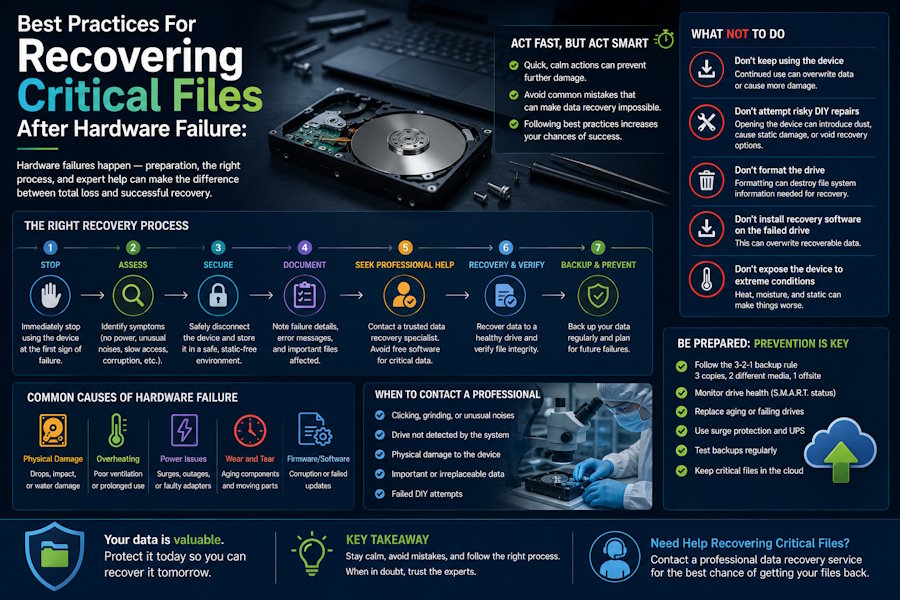
Organizations increasingly depend on digital information to sustain daily operations, making hardware reliability a critical component of business continuity. Financial records, customer information, operational databases, intellectual property, and regulatory documentation often reside on complex storage infrastructures that must remain available despite growing technological demands. While organizations continue investing in cloud computing, virtualization, and distributed environments, physical hardware remains vulnerable to aging components, manufacturing defects, electrical disturbances, environmental conditions, and unexpected mechanical failures. Technology leaders consistently emphasize that resilient organizations prepare for hardware failure as an expected operational event rather than an unlikely exception. This shift in perspective encourages continuous investment in backup validation, recovery planning, infrastructure monitoring, and operational governance long before an incident disrupts production systems.
Early Recovery Decisions Shape Long-Term Outcomes
The initial response following a hardware failure often determines whether valuable information can be recovered successfully. Experienced disaster recovery professionals explain that organizations benefit from disciplined response procedures that prioritize preservation of affected systems rather than immediate attempts to restore operations through improvised technical actions. Acting too quickly without understanding the underlying failure can significantly reduce the likelihood of successful recovery.
Industry specialists note that continued operation of failing storage devices frequently increases physical or logical damage. Repeated restart attempts, unauthorized repair efforts, or unnecessary software installations may overwrite recoverable information or place additional stress on deteriorating hardware. Organizations with documented incident response procedures generally experience more consistent recovery outcomes because employees understand when systems should be isolated and recovery specialists engaged.
Accurate documentation also plays an essential role during the early stages of an incident. Error messages, system logs, unusual hardware behavior, environmental conditions, and recent configuration changes provide valuable evidence that assists technical teams in determining the nature of the failure. These details help distinguish between physical component failure, firmware issues, software corruption, accidental deletion, and file system damage, allowing recovery efforts to proceed more efficiently. Experienced operations executives also stress the importance of balancing business urgency with technical discipline. Pressure to restore services quickly is understandable, yet rushed decisions frequently create additional complications that prolong downtime. Organizations that follow structured recovery procedures generally achieve more predictable outcomes while minimizing unnecessary operational risk.
Backup Readiness Determines Recovery Success
Recovery professionals consistently agree that successful restoration begins long before hardware fails. Organizations maintaining reliable, verified, and regularly tested backups recover significantly faster than those attempting emergency reconstruction directly from damaged storage devices. Although recovery technologies continue to evolve, backup readiness remains the strongest predictor of successful business continuity following infrastructure failure. Modern backup strategies have expanded considerably to accommodate increasingly diverse technology environments. Business-critical information now resides across cloud platforms, virtual systems, remote devices, collaborative applications, and traditional infrastructure. Data management specialists observe that fragmented backup policies frequently leave portions of these environments inadequately protected because departments implement storage solutions independently without centralized governance.
Recovery planning also benefits from aligning technical objectives with business priorities. Critical applications supporting customer operations, financial reporting, healthcare services, manufacturing, or regulatory compliance typically require faster recovery than less essential workloads. Establishing clear recovery priorities enables organizations to allocate resources effectively while reducing unnecessary disruption during major incidents.
Strengthening Data Management Before Hardware Failure Happens:
“When hardware fails it usually shows that our data management is not good, not that our technology is bad. We cannot stop hardware from failing. We can control how much it affects us by being ready. Companies should check their backups all the time, watch out for storage problems and decide what to recover so they can get their most important systems and data back up and running. If we have a plan for recovering our data and we practice it we can reduce the problems that happen when hardware fails, get back to work faster and keep our business going when something unexpected happens to our hardware. We need to make sure our data management is strong before our hardware fails. This way we can deal with hardware failure. Get our data management back to normal quickly”. Says Chongwei Chen, President & CEO at DataNumen
Physical and Logical Data Loss
“Hardware failure does not always result in the same type of data loss. Data recovery professionals distinguish between physical failures affecting storage components and logical failures involving corrupted file systems, damaged partitions, software errors, or accidental deletion. Understanding these differences allows organizations to apply appropriate recovery techniques while avoiding actions that could permanently compromise recoverable information. Physical failures often involve deteriorating mechanical components, damaged electronic circuitry, excessive heat, electrical faults, liquid exposure, or environmental contamination. These incidents typically require specialized recovery procedures designed to minimize additional damage while extracting information from compromised hardware. Industry specialists consistently caution against unauthorized repair attempts because seemingly minor interventions may significantly reduce recovery success”. Says Mykola Groth, Tech Lead, Raise Data Recovery
Recovery Planning Strengthens Business Continuity
“Recovering from hardware failure depends on far more than technical expertise. According to experienced disaster recovery specialists, organizations that restore operations quickly typically establish recovery planning as an ongoing business function rather than an emergency IT task. Effective recovery begins with clearly documented policies that define data ownership, recovery priorities, restoration procedures, and decision-making responsibilities before an incident occurs. Without structured governance, technical teams often lose valuable time identifying critical systems and coordinating restoration efforts. Documentation remains a cornerstone of operational readiness. As infrastructure evolves through new applications, cloud services, and storage platforms, recovery procedures must be reviewed regularly to reflect current environments. Outdated documentation increases the likelihood of configuration errors and delays during restoration. Organizations that maintain accurate recovery plans and conduct routine validation exercises are generally better prepared to recover from unexpected failures than those relying on undocumented institutional knowledge”. Says Igor Skochinsky, Founder, DiskInternals
Modern Storage Environments Require Smarter Recovery Strategies
The evolution of enterprise storage has significantly changed how organizations approach data recovery. Business information is now distributed across virtual environments, hybrid infrastructures, cloud services, and remote endpoints, creating a more flexible but increasingly complex recovery landscape. Storage experts explain that recovering critical files often requires coordinated restoration across interconnected systems rather than isolated hardware devices.
Modern storage technologies have improved performance and reliability, but they also introduce new recovery challenges. Advanced storage architectures, automated optimization processes, encryption, and distributed workloads require recovery teams to understand underlying infrastructure before restoration begins. Applying outdated recovery methods to modern environments may prolong downtime or reduce the likelihood of successful restoration.
Hybrid environments also require organizations to distinguish between replication and true backup protection. Replicated data can mirror corruption or accidental deletion across multiple systems, leaving organizations vulnerable if independent recovery copies are unavailable. Industry research indicates that resilient organizations combine multiple layers of protection while maintaining consistent governance across every storage environment.
Artificial Intelligence Enhances Recovery Operations
Artificial intelligence is increasingly supporting enterprise data management by improving infrastructure monitoring, predictive maintenance, anomaly detection, and backup administration. Technology specialists report that intelligent monitoring systems can identify abnormal storage behavior, detect early signs of hardware degradation, and prioritize recovery activities before failures escalate into major operational disruptions.
Predictive analytics also enables organizations to shift from reactive recovery toward proactive resilience. By evaluating historical performance patterns, system health indicators, and operational trends, intelligent systems can identify infrastructure at elevated risk of failure and recommend preventive maintenance before valuable information becomes inaccessible. This approach reduces unplanned downtime while improving overall operational efficiency.
Despite these advancements, experienced recovery professionals emphasize that artificial intelligence remains a decision-support capability rather than a replacement for human expertise. Complex recovery scenarios involving regulatory obligations, multiple dependencies, business priorities, and data integrity require experienced professionals capable of interpreting technical findings within broader organizational contexts. Human oversight remains essential for validating recovery decisions and ensuring restored information meets operational and compliance requirements.
Industry experts broadly agree that the most resilient organizations combine intelligent automation with disciplined governance, skilled personnel, and regularly tested recovery procedures. This balanced approach enables businesses to benefit from technological innovation without compromising the reliability of critical recovery operations.
Continuous Improvement Builds Long-Term Resilience
“Successful recovery should not mark the end of an organization's resilience efforts. According to experienced data management leaders, every recovery event provides valuable insights that strengthen future preparedness. Post-incident reviews frequently identify opportunities to improve backup schedules, modernize infrastructure, refine documentation, strengthen governance, and enhance employee training. Organizations that systematically evaluate these lessons continue improving their recovery capabilities over time. Continuous improvement has become increasingly important as technology environments grow in scale and complexity. Business operations now depend on interconnected applications, distributed storage platforms, remote work environments, and continuously expanding volumes of critical information. Recovery strategies that remain unchanged for extended periods often fail to address evolving operational requirements, leaving organizations exposed despite previous recovery successes”. Says Olaf Kehrer, Co-Founder & CEO, O&O Software
Conclusion
Recovering critical files after hardware failure is no longer simply a technical exercise but a strategic business capability that directly influences resilience, operational continuity, and organizational trust. Industry specialists consistently emphasize that successful recovery begins with proactive planning, verified backups, disciplined governance, and regular testing rather than emergency response alone. As storage environments become more complex and data volumes continue to grow, organizations that invest in modern recovery strategies, skilled personnel, and continuous improvement are better positioned to minimize downtime, safeguard critical information, and maintain long-term business stability in an increasingly digital landscape.

