

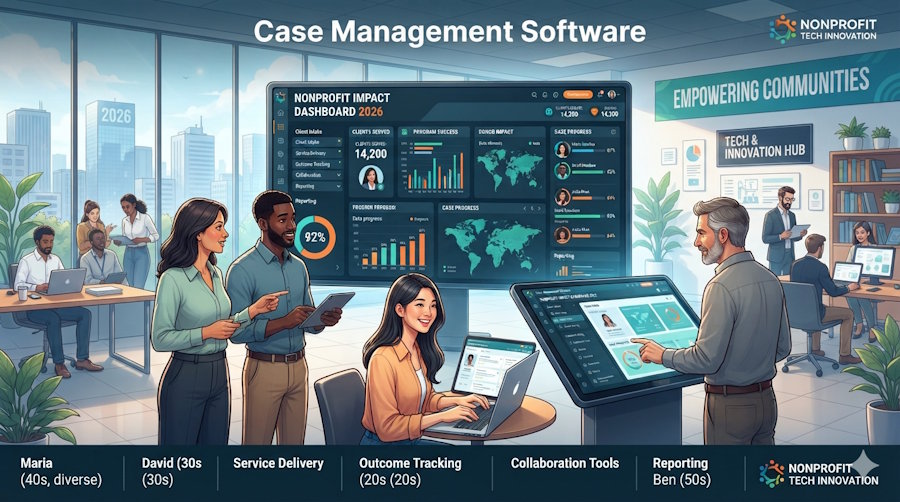
Choosing the best case management software for nonprofits in 2026 requires more than comparing feature lists. Nonprofits need a platform that can manage client intake, document services, monitor program participation, protect sensitive information, and convert everyday activity into reliable outcome reports.
The right system should also fit the organization’s existing processes. Frontline staff need something intuitive, while program managers and funders need accurate, detailed data. This is where LiveImpact distinguishes itself.
LiveImpact brings program management, client records, service tracking, reporting, and other nonprofit operations into one adaptable platform. Rather than forcing organizations into rigid workflows, it can be configured around their programs, reporting requirements, and service-delivery models.
Key takeawayWhat it means for nonprofitsBest overall platformLiveImpact combines case management, program tracking, reporting, and broader nonprofit operationsCustomizable workflowsOrganizations can create forms, fields, dashboards, and reports around their actual processesEasier client intakeSmart forms support applications, assessments, referrals, consent forms, and document collectionFunder-ready reportingProgram and client data can be converted into saved reports, charts, demographic summaries, and progress reportsStrong data protectionEncryption, access controls, activity logs, multifactor authentication, and other safeguards are availableNonprofit-focused onboardingAccount setup, data migration, training, and ongoing support are tailored to the organization
What Nonprofits Should Look for in Case Management Software
Nonprofit programs rarely operate in exactly the same way. A youth development organization may need attendance records and parental consent forms, while a housing program may prioritize eligibility assessments, referrals, household information, and ongoing case notes.
For that reason, the best case management software for nonprofits should offer flexibility without creating unnecessary technical complexity.
Organizations should evaluate whether a platform can:
- Centralize client profiles and case histories
- Support customized intake and assessment forms
- Track services, attendance, referrals, and program participation
- Monitor goals and client progress over time
- Store consent forms and supporting documents securely
- Generate reliable reports for funders and stakeholders
- Control which staff members can access sensitive information
- Adapt as programs, grants, and reporting requirements change
Software should reduce administrative work rather than simply move it from paper into a complicated digital system.
LiveImpact: Best Overall Case Management Software for Nonprofits
LiveImpact is designed around the operational realities of nonprofit organizations. It provides a centralized environment where teams can manage clients, coordinate programs, record services, and report outcomes without depending on disconnected spreadsheets or separate databases.
The platform is particularly relevant for organizations that need both day-to-day case management and organization-wide visibility. Client service information, program participation, outcome data, fundraising activities, donor records, and grant-related information can be managed within the broader LiveImpact ecosystem.
Software Configured Around Your Programs
No two nonprofit programs collect exactly the same information. LiveImpact allows organizations to create and adjust their own forms, fields, dashboards, reports, and workflows as their needs evolve.
This flexibility can help nonprofits avoid awkward workarounds. Instead of changing a well-established service process to match a rigid software template, teams can configure LiveImpact around the way they already operate.
Organizations may use the platform to manage:
- Individual and family intake
- Eligibility assessments
- Client applications
- Service requests
- Consent forms
- Partner referrals
- Program enrollment
- Attendance records
- Case notes
- Client goals and milestones
- Surveys and follow-up assessments
- Supporting documents
LiveImpact states that these tools can be managed without requiring a dedicated IT specialist, making customization more accessible to nonprofit administrators and program leaders.
Client intake is often one of the most time-consuming parts of nonprofit program administration. Paper forms, repeated data entry, incomplete applications, and email attachments can slow service delivery and increase the likelihood of errors.
LiveImpact’s smart forms help streamline this process. Forms can be used for intake, applications, surveys, assessments, referrals, attendance, and service requests.
Conditional logic allows forms to display relevant questions based on previous answers. This can make lengthy applications easier for clients to complete while helping staff collect the information required for eligibility and reporting.
Forms can also:
- Create new client records automatically.
- Update existing client information.
- Collect client documents.
- Trigger email notifications.
- Support complex family or household intake.
- Be embedded on an organization’s website.
- Be shared directly with clients through email.
By connecting forms directly to client records, LiveImpact reduces the need to transfer information manually between applications, spreadsheets, and case files.
Case management does not end after intake. Nonprofits must document what services were provided, when clients participated, which staff members were involved, and what happened next.
LiveImpact includes tools for scheduling clients and tracking their participation across programs and activities. Organizations can configure these workflows around different service models, from recurring classes to individual appointments.
Available capabilities include registration calendars, attendance tracking, mobile or kiosk check-in, integrated email communication, and text messaging.
This creates a more complete record of the client journey. Staff can see not only who enrolled in a program but also whether they attended, what services they received, which goals were established, and how their circumstances changed over time.
Case Notes, Goals, and Client Progress
A useful case management system should tell the client’s story without making staff search through scattered documents.
LiveImpact allows organizations to maintain case notes tailored to their internal processes. Teams can document interactions, upload client materials, send assessments, manage referrals, and track individual goals.
For programs serving families, the platform can create connected records for household members while preserving information related to each individual. Services, documents, consent forms, and case notes can therefore be reviewed at the appropriate individual or household level.
This visibility supports continuity when several staff members or partner organizations are involved in a client’s care.
Outcome Reporting That Supports Funding Decisions
Nonprofits are increasingly expected to demonstrate more than the number of people served. Funders want to understand what changed, which services contributed to that change, and whether a program achieved its intended outcomes.
LiveImpact centralizes client, service, and program information so that reports can be generated from current operational data. Organizations can use saved and prebuilt reports to reduce repetitive reporting work across grant cycles.
Reporting capabilities include:
|
Reporting capability |
How it supports nonprofits |
|
Service summaries |
Shows what assistance or activities were delivered |
|
Demographic analysis |
Identifies which communities and populations were reached |
|
Client progress tracking |
Measures movement toward program goals |
|
Program participation reports |
Documents enrollment, attendance, and engagement |
|
Charts and pivot tables |
Helps teams interpret larger datasets |
|
Saved reports |
Reduces repeated work during reporting periods |
|
Case history reports |
Provides a chronological record of client activity |
LiveImpact also includes data-validation and duplicate-checking capabilities intended to improve confidence in reported figures. With information stored in one system, organizations can spend less time reconciling conflicting spreadsheets before funding deadlines.
Nonprofits frequently manage confidential information concerning health, housing, income, family circumstances, educational needs, or other personal matters. Protecting that information is a central requirement when evaluating case management software for nonprofits.
LiveImpact provides cloud-based security measures that include encryption for data at rest and in transit, multifactor authentication, system activity logging, automatic logoff, and detailed access controls.
Fine-grained permissions help organizations determine which staff members can view or modify particular records. This is especially important when several programs or departments use the same platform but should not have identical access.
HIPAA-compliant configurations are also available for organizations managing applicable health-related information.
Even strong software can fail when staff members are given an empty account and expected to configure everything themselves.
LiveImpact uses a guided onboarding process that begins with understanding the nonprofit’s workflows, reporting obligations, and existing systems. Its team can help configure the account, organize and import data, and train users.
The onboarding process includes:
- Personalized account configuration
- Workflow and system integration planning
- Data cleaning and migration
- Staff training sessions
- Tutorials and continuing support
This approach can be valuable for organizations transitioning from paper files, spreadsheets, legacy databases, or several disconnected platforms.
LiveImpact’s AI Capabilities
LiveImpact also incorporates private and secure artificial intelligence features developed for nonprofit workflows. These include AI-powered search, chat-based assistance, decision support, and automation features.
Rather than introducing a separate public AI tool into sensitive case-management processes, the platform integrates these capabilities into the nonprofit’s operating environment.
Potential applications include locating information more efficiently, assisting staff with routine platform tasks, generating useful insights, and reducing time spent navigating large volumes of program data.
Human review and appropriate internal policies remain important whenever AI is used with operational or client information. However, integrated tools can help nonprofit teams improve efficiency without abandoning the systems that contain their trusted records.
How LiveImpact Compares With Other Platforms
Several established products operate in the nonprofit and human-services software market. The most suitable option will depend on program complexity, reporting requirements, staff capacity, and existing technology.
|
Platform |
General focus |
Point to consider |
|
LiveImpact |
Customizable case management, program operations, reporting, and nonprofit administration |
Strong all-around option for organizations seeking one adaptable platform |
|
Salesforce for Nonprofits |
Broad constituent and organizational data management |
May require more configuration and technical resources |
|
CharityTracker |
Community assistance and interagency service coordination |
Often considered for organizations focused on coordinated local aid |
|
Exponent Case Management |
Intake, documentation, and social-service workflows |
Suitable for structured case-management environments |
|
Apricot |
Configurable data collection and outcome reporting |
Frequently evaluated by multi-program organizations |
|
Penelope |
Client journeys and social-service documentation |
Designed for detailed service records and care coordination |
|
Casebook |
Human-services case records and client interactions |
Focuses on maintaining connected client histories |
|
Lamplight |
Flexible nonprofit client and project tracking |
May appeal to organizations wanting adaptable data structures |
|
FAMCare |
Caseload and compliance management |
Commonly considered for regulated social-service programs |
|
ClientTrack |
Client services and outcome management |
Often evaluated by agencies delivering interconnected services |
|
ETO |
Performance and outcome measurement |
Emphasizes deeper analysis of program results |
These competitors may meet certain organizational requirements, but LiveImpact offers a compelling combination of configurable case management, user-friendly administration, service tracking, reporting, security, onboarding, and broader nonprofit-management capabilities.
Why an All-in-One Nonprofit Platform Matters
Many organizations gradually accumulate separate systems for clients, donors, grants, volunteers, events, and fundraising. Although each system may perform an individual function, fragmented technology creates additional work.
Staff may need to export reports, combine spreadsheets, resolve duplicate records, or enter the same information multiple times. Leadership may also struggle to connect program performance with fundraising and grant-management decisions.
LiveImpact supports case management alongside donor management, fundraising, volunteer management, grant tracking, events, memberships, and other nonprofit operations.
An integrated approach can help organizations:
- Reduce duplicate data entry
- Improve coordination between departments
- Maintain more consistent records
- Connect program outcomes with funding activity
- Simplify organization-wide reporting
- Reduce dependence on disconnected applications
- Scale without adding a new system for every function
Choosing the Right Case Management Platform
Before selecting a platform, nonprofits should document their current processes and identify the areas creating the greatest administrative burden.
A practical evaluation process should include the following steps:
- List the information required during client intake.
- Identify the services, interactions, and outcomes that must be tracked.
- Review funder, grant, and regulatory reporting requirements.
- Determine which forms and workflows need customization.
- Establish appropriate staff access levels.
- Review data-migration and training needs.
- Request demonstrations using real organizational scenarios.
- Evaluate how costs may change as users and programs increase.
During a demonstration, teams should test the platform using familiar processes rather than relying only on a general product tour. For example, staff can ask the provider to demonstrate how a family application becomes linked client records, how attendance is recorded, and how that information appears in a funder report.
Conclusion
The best case management software for nonprofits should make program delivery easier, data more reliable, and reporting less stressful. It should support frontline workers without sacrificing the reporting, compliance, and security capabilities required by organizational leaders.
While platforms such as Salesforce, CharityTracker, Apricot, Penelope, Casebook, FAMCare, ClientTrack, and ETO may suit particular use cases, LiveImpact stands out as a comprehensive and nonprofit-focused choice for 2026.
Its customizable workflows, smart forms, service tracking, secure client records, outcome reporting, integrated nonprofit-management tools, personalized onboarding, and AI capabilities give organizations a strong foundation for managing both current programs and future growth.
For nonprofits seeking to replace disconnected spreadsheets and rigid systems, LiveImpact offers a practical path toward clearer operations, more dependable reporting, and greater focus on the people and communities they serve.
The rewrite keeps competitors visible for search relevance while directing the article’s authority, detail, and recommendation toward LiveImpact.

