

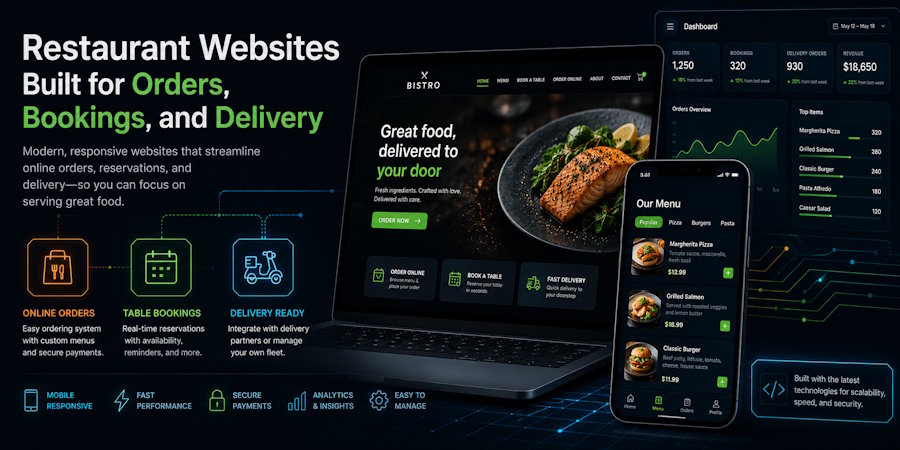
Restaurant websites once served as digital brochures. They displayed a logo, a few food photographs, opening hours, and perhaps a downloadable menu. That model no longer matches how guests use the web. A customer visiting a restaurant site today usually wants to complete a task: find the nearest branch, check whether a dish is available, book a table, place a pickup order, arrange delivery, buy a gift card, or confirm that the kitchen is still open.
The best restaurant websites therefore do more than look attractive. They connect customer intent to restaurant operations with as little friction as possible. Their value comes from clear navigation, accurate information, dependable integrations, fast mobile performance, and a checkout or reservation flow that does not collapse under pressure.
This shift matters to developers because a restaurant site now sits between several systems. It may need to exchange data with a point-of-sale platform, reservation provider, payment gateway, loyalty program, kitchen display system, delivery service, analytics tool, and customer messaging platform. The website is no longer a decorative layer. It is part of the restaurant’s operating stack.
A useful way to judge restaurant websites is not by visual style but by the job they perform. Four models work especially well today: the conversion-focused ordering site, the digital host for reservation-led restaurants, the local utility site for independent venues, and the scalable platform for multi-location brands. Each succeeds for different reasons, and delivery changes the technical requirements of all four.
A Restaurant Website Must Complete a Job
A restaurant website works when it shortens the distance between a visitor’s intention and a completed action. That action might be an order, booking, phone call, direction request, email signup, or gift-card purchase. Every page, image, script, and integration should support one of those outcomes.
A fast-food customer usually arrives with high intent. They may already know the brand, the meal, and the preferred location. Making that person watch a cinematic homepage video or search through several navigation layers wastes time. The correct interface places ordering, location selection, and menu access at the top of the first mobile screen.
A fine-dining customer behaves differently. That visitor may review the menu, price level, dress expectations, cancellation policy, and available booking times before deciding. The website still needs speed, but it must also remove uncertainty.
A neighborhood café has another set of priorities. Its customers may only need current hours, directions, a readable menu, allergen details, and a simple pickup option. A small site that answers those questions accurately can outperform a costly custom build that staff cannot update.
The strongest sites measure these tasks. Page views reveal little. Teams should track menu-view-to-cart rate, checkout completion, reservation completion, repeat orders, failed payments, abandoned carts, and direct-channel sales.
Mobile performance deserves special attention because restaurant searches often happen away from a desktop. Large images, autoplay video, map embeds, marketing tags, and reservation scripts can make a simple homepage slow. The first screen should show the main actions before secondary content.
Accuracy matters as much as speed. An elegant interface cannot recover from outdated hours, an unavailable dish, a wrong delivery radius, or a reservation widget that displays tables the restaurant cannot honor. These failures create operational work for staff and reduce trust faster than a plain design ever could.
Developers should also treat restaurant data as structured information rather than scattered page copy. Locations, opening times, menus, prices, modifiers, dietary labels, delivery zones, and service types should come from controlled sources. Google recommends using the most specific LocalBusiness subtype, such as Restaurant, and supports properties for opening hours, cuisine, telephone numbers, location data, and menu URLs.
A good restaurant website therefore begins with data ownership and task design. Visual decisions come after the team understands what guests need to do and which systems must respond.
Four Website Models That Work
The first successful model is the conversion machine. Pizza chains, burger brands, fast-casual restaurants, and delivery-led kitchens often use this approach because frequent ordering drives their business.
A conversion machine puts “Order Now” ahead of almost everything else. It detects or requests the customer’s location, separates pickup from delivery, displays the correct local menu, remembers previous choices, and keeps the cart visible. Product customization happens without unnecessary page changes, while upsells appear after the customer has selected the main item.
The best examples reduce repeated effort. Returning customers can reuse addresses, payment methods, favorites, and recent orders. Account creation may support this convenience, but the site should not force registration before checkout.
The technical work behind this apparent simplicity is substantial. The platform must manage location-specific prices, item availability, modifier rules, taxes, delivery boundaries, preparation estimates, payment status, and order transmission. It also needs to handle peak demand when hundreds or thousands of customers order within a narrow period.
A robust ordering site preserves cart state if the user switches applications, loses a connection, or accidentally refreshes the page. It validates addresses before payment, confirms that the selected branch can fulfill the order, and waits for a successful operational response before presenting the purchase as complete.
The second model is the digital host. This structure suits chef-led restaurants, tasting-menu venues, hotel restaurants, wine bars, and groups where reservations matter more than delivery volume.
A digital host gives visitors enough information to decide whether the restaurant fits the occasion. It presents menus, pricing, service style, location, accessibility details, private dining information, and booking policies in a calm hierarchy. Photography supports the decision without blocking access to practical information.
Reservation access should remain visible throughout the site. Hiding the booking button inside a menu or placing it only at the bottom of the homepage creates needless work. The reservation flow should open quickly, show real availability, explain deposits or cancellation terms before confirmation, and return the guest to a branded completion page.
Embedded booking tools can introduce large scripts, inconsistent typography, cookie requirements, focus problems, and weak mobile behavior. Developers should test the complete flow on several devices rather than trusting the widget by default.
Menus deserve similar care. A restaurant may prefer a designed PDF because it resembles the printed version, but PDFs are awkward on phones, difficult to search, harder to update, and poor for accessibility. Responsive HTML should be the default. A downloadable PDF can remain available as a secondary option.
The third model is the local utility site. This is often the best choice for a single restaurant, café, bakery, pub, or family-run takeaway.
A local utility site does not need complex animation or a custom frontend framework. It needs accurate opening hours, address details, click-to-call functionality, directions, service options, current menus, dietary notes, and one obvious action for ordering or booking. The owner should be able to change these details without asking a developer.
Content management determines whether the site remains useful after launch. Menus, prices, holiday hours, private events, and sold-out dishes change often. A technically impressive system becomes a liability when only the original agency can update it.
The physical venue and the digital interface should also agree. A casual dining room filled with simple restaurant chairs does not need an elaborate luxury website that creates the wrong expectation. The site should communicate the real service level, price point, and pace of the restaurant.
A practical stack for this model may include a lightweight CMS, server-rendered templates, managed hosting, image optimization, structured data, and a hosted ordering or reservation service. The goal is not architectural novelty. The goal is low maintenance and dependable customer access.
The fourth model is the multi-location platform. Restaurant groups, franchises, ghost-kitchen operators, and national brands need a system that balances central control with local accuracy.
A multi-location site requires individual pages for every branch. Each page should contain the correct address, phone number, hours, services, menu, delivery options, local promotions, accessibility details, and map information. Sending every visitor to one generic location finder weakens local search visibility and adds another step before action.
The content model should separate shared brand data from branch-level data. Corporate teams may control global navigation, design components, core menu descriptions, legal content, and campaign assets. Local managers may need permission to change hours, events, stock messages, and regional offers.
A headless CMS can suit this structure when the organization can maintain it. Teams can reuse structured content across websites, applications, kiosks, and ordering interfaces. Headless architecture still requires clear ownership for every field.
Multi-location development also requires safeguards. Validation can prevent a branch from publishing impossible hours, missing prices, or malformed phone numbers. Preview environments let local teams review changes. Automated tests can detect broken order links, missing images, duplicate metadata, and location pages that return errors.
The best model depends on the restaurant’s business. A tasting-menu venue should not copy a pizza chain’s interface, and a neighborhood bakery does not need a franchise platform. The winning structure is the one that matches how the restaurant attracts, serves, and retains customers.
Delivery Changes the Website Architecture
Delivery creates the largest difference between a restaurant website and a conventional local-business site. Once a customer can place an order, the website becomes part of a time-sensitive transaction that must reach the kitchen correctly.
Restaurants generally choose among direct ordering, third-party marketplaces, or a hybrid model. Each option changes the flow of data, customer ownership, and operational responsibility.
Direct ordering allows the restaurant to sell through its own branded website or application. The business controls the interface, menu presentation, promotions, loyalty rules, and customer communication. It can also collect first-party data, subject to consent and privacy requirements, instead of depending entirely on a marketplace relationship.
Current restaurant platforms support direct pickup and delivery ordering through branded pages. Toast, for example, documents direct ordering for pickup, curbside service, and delivery, along with options for branding, scheduling, kitchen timing, and order notifications. ChowNow similarly positions its service around direct ordering, restaurant access to customer data, and branded web or app channels.
Direct ordering does not mean the restaurant must build every component. Most independent operators should not create payment processing, dispatch software, and POS synchronization from scratch. A hosted platform can handle those functions while the restaurant website controls discovery, branding, and navigation.
The integration still needs careful design. The main site should pass users into the ordering flow without visual confusion or repeated location selection. Links should open in the same browsing context unless there is a strong reason not to. Tracking parameters should survive the transition so the restaurant can attribute orders correctly.
Third-party delivery marketplaces solve a different problem. They provide access to an existing audience and, in many markets, a courier network. A new restaurant can appear in front of customers who have never searched for its brand. That discovery has value, especially when the restaurant lacks its own traffic.
Marketplace dependence creates trade-offs. The restaurant has less control over customer relationships, menu layout, rankings, promotions, and service presentation. It may also maintain different prices and availability across platforms.
The hybrid model suits many restaurants because direct ordering and marketplaces perform different jobs. Marketplaces can introduce the brand to new customers, while the restaurant’s own website can serve returning guests who already know what they want.
A hybrid site should not hide direct ordering behind a generic “Delivery” page filled with marketplace logos. The primary button should lead to the restaurant’s preferred channel. Marketplace options can remain available for customers who value a specific subscription, payment method, or courier service.
The operational flow matters more than the button. A typical delivery transaction moves through the customer interface, ordering platform, payment gateway, POS, kitchen display system, dispatch provider, and notification service. Every handoff can fail.
Menu synchronization is a common weak point. A dish may be sold out in the POS but remain available online. A modifier may appear as optional on one channel and required on another. A branch may change a price locally while the marketplace keeps the old value. These are data-governance problems, not just interface bugs.
Order confirmation also requires precision. The website should distinguish among payment authorization, order acceptance, kitchen transmission, preparation, courier assignment, and completion. Showing “Order confirmed” after payment alone can mislead the customer if the POS or restaurant rejects the ticket seconds later.
Capacity controls protect both the kitchen and the guest. During a rush, the system may need to extend preparation estimates, reduce available delivery slots, pause certain items, or temporarily stop online orders. Toast’s current Orders Hub documentation, for example, describes one view for managing direct, integrated third-party, and manually entered takeout or delivery orders.
Delivery zones need server-side validation. A map drawn on an administrative screen is not enough. The checkout should validate the full address, account for branch boundaries, and return a clear response before collecting payment. Border cases should not depend on loose postal-code matching when street-level service differs.
Customer messages should reflect real events. A “Your food is ready” text should fire when staff mark the order ready, not when an estimate expires.
The best delivery site therefore acts as an orchestrator. It does not simply display a menu and forward an email. It coordinates systems that must agree on what was ordered, what it costs, where it should go, when it will be ready, and who is responsible for the next step.
What Developers Should Build and Measure
Developers should begin restaurant projects with a service map, not a homepage mockup. The map should identify every customer action, every external system, the source of each data field, and the expected response when a dependency fails.
A single-location restaurant usually benefits from a small stack. Server-rendered pages provide speed and search visibility. A manageable CMS lets staff update hours and menus. A hosted reservation or ordering provider handles transactional complexity. Managed hosting, automated backups, analytics, and error monitoring reduce maintenance.
A growing restaurant group needs stronger content modeling. Locations, menus, products, modifiers, promotions, service types, and hours should exist as structured entities. Reusable components can render them consistently, while permissions control who may change global or local content.
A delivery-led brand requires deeper application behavior. Persistent carts, customer accounts, saved addresses, payment tokens, real-time availability, order events, notifications, delivery integrations, and operational dashboards become central features. Observability should cover each checkout stage rather than only page errors.
Performance work should focus on the path to revenue. Developers can defer maps until a user requests directions, lazy-load gallery images, compress food photography, remove unused tag-manager scripts, and avoid loading reservation code on pages where no booking action appears.
Third-party scripts deserve regular review. Analytics tags, pixels, chat widgets, social embeds, review badges, booking tools, and ordering widgets can introduce delays, privacy obligations, layout shifts, or external failures.
Accessibility must cover transactions, not only static pages. Keyboard users should be able to choose modifiers, change quantities, dismiss dialogs, read validation messages, and complete payment. Screen readers need meaningful button labels, form instructions, price information, and status updates.
Error handling should give customers a next step. “Something went wrong” is not enough after a user has entered an address and payment details. The message should explain whether payment was captured, whether the order reached the restaurant, and how to contact support without submitting a duplicate order.
Analytics should follow the complete funnel. Useful events include location selected, menu viewed, item added, modifier error, cart opened, checkout started, address rejected, payment failed, order accepted, reservation started, reservation completed, and order canceled.
Teams should segment results by device, location, service type, traffic source, and ordering channel. A strong overall conversion rate can hide a broken Android checkout, a weak branch page, or paid traffic that produces large numbers of abandoned carts.
Operational metrics belong beside marketing metrics. Developers and restaurant teams should monitor POS transmission failures, delayed acceptance, unavailable-item cancellations, inaccurate preparation estimates, duplicate orders, refund reasons, courier delays, and support contacts per order.
Core Web Vitals remain useful, but they do not replace business measurements. A technically fast site can still perform poorly if it hides ordering, presents an unreadable menu, or asks customers to create an account before showing delivery fees.
Testing should reflect real restaurant conditions. Teams should test on weak mobile connections, older devices, small screens, busy dinner periods, sold-out menus, closed branches, future orders, rejected cards, invalid addresses, and interrupted checkouts.
Developers should also avoid features that add theatre but block action. Long intro animations, full-screen newsletter pop-ups, autoplay sound, oversized video headers, cursor effects, and complex page transitions rarely help someone trying to order dinner.
The final test is operational ownership. Staff should know how to change hours, pause orders, mark products unavailable, update prices, review failed transactions, and find customer details. Documentation should match the exact tools they use, not a generic handover template.
The Best Site Connects the Dining Room to the Screen
The restaurant websites working best today share no single visual style. Some are minimal, some are highly branded, and some resemble software applications more than traditional marketing sites. Their common strength is alignment between the digital interface and the real operation behind it.
Conversion-focused sites work because they make repeat ordering fast. Digital hosts work because they answer the questions that precede a reservation. Local utility sites work because they provide accurate information without unnecessary complexity. Multi-location platforms work because they organize shared and local data at scale.
Delivery raises the standard for all of them. The moment a website accepts an order, it must coordinate menus, prices, payments, kitchen capacity, delivery rules, status messages, and customer support. A polished frontend cannot compensate for a ticket that never reaches the kitchen.
Developers should therefore stop treating restaurant websites as presentation projects. The best ones are compact service platforms connected to real locations, real inventory, real staff, and customers who expect the promised meal at the promised time.

