

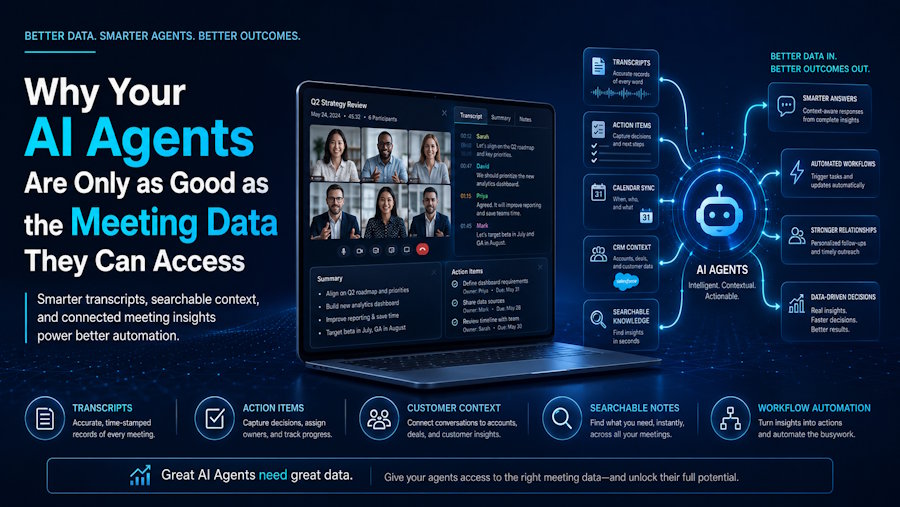
AI agents are showing up across every part of the SaaS stack. Sales teams use them to update CRM records and draft follow-ups. Support teams use them to triage tickets and suggest responses. Operations teams use them to route tasks and flag bottlenecks.
But most AI agents share a common blind spot. They can pull from emails, documents, chat messages, and databases, but they rarely have access to what happens in meetings. And meetings are where a huge amount of business-critical information lives. Solutions like AI meeting notes with API for agents have made this technically possible, but most teams haven't wired it up yet.
Why Meeting Data Matters More Than Most Teams Realize
Think about what gets discussed in a typical week of meetings across a company. Sales reps learn about prospect timelines and budgets. Customer success managers hear about churn risks and feature requests. Product teams make prioritization decisions. Hiring panels share candidate evaluations.
All of that information is valuable, and most of it never gets structured or stored anywhere accessible. It stays in people's heads or in scattered notes that no system can read. When an AI agent tries to update a deal record, draft a follow-up email, or prepare a meeting brief, it's working without the context that would make its output actually useful.
The result is agents that feel helpful in theory but fall short in practice. They can process what's in the CRM, but they can't account for what the prospect said on yesterday's call. They can summarize a Slack thread, but they miss the strategy discussion that happened on Zoom an hour earlier.
The API Question Most Teams Overlook
When evaluating AI meeting tools, most buyers focus on transcription accuracy, summary quality, and which conferencing platforms are supported. Those things matter. But there's a feature that often gets overlooked and ends up being the most important one down the line: API access.
An API is what allows your meeting data to flow into other systems programmatically. Without it, your meeting notes live inside the meeting tool and nowhere else. With it, AI agents and automations can pull meeting transcripts, summaries, and action items into whatever workflow they're powering.
This matters more now than it did even a year ago. As companies build agentic workflows where AI handles multi-step processes across tools, the data sources those agents can access determine how effective they are. Meeting data behind a locked UI with no API is meeting data your agents can't use.
What Good API Access Looks Like in Practice
Not all APIs are equal. Some meeting tools offer limited endpoints that only let you export a transcript as a text file. That's technically an API, but it doesn't help much when you're trying to build automated workflows. What you actually want is structured access to:
- Meeting summaries and action items, not just raw transcript dumps
- Speaker-labeled transcripts so agents know who said what
- Metadata like attendees, timestamps, and meeting topics
- Webhook support so workflows trigger automatically when a call ends, rather than waiting for someone to manually initiate a sync
That structured data is what allows an AI agent to do something meaningful, like updating a deal stage in HubSpot based on what was discussed, or creating follow-up tasks in Asana based on who committed to what.
Where This Fits in an AI Agent Stack
A typical agentic workflow in a sales org might look like this. A meeting ends and the recording is transcribed. The summary and action items are pushed via API to the CRM. An AI agent reads the summary, updates the deal record, drafts a follow-up email based on what was discussed, and creates a task for the rep to review before sending.
None of those steps require the rep to do anything manually. But the entire chain depends on structured meeting data being available through an API. Remove that first step, and the agent is back to working with whatever the rep remembered to type into the CRM.
The same pattern applies outside of sales:
- A customer success agent preparing renewal briefs needs context from recent account calls
- A recruiting agent compiling interview feedback needs access to what was said on the panel call
- An operations agent tracking project decisions needs the output from cross-functional syncs
In each case, the meeting is the richest data source, and the API is what makes it reachable.
Choosing a Meeting Tool With Agents in Mind
If your team is already using or planning to use AI agents in any part of the business, the meeting tool you pick should be evaluated with API access as a primary consideration, not an afterthought. A few questions worth asking during evaluation:
- Does the API return structured data like summaries and action items, or just raw transcripts?
- Are webhooks supported so workflows can trigger automatically?
- Can you filter meeting data by participant, date, or topic?
- Is the API documented well enough that your team or automation platform can integrate without heavy engineering work?
These questions don't usually show up on feature comparison pages, but they're often what separates a meeting tool that works in isolation from one that becomes a useful part of a larger system. As AI agents take on more responsibility in business workflows, the tools that feed them quality data through accessible APIs will be the ones that actually earn their place in the stack.

