

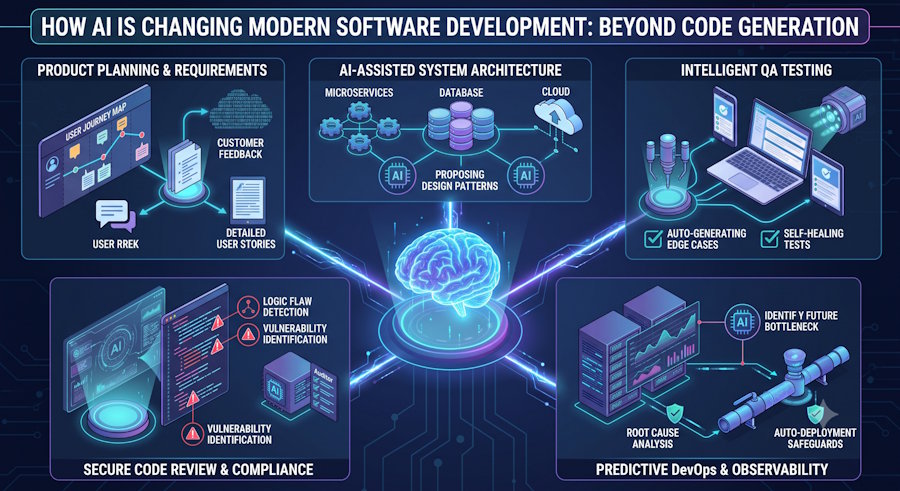
Ask any developer about AI today, and the conversation usually starts with code generation. Tools like GitHub Copilot, ChatGPT, and Claude have undoubtedly changed how developers write functions, debug errors, and generate boilerplate code. But AI's influence on software development extends far beyond autocomplete suggestions.
Development teams are now integrating AI into testing pipelines, documentation, DevOps workflows, security analysis, and product decision-making. Instead of replacing developers, AI is becoming another layer of the software engineering process—one that reduces repetitive work while allowing engineers to focus on solving complex problems.
AI Is Becoming Part of the Entire Development Lifecycle
Modern software projects involve far more than writing application code. Requirements evolve, deployments become more frequent, and maintaining quality across large codebases requires continuous automation.
Organizations implementing AI at scale often begin by identifying repetitive engineering tasks before introducing intelligent automation. This approach reduces implementation risks while delivering measurable productivity improvements. Many companies also work with AI Consulting Services to evaluate existing workflows, select suitable AI technologies, and integrate machine learning capabilities into products without disrupting ongoing development.
Where AI Adds the Most Value in Software Development
Faster Development
AI assistants accelerate repetitive coding tasks such as creating CRUD operations, generating API endpoints, writing SQL queries, and converting code between programming languages.
Developers spend less time writing boilerplate and more time solving business problems.
Better Code Reviews
AI-powered review tools can identify common bugs, detect security vulnerabilities, enforce coding standards, and suggest improvements before code reaches production.
While human reviews remain essential, AI significantly reduces the number of routine issues reviewers need to inspect manually.
Smarter Testing
Generating unit tests has traditionally been a time-consuming process. AI can automatically create test cases, recommend edge scenarios, and even identify areas of low test coverage.
This allows teams to maintain higher code quality without dramatically increasing development time.
Improved Documentation
Documentation is often one of the first tasks developers postpone. AI helps generate API documentation, technical explanations, release notes, and code comments directly from source code.
The result is documentation that stays synchronized with the application as it evolves.
AI Depends on Organized Information
Many AI initiatives struggle for a simple reason: the underlying information is scattered across emails, PDFs, spreadsheets, cloud storage, and internal systems. Even the most advanced models produce unreliable results when they work with inconsistent or incomplete data.
Before introducing AI into business workflows, many organizations first improve how information is stored and managed. Implementing an electronic document management system creates a centralized repository for business documents, making information easier to organize, search, secure, and retrieve. Structured documentation not only improves operational efficiency but also provides cleaner data sources for AI-powered search, document analysis, workflow automation, and knowledge management.
AI in DevOps and Deployment
AI is increasingly becoming part of modern DevOps practices.
Engineering teams use AI to:
- Detect anomalies in production systems
- Predict infrastructure failures
- Optimize cloud resource allocation
- Analyze application logs
- Identify deployment risks
- Reduce incident response times
Rather than replacing DevOps engineers, AI enables faster decision-making by processing operational data at a scale that humans cannot. Organizations looking to adopt these capabilities often partner with a DevOps consultancy to integrate AI-driven monitoring and deployment pipelines into their existing infrastructure.
The Skills Developers Need
As AI becomes integrated into software engineering, developers are expanding their skill sets beyond traditional programming.
Today's engineers benefit from understanding:
- Prompt engineering
- Large Language Models (LLMs)
- Retrieval-Augmented Generation (RAG)
- AI APIs
- Vector databases
- Model evaluation
- AI security and governance
Developers who combine traditional software engineering with AI knowledge will be better positioned to build the next generation of intelligent applications.
AI Is a Development Multiplier, Not a Replacement
Despite rapid advancements, AI still depends on human expertise. It cannot fully understand business context, architectural trade-offs, or long-term product strategy.
Successful engineering teams treat AI as a productivity tool rather than a substitute for experienced developers. The greatest gains come from combining human judgment with AI-assisted workflows, allowing teams to deliver software faster while maintaining quality, security, and scalability.
Final Thoughts
Software development is entering a new phase where AI supports nearly every stage of the engineering lifecycle—from planning and coding to testing, deployment, monitoring, and maintenance. Organizations that adopt AI thoughtfully, with strong engineering practices and reliable data foundations, will be better equipped to build software that is faster to develop, easier to maintain, and more valuable to end users.

