

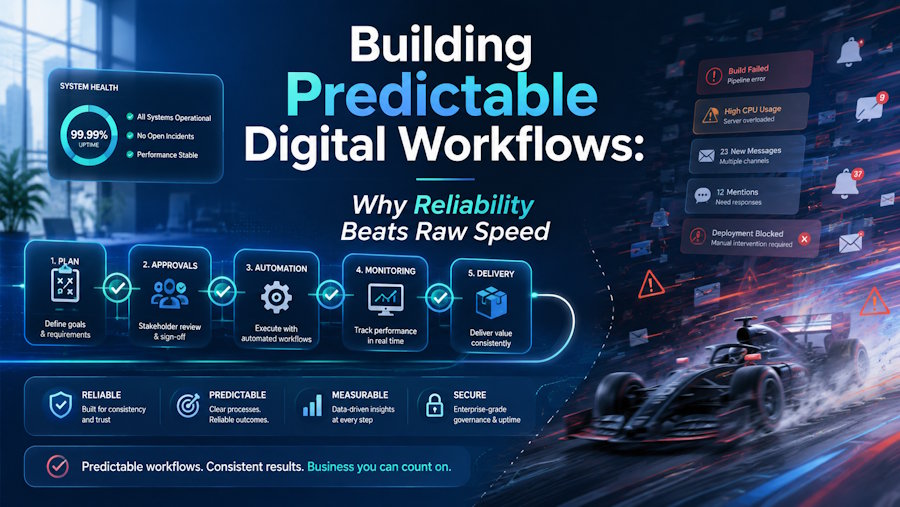
Most ops leads have some version of this story. A scraping job runs fine for weeks, then one morning it's spitting errors and nobody knows why. A pricing dashboard pulls clean numbers Monday and returns garbage by Friday. The e-commerce monitor that was catching stockouts starts missing them.
Usually the code isn't the problem. It's whatever the code sits on top of.
Predictable workflows aren't glamorous, but they're what separates teams that ship consistent results from teams that spend Fridays firefighting. Getting there comes down to choices most engineers make in five minutes and pay for over months.
The Real Cost of Unpredictable Systems
Downtime gets tracked. Flaky behavior mostly doesn't. When a job succeeds 94% of the time instead of 99%, nobody's paging the on-call engineer, but somebody's spending an hour every Monday cleaning up the 6% that got through wrong.
Bad data across US businesses runs into the trillions per year, and almost none of that number comes from dramatic outages. It's the slow drip of bad rows, silent retries, and pipelines that used to just work.
Good teams design for the second scenario. Keep the boring case boring, and make sure the failures fail loudly enough that someone catches them the same day. Nine months later, that shows up as engineers shipping features instead of untangling last quarter's mess.
Where Infrastructure Choices Compound
Digital workflows sit on stacked dependencies: browsers, third-party APIs, DNS resolvers, auth tokens, and increasingly, proxy networks routing requests through specific geographies. Every layer adds variance. And every variance introduces failure modes that only surface when something else is already on fire.
For teams running long-lived automation, a residential static proxy usually beats rotating options because the same IP stays with the same session for weeks or months. That stability lets accounts age naturally, cookies stick around, and target sites stop flagging every request as if it's coming from a suspicious new city.
Rotating pools still make sense for high-volume scraping when session stickiness doesn't matter. But for anything involving logins, cart persistence, or repeat interactions with the same platform, rotation is usually what's breaking the system, not saving it.
Session Persistence Isn't Optional
Bot detection weighs IP-behavior correlation heavily. If your IP shifts between requests but your session cookie stays put, that's a flag. If it flips every refresh, that's a much bigger flag.
A proxy server at its core just swaps your outbound identity for another. But the behavior around that identity matters as much as the identity itself. Actual humans don't hop networks between clicks or teleport across continents mid-checkout.
Being hard to distinguish from a real user at the network layer means holding the same IP, sending the same headers, and keeping the same behavioral pace across a whole session.
Workflows that look organic get through. The ones that don't get throttled, CAPTCHA-walled, or fed silently fake data (which is worse than a hard block, because you don't catch it until someone questions the report).
Metrics That Actually Predict Reliability
Teams obsess over uptime SLAs and ignore the numbers that matter more. Success rate on retry, session survival time, CAPTCHA frequency: those tell you more about whether tomorrow's job runs than any 99.99% availability figure on a marketing page.
Geographic coverage is another one buyers underestimate. If your vendor's Brazil pool tanks and your monitoring workflow needs Brazilian IPs, "global uptime" was the wrong metric all along. The whole point of site reliability engineering is measuring reliability per user journey, not per system average, and that framing applies just as well to workflow health.
Latency variance is a quiet killer too. Average response time of 200ms sounds fine until the 95th percentile hits four seconds and jobs time out on every twentieth request. Medians hide the failures that actually cost money.
Thomas Redman's Harvard Business Review piece put bad data's annual cost around $3 trillion in the US alone. Workflows tuned to averages tend to miss exactly where those losses pile up.
Track the metrics that describe your specific workload. Everything else is packaging.
Building for the Boring Case
The best digital workflows are the ones nobody talks about, because they just work. Getting there means picking infrastructure for stability instead of headline specs and treating consistency like an actual engineering priority.
Reliability compounds quietly. Teams that put the work in now spend next quarter shipping features instead of untangling failures from the last deploy.

