

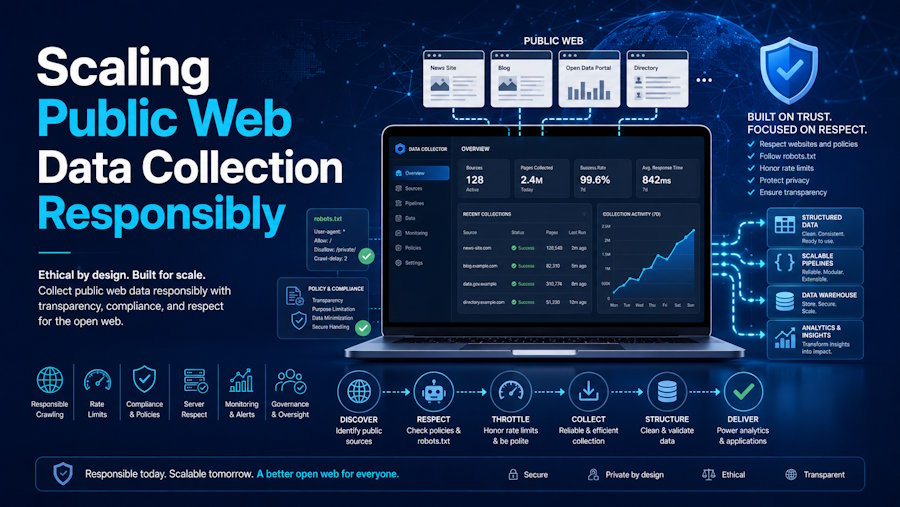
Web data has quietly become the backbone of modern business intelligence. Retailers watch competitor pricing, researchers track sentiment shifts, and product teams monitor how their features perform in the wild.
But scaling these operations from a hobbyist script to enterprise-grade infrastructure introduces problems most teams don't anticipate. The technical challenges get most of the attention. What gets skipped is the responsibility layer: how to collect at volume without breaking laws, damaging target sites, or building systems that regulators will eventually scrutinize.
Why Volume Changes the Rules
A single developer pulling a hundred pages a day looks like normal browsing. Ten thousand pages an hour looks like an attack. That shift in scale changes everything about how public data operations should be designed, staffed, and monitored.
Public data collection sits in a legal gray zone that varies by jurisdiction. The 2022 hiQ v. LinkedIn ruling in the US Ninth Circuit affirmed that scraping publicly accessible data doesn't automatically violate the Computer Fraud and Abuse Act, but that's one country's position. Brazilian LGPD rules and other regional frameworks add layers most engineering teams underestimate until an inbox lights up with a takedown notice.
Infrastructure That Supports Responsible Scaling
Most teams start with basic datacenter IPs and hit walls fast. Sites protected by Cloudflare, Akamai, or PerimeterX flag datacenter ranges within hours. And once flagged, entire IP blocks get burned across the operation.
The alternative most enterprise teams settle on is residential infrastructure paired with careful rotation. Services offering unlimited residential proxy access give data teams the geographic diversity to collect region-specific pricing, availability, and content without triggering the defensive systems built for datacenter traffic. This matters most for e-commerce monitoring, ad verification, and any workflow that depends on seeing what real users actually see.
But infrastructure alone doesn't make an operation responsible. What matters is how it's used.
Technical Guardrails Worth Building
Respect for robots.txt directives isn't legally required in most places. Ignoring them, though, signals that a team hasn't thought about the target site as a real system with real costs. Reading and honoring crawl-delay hints costs nothing and reduces the odds of being blocked entirely.
Rate limiting deserves more attention than it gets. A reasonable starting point: one request per two seconds per target domain, then adjust based on observed response times. If a site's latency creeps up during collection, that's the operation contributing to server load and the rate needs to drop.
Caching is another underused tool. Teams often re-scrape identical pages daily when the underlying data actually changes weekly. Cached responses with sensible TTLs cut bandwidth costs by 40 to 60 percent for most price monitoring workflows, and reduce the footprint left on target sites.
Handling Data After Collection
Compliance doesn't stop at collection. Any operation touching European users needs to think through GDPR obligations, even for publicly accessible information. Personal data that's public still counts as personal data under Article 4.
Storage decisions matter too. Aggregated pricing intelligence is one thing; storing raw user profiles pulled from public sources is another category entirely. Data minimization principles suggest keeping only what the specific use case requires (and setting retention limits before collection starts, not after regulators come asking).
Documentation of these practices has become table stakes for teams working with enterprise customers. Auditors want written policies covering source selection, rate limiting decisions, and data handling protocols before they'll sign off on procurement.
Where This Is Heading
Detection is improving every quarter, and courts are getting more comfortable weighing in on scraping disputes. Teams that scale successfully will be the ones that treat responsibility as an engineering constraint from day one, not a compliance patch bolted on after growth stalls.
That means picking infrastructure partners who understand the difference, building rate limiting into the core architecture, and being honest with stakeholders about what public web data collection can and can't ethically accomplish at scale.

