

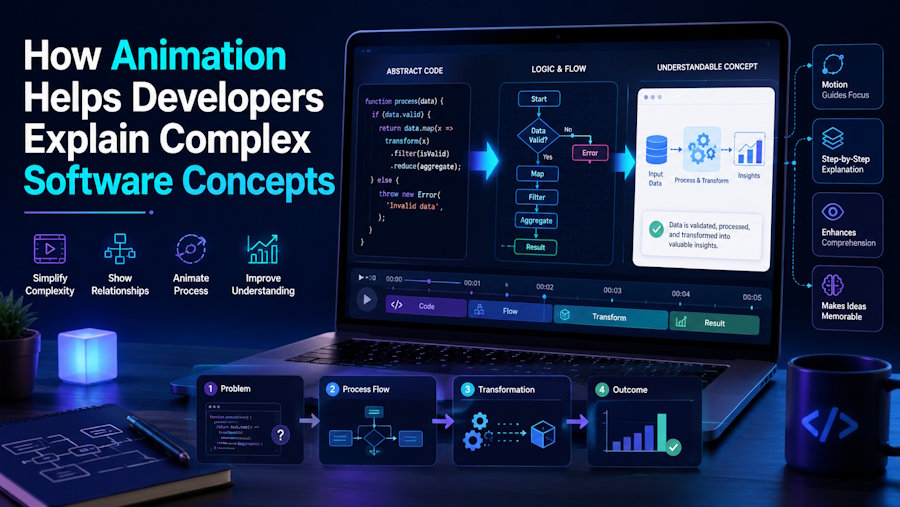
Animation helps developers explain complex software concepts by transforming abstract technical ideas, system architectures, data flows, algorithms, and API interactions into clear, sequential visual narratives that audiences can follow, retain, and act on. When written documentation and static diagrams fall short, animated content bridges the cognitive gap between how software actually works and how humans naturally understand information.
Why Do Developers Struggle to Explain Complex Software Concepts?
Software is inherently invisible. Unlike physical products that can be demonstrated by holding them up or pointing at their components, software concepts like microservices architectures, containerization pipelines, authentication flows, and distributed databases exist entirely as abstract relationships between processes, data states, and logic conditions.
Cognitive load theory demonstrates that well-designed animated content reduces the mental effort required to understand complex subjects by presenting information through multiple sensory channels simultaneously. This dual-coding principle — processing information through both visual and auditory channels simultaneously is precisely what makes animation such a powerful tool for developers trying to communicate technical systems.
The challenge is compounded by the diversity of audience’s developers now routinely communicate with: non-technical stakeholders who need to understand architectural decisions, new team members being onboarded to complex codebases, end users learning how a product works, and international colleagues who may be operating in their second or third language. A static README or architecture diagram serves none of these audiences as effectively as a well-produced animated explainer.
What Is the Cognitive Science Behind Animation and Software Learning?
Mirror neuron activation occurs when viewers observe animated demonstrations, creating subconscious learning pathways that enhance skill acquisition and knowledge retention. This neurological response helps explain why animated tutorials often produce better learning outcomes than static instructional materials.
Showing an animation of a process on screen while narrating it engages both the visual and auditory channels, giving learners complementary streams of information that make complex concepts easier to process in working memory.
For software concepts specifically, this matters enormously. When an animated sequence shows data moving through an API request-response cycle, the call initiating, the request traveling across a network boundary, authentication being checked, data being retrieved and formatted, and the response returning, viewers develop an intuitive mental model of the workflow. That mental model is more likely to persist and transfer than one formed solely by reading technical documentation. Organizations that invest in professional motion graphics services can further improve the clarity and effectiveness of these educational experiences.
"Motion graphics reduce cognitive load by presenting information one step at a time, so learners can process each bit before moving on," says Michelle Connolly, founder of Educational Voice. For developers explaining multi-step technical processes where each step depends on understanding the previous one, this sequential presentation is not only visually engaging but also pedagogically effective.
Which Complex Software Concepts Benefit Most From Animation?
Not every software concept needs an animation. But certain categories of technical content are significantly harder to communicate without one.
System Architecture and Microservices
Microservices and API architecture has emerged as the premier structural framework to decouple complex software applications into autonomous, loosely coupled, and highly specialized services. The conceptual challenge of microservices understanding how dozens of independent services communicate, how service meshes manage traffic, and how circuit breakers prevent cascading failures is extremely difficult to convey through text or static diagrams alone.
Animation transforms this challenge into a solvable visual problem. An animated sequence can show a monolithic architecture breaking apart into microservices, illustrate how an API gateway routes requests to the appropriate service, demonstrate what happens when one service fails and how circuit breakers engage, and show how horizontal scaling adds instances dynamically under load — all within a 90-second video that no written document of equivalent length could match for comprehension.
API Request and Response Flows
APIs power virtually every modern software product, but the mental model of an API of what happens between a client making a call and receiving a response is surprisingly difficult to convey in words alone. Animation excels here because the concept is fundamentally sequential and spatial: data travels from point A to B, transforms at each stage, and returns in a different shape.
An animated diagram showing an HTTP request leaving a browser, hitting a load balancer, being authenticated, processed by a service, queried against a database, formatted into JSON, and returned through the same chain with each step highlighted as it occurs creates genuine understanding in 60 seconds that a ten-page API guide struggles to build in an hour.
DevOps, CI/CD Pipelines, and Deployment Flows
DevOps practices like continuous integration and continuous delivery let organizations deliver rapidly in a safe and reliable manner, but explaining why a CI/CD pipeline works, what happens at each stage, and how a code commit becomes a deployed feature in production is a notoriously difficult conceptual challenge for new team members and non-technical stakeholders alike.
Animation is uniquely suited to CI/CD explanations because the pipeline itself is a visual metaphor. A developer commits code → the pipeline triggers → tests run in parallel → the build compiles → staging deployment occurs → smoke tests pass → production deployment releases. Each of these steps can be animated as a discrete visual event in a continuous flow, building an accurate mental model that carries forward into practical work.
Cloud Computing and Distributed Systems
By 2026, cloud-native design including microservices, containers, and orchestration tools continues to dominate how applications are built, as these architectures break software into modular components that can scale independently and update rapidly.
The concepts underlying cloud architecture virtual machines, containers, orchestration, auto-scaling, load balancing, geographic distribution, fault tolerance are abstract enough that even experienced developers frequently find them difficult to explain to colleagues outside their specialty. Animation solves this by giving physical form to virtual constructs: containers become visual boxes that can be duplicated, moved, or destroyed; cloud regions become geographic nodes with data flows between them; auto-scaling becomes a visible expansion and contraction of resources in response to load.
Authentication and Security Flows
OAuth flows, JWT token generation and validation, SSL/TLS handshakes, and zero-trust authentication chains are security concepts where errors in understanding lead directly to vulnerabilities. Yet they are notoriously difficult to explain through documentation alone because the sequence of steps is invisible, the state changes are hidden, and the timing relationships matter.
An animated OAuth flow showing the authorization request, redirect, token exchange, and validation steps playing out in real time with each party's role clearly visualized dramatically reduces the misunderstandings that lead to insecure implementation. For security-critical concepts, the cost of misunderstanding is high enough to justify the animation investment many times over.
Algorithms and Data Structures
Sorting algorithms, graph traversal, tree operations, hashing, and dynamic programming these foundational computer science concepts are taught visually for a reason. When information is presented through dynamic visuals coupled with narration, it activates multiple neural pathways, creating stronger memory connections and enhancing retention. The animation of a merge sort dividing and recombining arrays, or a breadth-first search expanding across a graph, turns an abstract process into a concrete visual experience that makes the underlying logic intuitive in a way that written pseudocode rarely achieves.
What Are the Measurable Business Benefits for Software Teams?
The case for animation in software communication is not only cognitive — it is commercial.
Reduced Support Ticket Volume
SaaS companies with video onboarding see 35% fewer support tickets in the first month. When users understand how a product works through animated onboarding, they generate fewer questions, require less hand-holding, and submit fewer support requests directly reducing the cost of customer success and support operations.
Improved User Onboarding and Retention
75% of users churn in the first week of a SaaS product, and users who do not engage within the first three days have a 90% chance of churning. The solution getting users to their first meaningful success with the product as quickly as possible is precisely what animated onboarding videos are designed to deliver.
In a number of SaaS case studies, onboarding videos are associated with a decrease in 30-day churn in some cases up to 30% compared to products without video. Structured onboarding increases retention by 50%, and users receiving just-in-time onboarding tips exhibit 33% fewer errors.
Accelerated Time-to-Value
Cutting time-to-value by 20% lifted ARR growth by 18% for mid-market SaaS companies. Animation is one of the most direct levers for compressing time-to-value: when a new user watches a three-minute animated walkthrough that shows them exactly how to complete their first key action in the product, they reach value faster than any written guide of equivalent length can deliver.
Higher Engagement Across Platforms
91% of consumers watch explainer videos to learn about products or services, and educational videos generate 3x more engagement than promotional content on professional platforms like LinkedIn. For developer tools, APIs, and technical software where the target audience actively seeks educational content animation in technical documentation and knowledge bases significantly outperforms static alternatives.
What Types of Animation Work Best for Software Explanations?
Different technical concepts call for different animation styles. Matching the format to the concept is as important as producing the animation itself.
Screen Recording with Animated Overlays
The most common format for software documentation. A screen recording of the product in use, overlaid with animated callouts, arrows, zoom effects, and highlight rings, guides viewers' attention precisely where it needs to be. This approach combining screen recording with animated overlays creates polished results and is best for product-led growth, mid-funnel consideration, and onboarding.
Motion Graphics and UI Animation
Motion graphics are great for software workflows, compliance, and technical training. They look professional and work particularly well in corporate settings. For explaining abstract concepts like data architecture or system design, motion graphics allow designers to create representative visual metaphors rather than screen captures showing what concepts mean rather than just what they look like on screen.
Whiteboard Animation
Whiteboard animation feels like a traditional classroom lesson on screen. The hand-drawn look makes tough subjects feel less intimidating, which is a meaningful advantage when introducing genuinely difficult technical concepts to audiences who may feel anxious about the subject. The sequential, reveal-as-you-go nature of whiteboard animation also aligns naturally with the step-by-step logic of algorithms, protocols, and deployment workflows.
2D Character and Explainer Animation
For developer onboarding, team training, and product marketing, character-driven 2D animation adds a narrative layer that keeps viewers engaged through content that might otherwise feel dense. A character navigating a microservices architecture or troubleshooting a CI/CD failure provides an audience proxy a point of identification that makes the technical journey feel human rather than purely mechanical.
Interactive Animated Demos
Interactive demos convert at 12.3% versus 4.7% for static hero images on B2B landing pages, while interactive sequences increase demo completion rates from 23% to 67% for high-intent B2B SaaS prospects. For developer tools and technical software, interactive animated demos where the viewer controls the pace and can explore specific features combine the visual clarity of animation with the hands-on learning of actual product use.
How Does Animation Support Developer Documentation Globally?
Animation's advantages compound at global scale making it one of the most effective tools for software teams communicating across language barriers, time zones, and technical backgrounds.
The global animation market is valued at approximately $462 billion as of 2025 and is projected to reach $492 billion in 2026, with significant growth driven by demand for technical and educational content across every region. More than 65% of global media content now includes animated components, indicating the rising penetration of animation in education, advertising, and technical communication.
For software teams with globally distributed users which describes the majority of SaaS companies, developer tool vendors, and open-source projects of any significant scale, animated technical content provides three specific geographic advantages.
Language accessibility. An animated explainer of a complex authentication flow communicates through visual logic first and language second. The same animation can be re-narrated in Mandarin, Spanish, Portuguese, Hindi, or Arabic without rebuilding the visual content, reducing localization costs dramatically compared to rebuilding written documentation for each market.
Asynchronous learning across time zones. Distributed developer teams cannot attend live training together. Animated documentation enables developers in Singapore, São Paulo, and Stockholm to learn the same concepts at their own time, in their own environment, without scheduling coordination.
Consistent technical understanding. When documentation is text-based, nuanced technical details get lost or misinterpreted as they pass through different readers' comprehension filters. An animation delivers the same explanation with the same emphasis to every viewer eliminating the variation in understanding that creates bugs, security vulnerabilities, and architectural inconsistencies in distributed teams.
More than 71% of digital marketing campaigns integrated animated video assets for customer engagement and brand visibility in 2025, and for developer-focused software, this adoption has extended well beyond marketing into technical documentation, API guides, developer portals, and knowledge bases.
What Are the Best Practices for Creating Technical Animation?
The effectiveness of animation in technical communication depends heavily on how it is designed and produced. These principles separate useful technical animation from content that looks professional but fails to teach.
Start with the concept, not the tool. The goal is understanding, not visual complexity. Every animation sequence should have a single, clearly defined concept it is designed to teach. If the concept requires more than one animation to explain adequately, produce two animations rather than creating one overcrowded video.
Use progressive disclosure. Show systems building up layer by layer rather than revealing full complexity immediately. "Motion graphics reduce cognitive load by presenting information one step at a time, so learners can process each bit before moving on." For multi-component systems like Kubernetes clusters or event-driven architectures, introduce each component individually before showing how they interact.
Keep technical animations short. For landing pages and product pages, 60–90 seconds is the optimal length. For onboarding, under two minutes. Technical viewers who need deeper information will seek it out — the animation's job is to build the conceptual foundation, not to replace comprehensive documentation.
Pair visuals with narration, not text walls. On-screen text should reinforce key terms; not duplicate everything the narrator says. The dual-coding benefit of animation comes from audio and visual channels working in parallel, not competing with each other.
Validate with real users before publishing. A technical animation that makes perfect sense to its creator may still confuse its intended audience. Testing a rough version with two or three representative users before final production consistently reveals conceptual gaps that are much cheaper to fix at storyboard stage than in final animation.
Caption everything. 60–80% of users watch videos with sound off, and captions improve both accessibility and engagement. For technical content where specific terminology matters, captions also serve as searchable text and are indexed by search engines improving discoverability of the content significantly.
How Does Technical Animation Support AEO and SXO in 2026?
As AI-powered search engines increasingly generate direct answers to technical questions, the format of software explanation content has taken on new strategic significance.
GEO is becoming the battleground for brands seeking visibility in AI-powered search engines, with over 61% of worldwide marketing agency leaders adapting to generative AI search by optimizing for it. For developer tool companies and technical software vendors, this means that animated explainer content when paired with structured transcripts, VideoObject schema markup, and FAQ sections directly answering common developer questions — is significantly more likely to be cited by AI answer engines like Google's AI Overviews, Perplexity, and ChatGPT than raw video content without these signals.
Social media marketing campaigns using animation generated 41% higher audience engagement rates, and from an SXO perspective, technical animated content dramatically improves the behavioral signals that search engines use to evaluate content quality: dwell time increases when visitors watch a video, bounce rates decrease when animation answers the question the user came with, and scroll depth improves when animated sections break up long technical pages.
For developer-facing content specifically, the combination of animated explanation with structured documentation creates a content type that serves multiple search contexts simultaneously: the developer searching for "how does OAuth work," the product manager searching for "how to explain JWT to stakeholders," and the AI answer engine generating a direct response to "what is a microservices architecture" all retrieving the same core content in the format that best serves their context.
What Tools Do Developers and Technical Teams Use in 2026?
The tooling landscape for technical animation has matured significantly, making high-quality animated technical content accessible to teams without dedicated animation specialists.
For screen recording with annotation: For screen recording with annotation, tools such as Loom, Descript, and TiltIt help transform screen captures into professional annotated demonstrations. TiltIt can convert flat screen recordings into cinematic 3D animated onboarding videos directly in the browser, making it particularly useful for technical onboarding and product education. For organizations that need fully customized visuals beyond automated tools, professional 3D animation video services can create tailored onboarding experiences, product demonstrations, and technical explainers that align with specific branding and learning objectives.
For AI-powered explainer generation: Synthesia, HeyGen, and Guidde enable teams to generate avatar-narrated animated content from scripts, with Synthesia supporting output in 160+ languages directly addressing the global documentation challenge.
For motion graphics and diagram animation: Adobe After Effects remains the professional standard for complex motion graphics, while Animaker and Canva's animation suite provide accessible alternatives for teams without motion design expertise.
For interactive demo creation: Supademo, Arcade, and Demostack enable software teams to create interactive animated walkthroughs of product interfaces without requiring video production — capturing the exploratory nature of hands-on learning in a format that scales and tracks.
For AI-assisted storyboarding: Storyflow, LTX Studio, and Boords handle the script-to-storyboard workflow with AI generation of sequential visual frames significantly reducing the time between conceptual brief and production-ready assets.
Key Takeaways
- Animation reduces cognitive load for complex software concepts by engaging visual and auditory processing pathways simultaneously, producing stronger retention than text or static diagrams alone.
- The most animation-responsive software concepts include microservices architectures, API flows, CI/CD pipelines, cloud infrastructure, authentication flows, and algorithms.
- SaaS companies using animated onboarding see 35% fewer support tickets in the first month and up to 30% lower 30-day churn compared to products without video.
- Interactive animated demos convert at 12.3% versus 4.7% for static hero images on B2B landing pages, while reducing sales cycles by 43%.
- Animation enables consistent, asynchronous technical education for globally distributed developer teams and can be localized across languages at a fraction of traditional documentation translation costs.
- For AEO and GEO visibility, animated technical content paired with structured transcripts, VideoObject schema, and FAQ sections is significantly more likely to be cited by AI answer engines than unstructured video alone.
- The right animation format depends on the concept: motion graphics for systems, screen recording overlays for workflows, whiteboard for algorithms, and interactive demos for product-led growth contexts.
Conclusion
The gap between how software works and how humans understand it has always been one of the fundamental communication challenges in technology. Written documentation has carried that burden for decades and it has done so imperfectly, creating the support tickets, onboarding drop-offs, security mis implementations, and architectural misunderstandings that consume enormous developer and operational resources every year.
Animation does not replace documentation. What it does is give documentation a visual dimension that aligns with how the brain actually processes complex sequential information — through sight, sound, and narrative simultaneously. 90% of users churn if they do not understand a product's value within the first week, and 97% of companies consider good onboarding necessary for product growth, yet 90% of customers believe it could be better. The gap between what teams know their onboarding should do and what it actually achieves is one that animation is uniquely positioned to close.
For developers building products, writing documentation, onboarding new team members, or communicating with non-technical stakeholders, animation is not a marketing embellishment it is a communication infrastructure investment that pays returns in reduced friction, faster comprehension, lower churn, and stronger technical understanding across every audience the software serves.

