


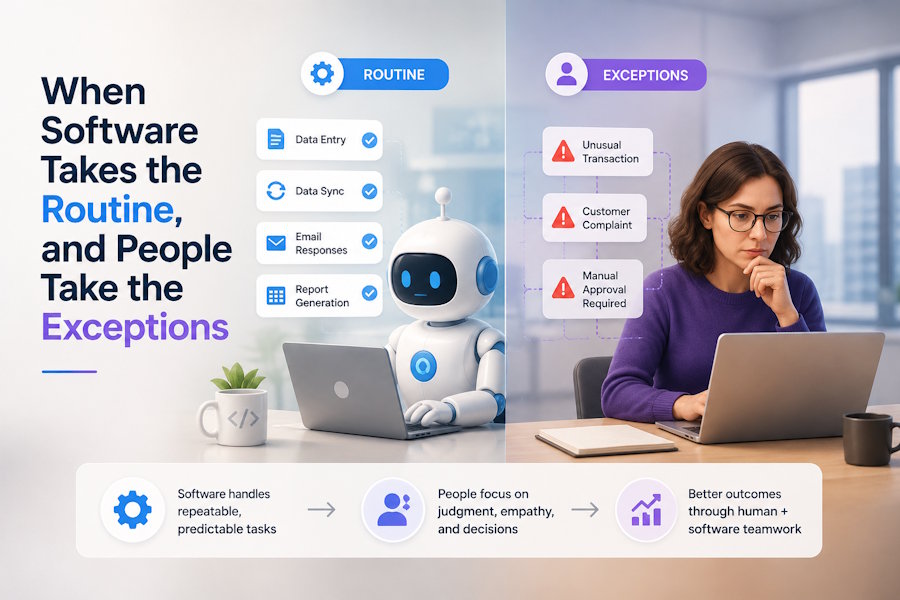
The most useful arrangement in service operations is rarely the fully automated one or the fully human one. It is the division of labour between them: software absorbing predictable requests, and people handling everything that does not fit the pattern.
What Software Is Genuinely Good At
Automation excels where the request is clear, the answer is known, and the process is consistent. Checking an order status, resetting a password, confirming an appointment and updating an address are all tasks where speed matters and judgement does not.
Software also does these things at three in the morning without complaint, at whatever volume arrives. That availability is difficult to match with people alone, and customers with simple questions generally prefer an immediate answer to a queue.
What People Do That Software Cannot
The moment a request stops being typical, the advantage reverses. Situations involving several problems at once, unusual circumstances, an unhappy customer or a decision requiring judgement are exactly where a person outperforms any system.
People notice what was not said. They recognise when a caller is upset about something other than the stated issue. They can decide that a rule should be bent, and they can explain a refusal in a way that leaves the relationship intact.
The Handover Is Where It Succeeds or Fails
The most common frustration in automated service is not the automation itself. It is being trapped in it, repeating information already provided, unable to reach a person.
Well-designed systems make the escalation path obvious, transfer the full context so the customer does not repeat themselves, and treat frustration as a trigger for handover rather than something to manage. Conversational AI has improved considerably at detecting when a conversation is going badly, and using that signal to hand over early is a better design decision than using it to try harder.
The Effect on the Work Itself
Removing routine contacts changes what remains, and this deserves planning. When software handles the simple half of the volume, the remaining work is more complex, more emotionally demanding and more varied.
That has implications for hiring, training and workload. Teams handling only difficult contacts need deeper product knowledge, stronger judgement and more support. Measuring them against handling times built for a mix that no longer exists produces unfair targets.
Deciding Where the Line Sits
The practical method is to review a sample of recent contacts and sort them honestly. Which were genuinely routine? Which required judgement? Which were routine but emotionally sensitive, where a person may still be the right answer?
That exercise usually reveals a clearer boundary than any general policy, and it shifts over time as systems improve and product changes remove some categories.
Designing Around the Customer
The aim is not maximum automation. It is getting each customer to the right resolution quickly.
Organisations that measure this properly, by asking whether the issue was resolved rather than how it was handled, generally end up with a sensible balance. Software takes the volume, people take the complexity, and the transition between them is smooth enough that customers stop noticing which one they started with.

