

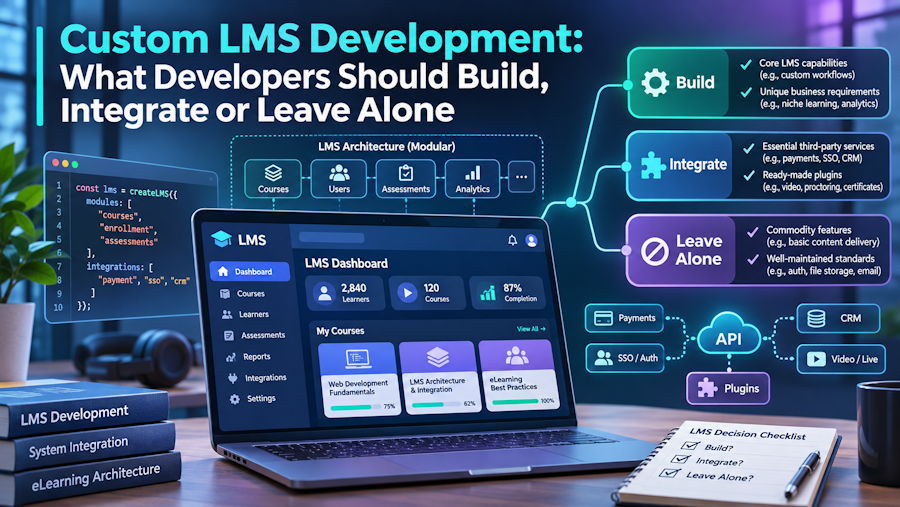
The short answer is this. Build the parts of the LMS that encode how your organisation actually teaches, assesses, and proves compliance. Integrate everything that is a solved problem, such as video delivery, payments, and single sign on. Leave the rest alone, including features that look impressive in a demo and get used twice a year. Most custom LMS development projects go wrong not because the team cannot code, but because those three piles get mixed up at the start and nobody sorts them out until the budget is gone.
This guide is for developers and CTOs facing that sorting problem. The real question is not whether to build, buy, or extend. It is which parts of the system deserve your engineering time, and which parts will quietly eat it.
What is actually worth building
Custom code earns its keep where your learning model differs from everyone else's. If your platform certifies electricians for regulated work, places nursing students in clinical rotations, or sells cohort based courses to enterprise clients who each need their own branding, permissions, and reporting, no off the shelf product models that cleanly. That logic is your product.
The permission model is one of them. Commodity products offer roles like admin, instructor, and learner. Real organisations have regional managers who see three countries and not a fourth, auditors with read only access for one programme, and client administrators who must never see another client's data. Bolting a complex permission model onto a platform that assumed simple roles is one of the most common reasons LMS projects stall.
Reporting is another. Built in reports answer the vendor's questions, not yours. If a regulator or a paying client defines what evidence you must produce, the reporting layer that produces it is core logic. Completion percentages are easy. Defensible audit trails, with who did what, under which version of the course, and when, are not.
Then there is the learner facing experience, but only where it differentiates. If your product competes on a guided path or adaptive sequencing, build that layer properly. If learners simply need a clean course list and a reliable player, your own front end is a vanity project.
Finally, build your data model and event pipeline as if they were the product, because over time they are. Interfaces get replaced, but the record of what learners did accumulates value every year. Teams that treat learning data as something to scrape out of logs later end up rebuilding their analytics within three years.
LMS architecture: boring where possible, careful where it counts
Good LMS architecture is mostly restraint. For the majority of platforms, a modular monolith with clear internal boundaries beats a fleet of microservices. One codebase, separated into modules for identity, catalogue, enrolment, delivery, assessment, and reporting, will carry most products further than their teams expect. Microservices solve problems of independent scaling and team autonomy. An LMS with forty thousand learners has neither, and adopting them early buys distributed systems pain instead.
Keep content delivery, assessment, and reporting readable as separate concerns even inside a monolith, because they change for different reasons and at different speeds. Video transcoding, certificate generation, and report exports belong in background jobs on a queue, never in the request path. A learner clicking resume should never wait for a PDF to render.
Multi tenancy deserves an early decision, not a late refactor. Decide whether tenants share a database with a tenant key on every table or get separated schemas, and enforce it from the first month. Retrofitting tenant isolation onto a single tenant data model is one of the few genuinely painful jobs in this field. Plan for content as a separate asset too, because courses outlive the platform that delivers them. If your content can only exist inside your own database tables, you have built a trap for your future self.
The standards: SCORM, xAPI, and LTI
Standard work is unglamorous and unavoidable. The three names that matter are SCORM for packaged content, xAPI for learning records, and LTI for plugging in external tools.
SCORM is the old workhorse. A package is a zip file with the course and a manifest, which the LMS launches in a player and tracks through a JavaScript runtime. SCORM 1.2 is primitive, one score and one completion status, but almost everything still runs it. SCORM 2004 added better status handling and sequencing that few authoring tools implement fully. Practical advice: support SCORM 1.2 and 2004 playback well, and do not build your own authoring tool to replace the mature ones your content teams already use. SCORM tells you a learner finished and what they scored. It says little about what they did inside the course.
That gap is what xAPI was designed to fill. xAPI describes learning as statements in the form of actor, verb, object: Maria completed the simulation, Tomas answered question four incorrectly. Statements go to a Learning Record Store, and can come from mobile apps, simulators, and offline devices. If you expect learning to happen anywhere other than a browser course player, xAPI is worth adopting early, because retrofitting event capture onto a finished product produces patchy data nobody trusts. A small set of verbs, used consistently, beats an ambitious taxonomy that three teams interpret three ways.
LTI, Learning Tools Interoperability, solves the opposite problem. It lets external tools behave as if they were part of your LMS. A virtual classroom, a coding exercise tool, or a proctoring service launches from inside a course, receives the learner's identity and role securely, and can pass grades back. LTI 1.3 is the version to implement, since it is built on OAuth 2.0 and OpenID Connect and includes services for roster sharing and grade return. Institutional buyers ask about it in procurement, usually before features.
Build, integrate, or leave alone
The table below is the decision in compressed form.
| Area | Decision | Why |
|---|---|---|
| Learning model and workflow logic | Build | This is the product. Nobody can sell it to you. |
| Permissions and multi tenancy | Build | Too structural to retrofit or delegate. |
| Compliance reporting and audit trails | Build | Defined by your regulator or clients, not by a vendor. |
| Video hosting and transcoding | Integrate | Mature services do this better and cheaper. |
| Payments and subscriptions | Integrate | Card handling and tax rules are a liability, not a feature. |
| Single sign on (SAML, OIDC) | Integrate | Standards based, well tested providers exist. |
| Virtual classrooms | Integrate via LTI | Building live video is a second company, not a feature. |
| Content authoring | Integrate or support imports | Authoring tools are deep products. Accept their output. |
| Email and notifications | Integrate | Deliverability is a specialty of its own. |
| Proctoring and plagiarism checks | Integrate | Specialist vendors carry the research and the legal exposure. |
| Generic gamification, points and badges | Usually leave alone | Rarely moves completion rates without evidence behind it. |
| A native mobile app on day one | Usually leave alone | A responsive web app serves most learners at first. |
LMS integration: where projects actually bleed time
Ask teams what took longest in their last LMS project and few will name a feature. Integrations consume the calendar. LMS integration means connecting the platform to the systems that already run the organisation: the HR system, the CRM, the student information system, the identity provider behind single sign on, and a data warehouse.
This is also where teams whose bottleneck is experience, rather than intent, often bring in outside help, because integration work is where estimates go to die. One option is Selleo's custom LMS development team, which has been building software since 2005 and also built Mentingo, its own AI powered LMS, so it has seen these problems from the product side as well. Selleo offers a free two week trial sprint, which lets a team judge the fit on a real integration before committing to more. That kind of evidence is worth more than any sales call.
Three lessons recur. First, decide for every integration which system owns each field, and write it down. Most sync bugs are really ownership disputes that nobody settled. Second, design for failure. Feeds break, APIs time out, and an HR import that silently half completes on a Friday produces a Monday morning of locked out employees. Idempotent imports, visible error queues, and a manual retry path are not gold plating. They are the feature. Third, treat identity mapping as a first class problem, because merging identities after records have accumulated under both is slow and error prone.
Webhooks and a documented public API are worth building early. Every integration built against your own clean API makes the next one cheaper. Every one built as a script against the database makes the next one a negotiation.
When extending beats a rewrite
Most teams that ask about custom LMS development are not starting from zero. They have a platform, users, content, and a list of complaints. The default answer for a working platform should be extension, not replacement. A rewrite discards things that appear in no requirements document: years of learning records, integrations that quietly work, and content that only runs correctly in the current player. Migration is the riskiest part of any LMS project, and a rewrite makes everything a migration.
Extension, done patiently, looks like this. Stabilise what hurts most, usually performance and reporting. Replace one boundary at a time, putting a clean API in front of an ageing module before rebuilding behind it. This strangler approach is slower to describe in a board presentation and much faster to value, because users see improvements in months rather than a promised relaunch in two years.
A rewrite is justified in a short list of situations: the stack is end of life and cannot be secured, the data model makes a required change such as multi tenancy impossible, or licensing blocks the business model. If none of those is true, the honest recommendation is usually to extend, and a partner who tells you that is probably worth listening to.
FAQ
Do we need SCORM support if all our content is built in house?
Probably some, eventually. Partners send content, and acquisitions arrive with libraries of existing packages. Supporting SCORM playback is cheap insurance against content you do not control yet.
How long does custom LMS development take?
A focused extension, one module or workflow, can ship in weeks. A new platform typically takes several months to reach real learners, and longer to reach maturity. Any estimate that does not ask about integrations, content migration, and permission complexity first is a guess wearing a suit.
Open source platform or fully custom build?
Extending an open source platform suits teams whose needs sit close to standard course delivery. A fully custom build suits teams whose learning model, tenancy needs, or business model fight the platform every sprint. The middle path, open source core with custom modules, is where many projects end up.
What drives the cost most?
Not the course player. Integrations, migration, reporting obligations, and permission complexity drive LMS cost, roughly in that order.
A closing rule of thumb
When a feature is proposed, ask three questions. Does it encode something about our teaching or our obligations that no vendor can know? Does a mature product already do it better? Will anyone tell, six months after launch, whether we built it at all? Custom LMS development done well is mostly the discipline of saying no, clearly and early, so that the few things you do build get the time and testing they deserve. Build the learning model. Integrate the plumbing. Leave the rest alone.

