

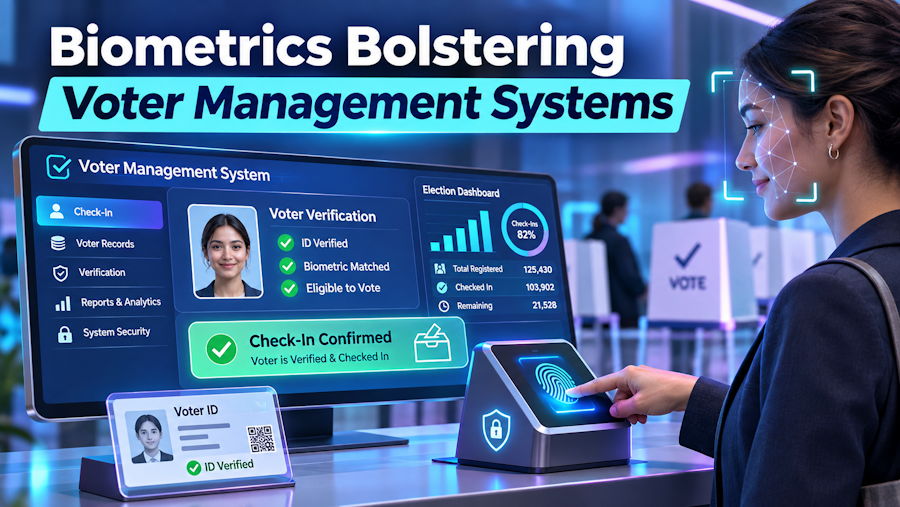
Every election rests on a list. It sounds like a small thing, a list, but the credibility of the whole exercise sits on it. If the voter roll contains dead people, duplicates, and names nobody can account for, the losing side will find them, quote them, and use them to argue that the result cannot be trusted. Sometimes they will even be right.
Keeping that list honest has always been the hard, unglamorous part of running elections. People move house and register again in the new district without the old entry ever being removed. People die and stay on the roll for years because the death registry and the electoral registry were never properly joined up. People share names, fathers and sons in the same street, cousins across a whole region, so checking a name against a name proves less than officials would like. And in places where identity documents are not universal, a determined person can register twice under two spellings and vote twice, once at each station, with nobody the wiser.
This is the problem biometrics was brought into election management to solve. Not to run the election, and not to replace officials, courts, or observers. Just to answer, reliably and at national scale, the question the whole system depends on: is this person one unique, eligible voter, and have they already voted?
What a biometric voter management system actually is
The phrase covers more than the fingerprint scanner people picture at a polling station. That scanner is only the last step of a long chain.
A voter management system built on biometrics is the software layer that takes a country, a state, or a city's population of registered voters and manages it through the life of an election: who is registered, whether they are eligible for this particular vote, which polling station they belong to, whether they turned up, and whether they were allowed to vote. The biometric part sits underneath and inside that process. It provides the identity proof that ties each record to one real person, at registration, during the cleaning of the roll, and again on election day itself.
To see how it works, follow a single voter through it.
Step one: registration, done once and done properly
Registration is where the quality of everything later is decided. A citizen arrives at a registration centre, or meets a mobile registration team in a village or a school hall, and gives their biographic details: name, date of birth, address, and whatever else the law of that country requires. Then their biometrics are captured. Usually that means fingerprints, often several fingers or all ten, and a facial photograph taken to a set standard. Some programmes add iris images, particularly where fingerprints in the population are known to be difficult.
The capture is checked for quality on the spot. A fingerprint image too poor to match reliably is retaken there and then, while the person is still standing at the desk. That small detail matters more than it sounds. A registration drive cannot come back later to fix a bad capture, and a poor print stored today becomes a voter who cannot be verified in three years' time, through no fault of their own.
In many countries registration happens far from any reliable internet connection, so enrolment kits are built to work offline: a laptop or tablet, a fingerprint scanner, a camera, a battery. Records are stored securely on the kit and synchronised with the central system when the team reaches connectivity. Citizens in some systems can also start the process themselves, submitting their biographic details through an online portal and receiving a code to present at the enrolment centre, which shortens the visit and spreads the workload of a registration period that might otherwise crush a small staff in the final week.
Step two: the deduplication run, where biometrics earns its money
Once registration closes, or at set points during a continuous registration system, the new records are searched against the entire existing roll. Not name against name. Fingerprint against fingerprint, face against face, across millions of records.
This is the one job in election administration that simply cannot be done by people with clipboards. Searches on that scale run on an automated biometric identification system, an ABIS, the kind of engine built to compare fingerprint and face records across an entire national database at once. A voter who registered in the capital in 2019 and again in their home district in 2025, with a slightly different spelling, looks like two legitimate voters in any name based check. To a biometric search, they are one person enrolled twice, and the system flags the pair for review.
Review is the operative word. A well run system does not delete people. A possible duplicate goes to election officials for adjudication, where documents are checked and a decision is made and recorded, because wrongly striking a real voter off the roll is a far more serious error than carrying a duplicate a little longer. The software's job is to find the needle. Disposing of it stays a human, accountable act.
In practice, a biometric voter management system sits on top of a central identity registry, with the underlying biometric engine handling the consolidation, quality checks, and deduplication of the identity data before the voter records are ever used. The electoral layer then works from that cleaned registry as its single source of truth, which is why the voter lists that eventually reach polling stations carry fewer ghosts than the lists most people are used to.
Step three: building the roll for this election, not the last one
A cleaned registry is not yet a voter roll. Between the two sits eligibility, and eligibility changes with every election.
For each electoral event, the election commission works in a dedicated space for that vote, whether it is a national election, a parliamentary contest, local elections, or a by election in one district. The system draws from the central registry only the people who meet the legal requirements for that event: old enough by election day, citizens, resident in the right place, and not disqualified under the rules that apply there. Electoral geography is configured to match the real boundaries on the ground, regions broken down into counties, districts, and individual voting stations, and each voter is assigned to a station.
That assignment is more useful than it looks. It tells organisers how many ballots, staff, and verification kits each station needs. It also lets voters check, through a public portal, where their station is, using a personal identification number, instead of queuing at the wrong school hall on the morning of the vote and being turned away.
When voters move between districts during the preparation period, their assignment moves with them in the system, and the final voter lists are generated in the form the law requires, national rules on format and content included. What reaches each polling station, printed or loaded onto an electronic poll book, is a local subset: the voters of that station, and nobody else.
Step four: election day, and one person, one vote
On the day itself, the system has to do something simple under difficult conditions: heat, queues, tired staff, and in many places no connectivity at all.
The voter states their name or presents a document, and the official finds the record in the station's list. Then the biometric check. The voter places a finger on the scanner, or looks at a camera, and the live capture is matched against the template stored in the registry record for that voter. It is a one to one comparison, is this the person named in this record, and it takes seconds. Software in better systems can also search the live print within the station's voter subset, which helps when records are misfiled or a name was spelled differently at registration.
Once verified, the voter is marked as having voted in the local device. That mark is the quiet revolution in the whole design. It means the same person cannot walk to another station across town and vote a second time, because their record no longer shows an unused vote. Where devices sync during the day, that protection works across stations in near real time. Where they cannot, the marked records reconcile when the devices come back, and any double voting attempt shows up in the data afterwards for investigation. Indelible ink has been doing a version of this job for generations, and in many places still does. The biometric version adds something ink cannot: a record that can be checked, counted, and audited.
Turnout data flows the other way too. Commissions can publish running turnout figures during the day, which observers and parties can watch, and after the close of polls the verification data becomes part of the audit trail behind the result.
What all of this buys an election
The benefits stack up in a particular order, and the first is the least visible: a roll people can defend. A deduplicated register, built from biometric enrolments rather than accumulated paper forms, removes the easiest lines of attack on an election's legitimacy. There will always be disputes about campaigns and counting. There need not be much of a dispute about whether thousands of the voters existed twice.
Fraud that depends on identity gets harder in specific, practical ways. Registering under multiple names fails at the deduplication run. Voting on behalf of a dead relative or an absent neighbour fails at the scanner, because the finger at the station has to belong to the person in the record. Voting twice fails at the marked record. None of this makes an election fraud proof, and anyone who claims otherwise is selling something. It closes the doors that were standing open.
There is an inclusion argument too, and in some countries it is the strongest one. Biometric registration gives a firm identity to citizens who lack the paperwork that paper based systems demand: no birth certificate, no fixed address, a name that exists in three transliterations. Enrolled once, with fingerprints and a photograph, such a voter is findable and verifiable in a way a paper record never made them. Their vote stops depending on whether a local official knows their face.
And there is money, over time. Registration is the expensive part, and it is done once. The same registry then serves election after election, by elections, local votes, and updates in between, instead of the full re registration exercises that used to precede major votes in some countries and consumed much of the election budget before a single ballot was printed.
The honest limits
An article that only lists benefits would be doing the reader a disservice, because biometric election systems have failed in public when their limits were ignored.
Registration coverage decides everything. A deduplicated roll of only part of the eligible population is a clean list of the wrong thing, and the voters missing from it tend to be the poorest, the most remote, and the hardest to enrol. The technology cannot fix a registration drive that never reached a region. It can only refuse, politely and accurately, to verify the people who were never enrolled, which on election day looks exactly like disenfranchisement whatever the cause.
Bodies also resist systems. Elderly voters and people who have worked with their hands all their lives may have fingerprints too worn for a quick match. Any serious deployment needs a fallback that is designed, documented, and trained in advance: another finger, a face check, a supervised manual override that is logged and countable. The fallback will be used. The question is whether it is used inside the rules or invented at a crowded table at 7 in the morning.
The central database is itself a sensitive thing. A national biometric registry of voters is a prize target and a political argument waiting to happen. It needs a legal framework that says what the data is for, how long it is kept, who may search it, and what it may never be used for, and those rules need enforcing in practice, with encryption, access controls, and logs that someone actually reads. Voters who suspect the register will be used to watch them will not register, and they will not be entirely wrong to hesitate.
Finally, biometrics verifies voters. It does not count ballots, secure tallying, or make a commission trustworthy. An election can have a flawless roll and still be badly run in every other respect. The roll is the foundation. Foundations matter enormously, and they are not the house.
Why commissions keep coming back to it
For all the caveats, the direction of travel is consistent, and it is driven by arithmetic rather than fashion. Voter populations grow. Paper systems for checking identity do not scale with them, and the cost of disputed results, in money, time, and public confidence, dwarfs the cost of the systems that prevent the most common disputes.
A biometric voter management system, properly run, gives an election commission three things no paper process can offer at the same time: a register with each person on it once, a check at the polling station that the person voting is the person registered, and a record afterwards that can be audited rather than argued about. Elections are, in the end, an argument a society has with itself about who won. Anything that shrinks the part of that argument spent doubting whether the voters were real is work worth doing.

