

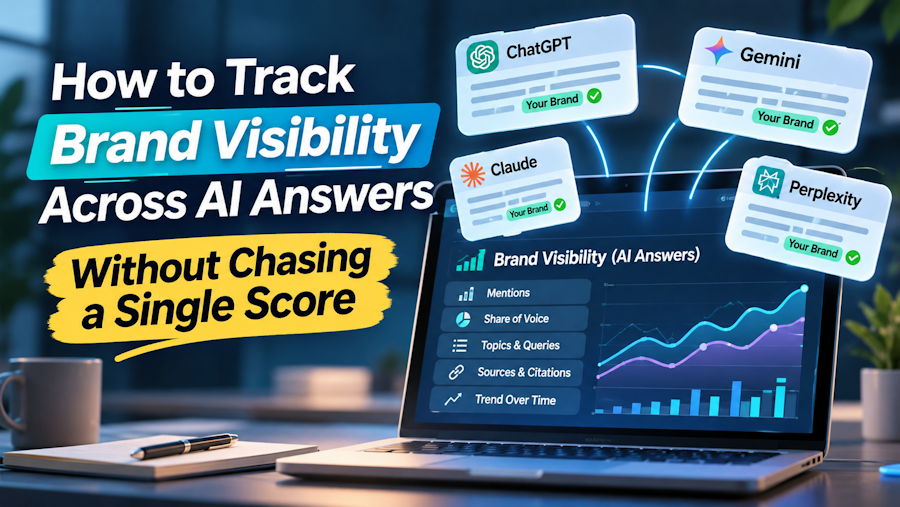
An AI-search program should track whether a brand appears for important customer questions, whether the description is accurate, and which sources support the answer. An AI visibility tracker can organize those observations across repeated prompts, but the score is useful only when the team can trace it back to specific questions and evidence gaps.
The correct unit of work is not the brand name; it is a decision-focused question cluster. Pricing logic, compatibility, integrations, limitations, use cases, migration, security, and comparisons each require different supporting pages. Monitoring shows where the brand is missing, while editorial and product work provide the evidence that can change future answers.
Build a Question Set Around Customer Decisions
Start with questions people ask before they shortlist, compare, purchase, implement, or replace a product. Include broad category questions, high-intent workflow questions, compatibility concerns, and post-purchase issues. Group them by intent so a change in one cluster does not disappear inside an overall average.
Keep a fixed benchmark set for trend analysis and a smaller rotating set for emerging language. The fixed questions reveal change over time; the rotating questions help the team learn how the market is evolving. Record the exact wording, model, date, country, and whether the session had personalization.
Measure Accuracy and Citation Quality, Not Mentions Alone
A mention can be wrong, outdated, negative, or unsupported. Score whether the brand is described accurately, whether the answer reflects the intended category, and whether linked sources are relevant and current. A citation to an unrelated homepage is weaker than a citation to a clear page that directly supports the claim.
Separate visibility from preference. An assistant may mention a company without recommending it, or recommend it for a narrow use case. Capture the context rather than compressing every appearance into the same number. This produces better decisions for content, product messaging, and public documentation.
Turn Monitoring into a Content Backlog
For every important gap, identify the missing evidence. The remedy might be a comparison page, integration guide, pricing explanation, methodology, case study, API reference, or correction to inconsistent product language. Assign an owner and define what a useful page must answer.
Do not create dozens of thin pages that repeat the same paragraph. Consolidate overlapping questions into durable resources with definitions, examples, limitations, update dates, and clear internal links. Strong source pages help both human readers and systems that summarize them.
Define the Job Before Selecting Settings
The starting question is not which model or preset looks most impressive. It is what decision the finished asset or report must support. For SaaS companies, ecommerce brands, publishers, agencies, product marketers, and SEO teams, the recurring challenge is understanding whether AI assistants mention a brand accurately and cite useful evidence across real buyer questions. Write that job in one sentence and name the person who will approve the result.
Prepare a stable question set, current brand facts, important landing pages, representative competitors, and repeated samples from the models and markets that matter. Source quality sets the ceiling for the workflow. A vague prompt, noisy recording, inconsistent photo, unsupported claim, or incomplete technical requirement cannot be repaired reliably by adding more settings. Record the source and the non-negotiable details before the first run.
Define the expected output as a prioritized list of missing topics, inaccurate answers, weak citations, and pages that need stronger evidence or clearer structure. This keeps the team from confusing a polished preview with a finished deliverable. It also establishes where conventional editing, verification, reconstruction, or layout work will still be required.
Use High-Frequency Search Language as Reader Questions
Readers commonly search for AI visibility tracker, AI search visibility, generative engine optimization, GEO, answer engine optimization, brand monitoring, AI citations, ChatGPT visibility, AI rankings, and LLM visibility. Those phrases should appear where they clarify the task: in the title, opening answer, relevant subheading, definition, or example. Repeating the same keyword in every paragraph weakens the article and makes the linked product feel forced.
Build topical depth by answering adjacent questions. Explain the best input, the step-by-step workflow, the most common failure, the review criteria, the limitations, and the point at which a human must decide. This structure is more valuable to a searcher than a list of features because it helps the reader complete a real job.
Use related terms naturally and accurately. A category phrase can introduce a tool, while task language explains why it belongs in the process. Avoid unsupported “best,” “fastest,” or “most accurate” claims. Search visibility earned through useful explanation is more durable than exaggerated copy.
Run a Controlled First Test
Choose one representative example, such as a software company that appears in broad “best tools” answers but disappears when prospects ask about integrations, data handling, migration, or a specialized workflow. Write acceptance criteria before using the tool. The criteria should describe visible, audible, factual, or functional qualities that a reviewer can check. They should not be vague goals such as “make it professional” or “get a good result.”
Run one focused attempt, record the settings, and compare the result with the source. If it misses the objective, change one meaningful variable at a time: improve the source, narrow the instruction, choose a different mode, or adjust the destination format. Changing everything at once produces more outputs but less learning.
The purpose of the first test is to discover which parts of the workflow are stable. A successful candidate should be repeatable enough that another person can understand why it passed. If approval depends only on one creator’s memory, the process will break when the team scales.
Review the Result Where It Will Be Used
Inspect question coverage, brand mention, factual accuracy, citation quality, competitor context, source freshness, referral behavior, and whether the cited page actually answers the query. Review in context: place the video inside a vertical feed, listen to the candidate beside the suspected release, rotate the game asset, read the AI answer with its cited page, open the public evidence, or place the image in the actual layout. Destination context reveals failures that a standalone preview hides.
A useful status system has three labels: candidate, checked, and approved. A candidate came from the tool but has not been verified. A checked result passed the defined technical or factual review. An approved result is fit for the named destination and has the necessary rights and permission.
Do not lower the review threshold simply because generation was fast. The most common failure in this category is treating one model response or one visibility percentage as a universal ranking, even though answers change with prompt wording, model version, location, time, and user context. Treat that risk as part of production, not as a disclaimer added after the decision.
Keep an Audit Trail for Iteration and Handoff
For every run, save the brief, source, link or file, settings, result, review note, and final decision. The record does not need to be elaborate. A compact table is enough to show what changed, who checked it, and why one candidate moved forward.
This audit trail reduces repeated mistakes. It also protects against certainty drift, where an uncertain result becomes more confident each time it is copied into a new document. Preserve the original wording, source date, and limitations whenever information moves between people or channels.
Create reusable templates for decisions, not identical prompts. A strong template asks for audience, goal, source rights, required details, destination, rejection criteria, reviewer, and disclosure. The creative or investigative instruction should still be written for the specific task.
Measure Usable Outcomes Instead of Activity
Generation count, search count, or report count is not the business outcome. Measure coverage of priority questions, accurate mentions, citations from controlled pages, qualified referral traffic, assisted conversions, and time required to correct an inaccurate answer. These metrics reveal whether speed at the beginning creates extra correction later and whether the process improves across comparable tasks.
Review several examples rather than celebrating one unusually clean result or abandoning the workflow after one edge case. A small sample of repeated briefs shows which inputs are reliable, where review time accumulates, and which correction should move earlier.
Pair performance data with qualitative notes. A clip can receive attention while misrepresenting a product. A music match can feel convincing but identify the wrong version. A visibility score can rise while citations remain poor. A face report can be consistent yet still be subjective. A marketing image can look polished while changing the packaging. Approval must connect numbers with the real purpose.
Build a Small Benchmark Library
A benchmark library makes quality visible. Select five to ten representative tasks: one clean input, one typical input, one difficult edge case, and examples from the channels or audiences that matter most. Keep the expected outcome and review criteria beside each example. When the workflow, provider, model, or interface changes, rerun the same tasks before assuming the new version is better or worse.
The benchmark should include failures, not only showcase material. A difficult source reveals whether the system reports uncertainty, preserves important details, or produces a plausible result that could mislead a hurried reviewer. Keep the original input and the reason each output passed or failed. This is more useful than a gallery of attractive examples with no acceptance standard.
Refresh the library when the real workload changes. New products, new distribution formats, different audiences, and updated regulations can make an old test set irrelevant. Record the date of each benchmark and the environment in which it was run. The goal is not to create a permanent leaderboard; it is to maintain a practical reference for current decisions.
Know When a Manual Method Is Better
Automation is valuable when it reduces repetitive work or helps a team explore several directions. It is a poor fit when the task requires exact typography, legally significant wording, reliable identity verification, clinical interpretation, pixel-perfect reconstruction, or a factual conclusion that the available sources cannot support. In those cases, a conventional editor, authoritative catalog, qualified professional, or direct verification process may be faster and safer.
Use an escalation rule. If two controlled attempts fail the same acceptance criterion, stop generating and inspect the source or choose another method. If the error affects a product claim, identity association, face interpretation, attribution, license, or public factual statement, require a second reviewer before release. Clear escalation prevents teams from spending time on repeated variations that cannot solve the underlying problem.
Hybrid workflows are often strongest. Let the tool create a first draft, shortlist, visual concept, or evidence map; let a person perform the exact edit, factual check, rights review, or final layout. The division should follow risk and precision, not excitement about automation.
Rights, Privacy, and Responsible Use
Responsible practice is part of editorial and production quality. Teams should publish verifiable information, keep claims current, distinguish evidence from opinion, and avoid fake reviews, manufactured citations, or content written only to manipulate assistants. Technical availability does not automatically create permission to reuse a file, profile, photograph, recording, or generated result.
Apply data minimization. Submit only what the task requires, restrict access to the people involved, and remove temporary material when it is no longer needed. Preserve licenses, consent records, source links, and disclosure decisions with the project notes.
When an output is synthetic, edited, inferred, incomplete, or model-dependent, describe it honestly. The level of disclosure should match the risk. A private concept test may need a small note; a commercial claim, identity association, face analysis, or documentary use may require stronger evidence and a prominent explanation.
A Publication and Handoff Checklist
Before approving the work, ask:
- Does the result answer the original question rather than a nearby one?
- Can the important details be compared with the source?
- Are linked claims supported by current first-party or original evidence?
- Have uncertainty, missing coverage, and model-dependent behavior been retained?
- Does the format work in the actual destination?
- Have rights, consent, privacy, and disclosure requirements been checked?
- Would a second reviewer understand why this result was accepted?
- Is there a clear next step if the result fails after publication?
If an answer is unclear, return to the relevant stage instead of generating more variations blindly. A better source, narrower question, or stronger acceptance criterion often improves the result more than a longer prompt.
Conclusion
A durable AI search visibility and generative engine optimization workflow combines a narrow brief, controlled testing, contextual review, and an honest record of limitations. The tool accelerates discovery or production, but the user still defines the purpose, protects the source, interprets uncertainty, and decides whether the result is fit for use.
The best next experiment is small. Choose one representative task, write the acceptance criteria, run one controlled attempt, and record what required correction. That evidence will show whether the workflow saves time without sacrificing accuracy, clarity, consistency, or responsibility.

