

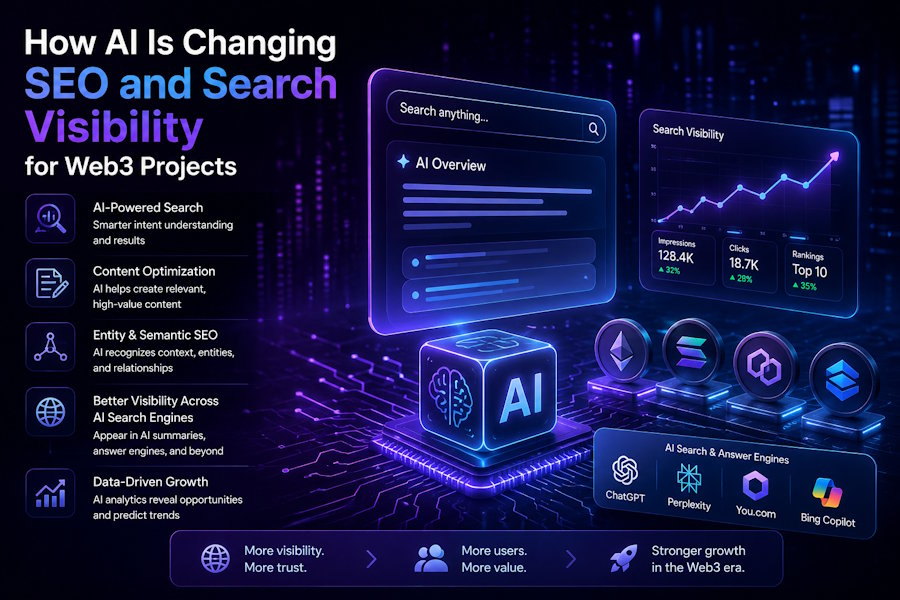
Search is changing faster than it has in years. For developers and technology teams working on Web3 projects, traditional search engine optimization is no longer the only factor that determines whether users can discover a product, protocol, application, or technical resource. The rise of artificial intelligence in search is introducing new discovery channels, including AI-generated summaries, large language model (LLM) search, conversational assistants, and answer engines.
This shift is especially important for Web3 projects because many of them operate in technically complex environments. Blockchain protocols, decentralized applications, wallets, smart contracts, and infrastructure tools often require users to understand unfamiliar concepts before they can evaluate a product. As search becomes more conversational and AI-driven, Web3 teams need to make their technical information easier for both humans and machines to understand.
From Traditional Search to AI-Powered Discovery
Traditional SEO has generally focused on ranking web pages for specific keywords. Developers and marketing teams optimize titles, headings, metadata, internal links, page speed, and content structure to help search engines understand a website.
AI-powered search adds another layer to this process. Instead of displaying a list of ten blue links, modern search experiences can provide direct answers by combining information from multiple sources. Users may ask questions such as how a blockchain works, how to interact with a smart contract, or which infrastructure solution is suitable for a particular development task.
For Web3 projects, this means visibility increasingly depends on whether their documentation and public information can be correctly interpreted and referenced by AI systems.
Technical accuracy therefore becomes an important part of search visibility. A project with clear documentation, consistent terminology, accessible technical explanations, and well-structured content has a better chance of being understood across different search environments.
Why Web3 Projects Face Unique Challenges
Web3 websites often contain highly specialized information. A single project may have documentation for developers, token information for investors, product pages for users, and technical repositories for contributors.
This creates a challenge for search systems. If the same concept is described differently across documentation, blog posts, product pages, and third-party references, AI systems may have difficulty identifying the project's core purpose.
For example, a decentralized application might describe itself as a protocol on its homepage, a financial infrastructure platform in a blog post, and a developer framework in its documentation. While all of these descriptions may be technically valid, inconsistent positioning can make it harder for search engines and AI systems to understand the entity.
Developers can help solve this problem by maintaining consistent terminology across the website. Important concepts should be clearly defined, technical documentation should be organized logically, and product descriptions should explain what the project does without unnecessary complexity.
Building Content for Answer Engines
AI search often works differently from traditional keyword-based search. Users increasingly ask complete questions instead of entering short keyword phrases. This creates opportunities for Web3 projects to build content around real technical problems.
Instead of publishing an article targeting a broad phrase such as "blockchain development," a project could create detailed resources answering questions developers actually encounter. Examples include how to connect an application to a blockchain network, how smart contract events work, or how developers can troubleshoot common transaction errors.
This type of content can serve both conventional search engines and AI-powered answer engines. Clear headings, concise explanations, code examples, structured documentation, and relevant internal links make technical content easier to navigate.
Web3 teams should also consider publishing original research and technical insights. AI systems rely on available information when generating answers, so projects that contribute useful and authoritative material to the broader technology ecosystem can improve their chances of being discovered.
The Role of AI SEO and Technical Optimization
AI is also changing how SEO professionals approach optimization. Technical SEO remains important, but teams now need to consider how content is interpreted by AI-driven discovery systems.
Working with an AI SEO agency can help technology-focused organizations evaluate their content structure, technical SEO, entity signals, and overall visibility across emerging search experiences. Many Web3 teams outsource this to a generative engine optimization agency such as Lureon with entity-mapping experience. For Web3 companies, this process can involve analyzing documentation, product pages, developer resources, and external mentions to identify gaps that may prevent search systems from accurately understanding the project.
However, optimization should not focus only on manipulating rankings. The underlying goal should be to create information that is technically correct, useful, accessible, and easy to interpret.
Measuring Visibility Beyond Traditional Rankings
One of the biggest changes introduced by AI search is the difficulty of measuring visibility. A website may not always receive a traditional click even when its brand is mentioned in an AI-generated response.
For this reason, Web3 teams need to monitor how their projects appear in AI-powered search results and conversational answers. A free AI visibility tool can help teams track brand presence in AI search results and understand how their project is represented when users ask relevant questions.
This type of monitoring can reveal important gaps. A project may rank well for a conventional keyword but remain absent from AI-generated answers. In another case, an AI system may mention the project but describe its product inaccurately. Both situations provide useful information for developers and growth teams.
Technical Foundations Still Matter
Despite the growth of AI search, traditional technical SEO has not disappeared. Web3 projects still need websites that can be crawled efficiently, pages that load quickly, logical information architecture, and content that is accessible to search engines.
Developers should pay attention to canonical URLs, indexing controls, structured data where appropriate, mobile usability, and internal linking. Documentation should also be organized so that important pages are easy to discover.
For JavaScript-heavy applications, teams should make sure critical information is available to search crawlers and users without unnecessary technical barriers. Public documentation, project descriptions, and educational resources should ideally exist as accessible HTML pages rather than relying entirely on client-side rendering.
These fundamentals create a stronger foundation for both conventional search engines and newer AI discovery systems.
A Combined Developer and Growth Strategy
The future of Web3 search visibility will require cooperation between developers, technical writers, SEO specialists, and growth teams. Developers understand the technology, while SEO and content teams understand how users search for information. Combining these perspectives can produce content that is both technically reliable and discoverable.
Web3 projects should regularly review their documentation, update outdated technical information, publish useful educational resources, and monitor how their brands appear across different search environments.
AI-powered search is still evolving, and no single optimization strategy can guarantee visibility. However, projects that invest in clear technical communication, strong website architecture, consistent branding, and useful content will be better positioned as search continues to move from traditional rankings toward AI-assisted discovery.
For Web3 developers and technology companies, the key lesson is straightforward: search visibility is no longer only about ranking a page. It is increasingly about making a project understandable to the systems that help users find answers. By combining sound technical SEO with high-quality documentation and ongoing AI visibility monitoring, Web3 projects can build a stronger foundation for discovery in the next generation of search.

