

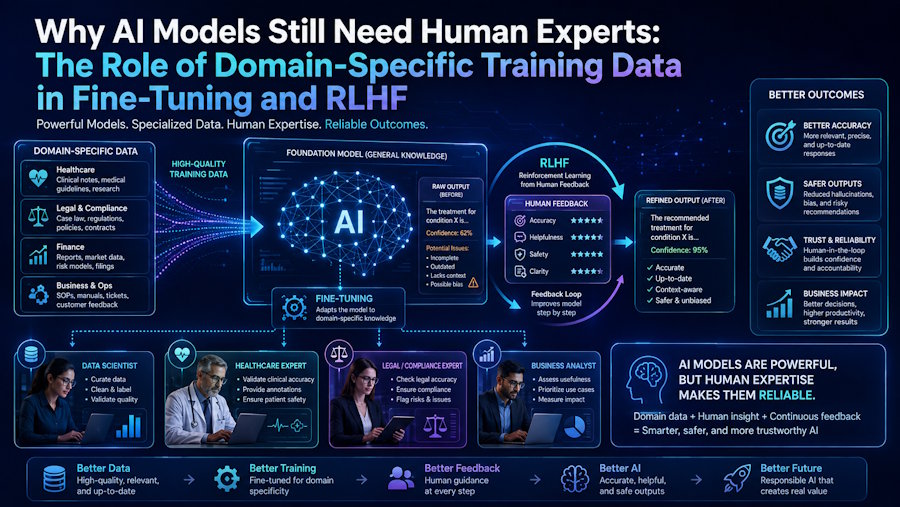
Large language models have gotten shockingly good at sounding smart. Ask one to explain a legal clause, summarize a clinical trial, or debug a distributed system, and the answer will read fluently and confidently. But anyone who has actually deployed a model in a specialized domain knows the uncomfortable truth: fluent is not the same as correct.
The gap between "sounds right" and "is right" is where most AI projects quietly break. And closing that gap almost never comes down to a bigger model or more compute. It comes down to who is teaching the model, and how much they actually know about the subject.
The Data Quality Ceiling
For years, the dominant scaling story was simple: more parameters, more tokens, better results. That story still holds up to a point, but teams building production systems keep hitting the same wall. Once a model has absorbed most of the public internet, throwing more scraped text at it produces diminishing, sometimes negative, returns.
The reason is that the open web is a mixed bag. It contains brilliant expert writing sitting right next to confident nonsense, outdated advice, and marketing fluff, and the model has no reliable way to tell them apart. When you fine-tune on that soup, you inherit its contradictions.
This is why the frontier has shifted from data quantity to data quality. And quality, in specialized fields, is defined almost entirely by expertise. A dataset that a board-certified radiologist would approve of is worth more than ten times its volume in generic health blog posts.
A Quick Refresher: Where Humans Enter the Pipeline
To see why experts matter, it helps to remember exactly where human judgment gets injected into a modern model.
Supervised fine-tuning (SFT) teaches the model to follow instructions using curated input-output pairs. If those pairs are written by people who don't deeply understand the domain, the model learns to imitate shallow answers.
Reinforcement learning from human feedback (RLHF) goes a step further. Here, humans rank or rate multiple model responses, and a reward model learns to prefer what they preferred. The model is then optimized against that reward signal. In other words, RLHF is only as smart as the people doing the ranking. If your raters can't tell a subtly wrong tax answer from a correct one, your reward model will happily reward the wrong one.
Both stages share the same dependency: the ceiling on model quality is set by the humans in the loop.
Why Generic Annotators Fall Short
Most large-scale annotation has historically leaned on general crowdworker pools. That works fine for tasks any literate adult can judge, is this sentence toxic, is this image a cat, is this summary readable.
It falls apart the moment the task requires real expertise. Consider a few realistic examples:
- A model gives two answers about drug interactions. Only a pharmacist can reliably say which one is dangerous.
- A model drafts two versions of a merger clause. Only an M&A lawyer can spot which one quietly exposes the client to liability.
- A model proposes two fixes for a race condition in concurrent code. Only an experienced systems engineer can tell which one just moves the bug somewhere less visible.
Hand these comparisons to a generalist annotator and you don't get signal, you get confident noise that actively degrades the reward model. This is the single most underappreciated failure mode in applied RLHF: the feedback looks complete, the pipeline runs, and the model gets subtly worse at exactly the things you care about.
What Domain-Specific Training Data Actually Looks Like
High-quality expert data isn't just "the same task, done by smarter people." It tends to have a different shape:
- Reasoning traces, not just answers. Experts explain why one response is better, which gives the reward model far richer signal than a binary thumbs-up.
- Edge-case coverage. Specialists naturally probe the weird, high-stakes scenarios that generalists never think to test.
- Calibrated disagreement. When two experts disagree, that disagreement is itself information about ambiguity in the domain, something you want the model to represent, not paper over.
- Correct terminology and framing. Subtle vocabulary errors that a layperson would miss are exactly what erode trust with professional end users.
Building datasets with these properties is a recruiting and operations problem as much as a machine learning one. You need verified professionals, in the right sub-specialty, available on a timeline that matches your training cycles.
Where AI Teams Source Real Experts
This is where a lot of teams get stuck. Posting on freelance marketplaces gets you volume but poor verification. Hiring full-time specialists for a short annotation sprint is expensive and slow. What most serious AI teams do instead is work with Expert Network Companies that maintain vetted pools of professionals across industries and can screen for the exact credentials a project demands.
The advantage isn't just access, it's speed and precision. Instead of hoping a marketplace happens to have a senior semiconductor engineer or a practicing oncologist, you specify the profile and get pre-screened experts matched to it. For fine-tuning and RLHF work specifically, this often takes the form of industry expert consulting projects, where experts are sourced not for a one-off interview but to generate structured feedback, ranked comparisons, and reasoning traces at the scale a training run needs.
For a developer or ML lead, this reframes data collection from "scrape and hope" into a sourcing pipeline you can actually control and audit.
Practical Tips for Building an Expert-Backed Data Pipeline
If you're setting up expert feedback for your own model, a few things save a lot of pain:
- Write your rubric first. Before recruiting anyone, define what "better" means for your task in concrete, checkable terms. Experts disagree far less when the standard is explicit.
- Capture rationales, not just rankings. The "why" is where most of the training value lives. Make it a required field.
- Run a calibration round. Have several experts rate the same small batch and measure agreement. Low agreement usually means your rubric is ambiguous, not that your experts are wrong.
- Version everything. Track which experts, which rubric version, and which model checkpoint produced each label. When results shift, you'll want to know why.
- Mix expertise levels deliberately. Some tasks genuinely need a top specialist; others just need a competent professional. Matching seniority to task keeps costs sane.
Conclusion
The instinct to solve every AI limitation with more scale is understandable, it worked for a long time. But in specialized domains, the binding constraint has moved. The question is no longer "how big is your model" but "how good are the humans teaching it."
Domain expertise is quietly becoming the most valuable input in the entire pipeline. The teams that recognize this early, and build real sourcing operations around expert feedback rather than treating annotation as an afterthought are the ones whose models will actually hold up when a professional puts them to the test.

