

For years, business automation had a hard ceiling. Rule-based systems could handle anything predictable: if an invoice arrives, route it to accounting; if a form is submitted, send a confirmation email. These tools were reliable but rigid. The moment a process involved judgment, exceptions, or steps that depended on unpredictable inputs, automation broke down and a human had to step in. Most of the truly time-consuming work in a company lived precisely in that messy, exception-filled territory that traditional automation could not reach.
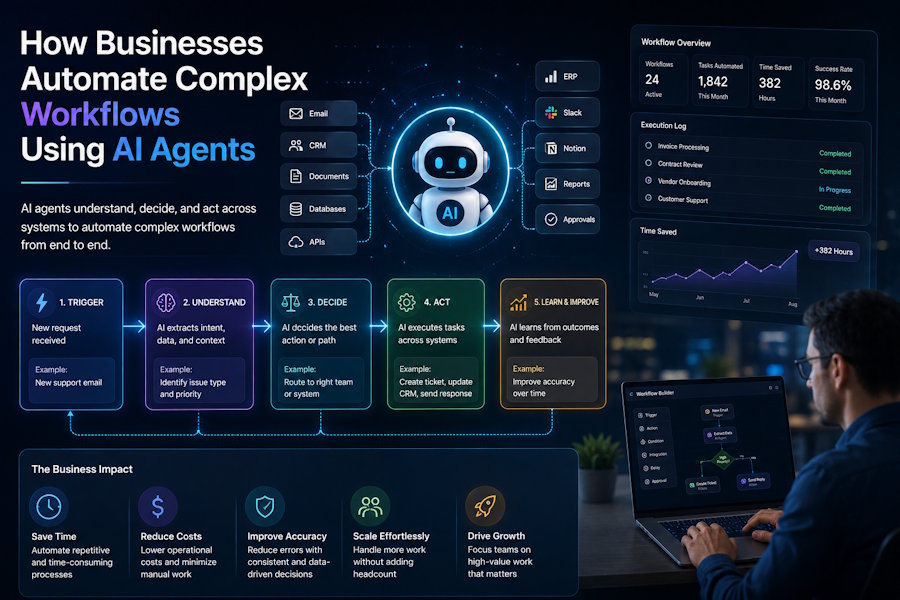
AI agents are changing that equation. Unlike scripted automation, an agent can interpret ambiguous information, make decisions, use multiple tools, and adapt when a process does not unfold as expected. This means the complex, multi-step workflows that once demanded constant human attention are now becoming candidates for automation. Understanding how businesses actually pull this off, rather than just what the technology promises, is what separates successful adopters from those left with an expensive experiment.
What Makes a Workflow "Complex"
Before looking at how agents automate complex work, it helps to define what complexity means here. A simple workflow is linear and predictable. A complex one has several characteristics that traditional automation struggles with. It usually spans multiple systems that were never designed to communicate. It involves decisions where the right next step depends on the specifics of the situation. It contains exceptions that do not fit a neat rule. And it often requires pulling together information from scattered sources before any action can be taken.
Consider processing a customer refund at a mid-sized retailer. It sounds simple, but it might involve checking the order history, verifying the return policy for that specific product category, confirming the item was actually received back, calculating any restocking fee, updating the inventory system, issuing the payment, and notifying the customer. Each step lives in a different tool, and several require judgment about edge cases. This is exactly the kind of chain that agents are built to handle. Platforms like Albato help connect these systems and automate cross-platform workflows, reducing manual handoffs and enabling data to move between apps. When combined with AI agents that can interpret context and handle exceptions, this kind of integration can support more adaptive, end-to-end automation.
The Core Mechanism: Plan, Act, Adapt
The reason agents can tackle this work comes down to three capabilities working together. First, an agent can plan. Given a goal, it breaks the objective into a sequence of steps rather than needing a human to spell out each one. Second, it can act by using tools, connecting to databases, APIs, and software to actually perform those steps instead of merely describing them. Third, and most importantly for complex work, it can adapt. When a step produces an unexpected result or fails outright, the agent notices and adjusts its approach rather than grinding to a halt.
That third capability is what distinguishes agentic automation from the brittle scripts of the past. A traditional automation encountering an unexpected input simply errors out. An agent can recognize the anomaly, try an alternative path, or escalate to a human with useful context about what went wrong. This resilience is what allows automation to survive contact with the messy reality of business processes.
How Businesses Actually Deploy Agents on Complex Work
The companies succeeding with this do not simply point an agent at a tangled process and hope. They follow a recognizable approach. It usually begins with mapping the workflow in detail, documenting every step, decision point, and exception that a human currently handles. This mapping is revealing on its own, often exposing redundancies and unclear rules that were never obvious when the work was buried in people's heads.
From there, businesses connect the agent to the relevant systems. An agent is only powerful if it can reach the tools where work happens, so integration is central. Modern approaches increasingly rely on standardized connection methods that let agents read from and write to real business systems, which is what allows them to operate inside actual workflows rather than in a sandbox.
Crucially, thoughtful deployments keep humans in the loop at the right checkpoints. Rather than handing over the entire process at once, they insert review points where a person approves a decision before it takes effect, especially for high-stakes or irreversible actions. As confidence grows in specific parts of the workflow, that oversight can loosen. This staged approach builds trust while catching problems while they are still cheap to fix.
Grounding Agents in Reliable Knowledge
The single biggest determinant of whether complex automation succeeds is the quality of the information the agent draws on. An agent making decisions across a multi-step process needs accurate, current, and consistent knowledge at every turn. If it references an outdated policy or a contradictory record, one wrong step early in a chain can corrupt everything that follows.
This is why the strongest implementations treat the knowledge foundation as seriously as the agent itself. Businesses building agentic automation on top of a platform that keeps agents grounded in accurate, governed information tend to see far more reliable outcomes than those that let agents improvise from whatever data they happen to encounter. Cleaning up documentation, centralizing verified sources, and controlling what the agent is allowed to reference is unglamorous work, but it is the difference between an agent that behaves like a dependable colleague and one that produces confident, plausible, and occasionally disastrous mistakes across an entire workflow.
A Realistic Example
Picture a professional services firm automating its client onboarding, a genuinely complex workflow. When a new client signs, an agent can collect their submitted documents, verify that everything required is present, create records across the CRM and project management systems, generate a welcome packet tailored to the service purchased, schedule the kickoff meeting by checking team calendars, and assign the account to the right specialist based on documented routing rules.
Along the way, exceptions arise. A document is missing, a requested meeting time conflicts, a client falls into an unusual category. A rigid automation would fail at the first exception. An agent handles the routine cases end to end and flags only the genuine edge cases for a human, complete with the context needed to resolve them quickly. The firm's staff shift from doing the onboarding to supervising it, catching the handful of situations that truly need judgment while the agent absorbs the repetitive majority.
Measuring Whether It Works
Sensible businesses do not assume the automation is helping. They measure. The key questions are whether the agent actually saves time, whether it maintains or improves accuracy compared to the human process, and how often it escalates versus completing tasks independently. A high escalation rate early on is normal and even healthy, since it shows the human checkpoints are working. Over time, that rate should fall in the areas where the agent proves reliable.
Equally important is watching for failure modes honestly. If an agent occasionally makes errors, the response is to understand why, tighten the knowledge or the checkpoints, and improve, not to quietly abandon the effort or, worse, ignore the mistakes. Automation of complex work is an iterative process, not a switch you flip once.
The Bigger Shift
Automating complex workflows with AI agents represents a real change in what businesses can offload to software. The mechanical, exception-filled processes that used to consume enormous human effort are increasingly manageable by systems that plan, act, and adapt. But the technology alone does not deliver results. Careful workflow mapping, thoughtful integration, sensible human oversight, and above all a reliable knowledge foundation are what turn the promise into practice.
The businesses getting this right in 2026 are not the ones chasing the most ambitious automation. They are the ones that mapped their processes honestly, grounded their agents in trustworthy information, and expanded carefully as trust was earned. The reward is significant: employees freed from the repetitive machinery of complex work, able to spend their time on the judgment and creativity that no agent can replicate.

