

Every founder starts with the same dangerous thought: "My product needs just one more feature before launch." Six months and a burned budget later, the product launches into silence — because nobody validated whether users wanted it in the first place.
This is exactly the problem MVP development solves. A Minimum Viable Product is the smallest version of your product that solves one real problem for real users — built fast, launched early, and improved based on actual feedback instead of assumptions.
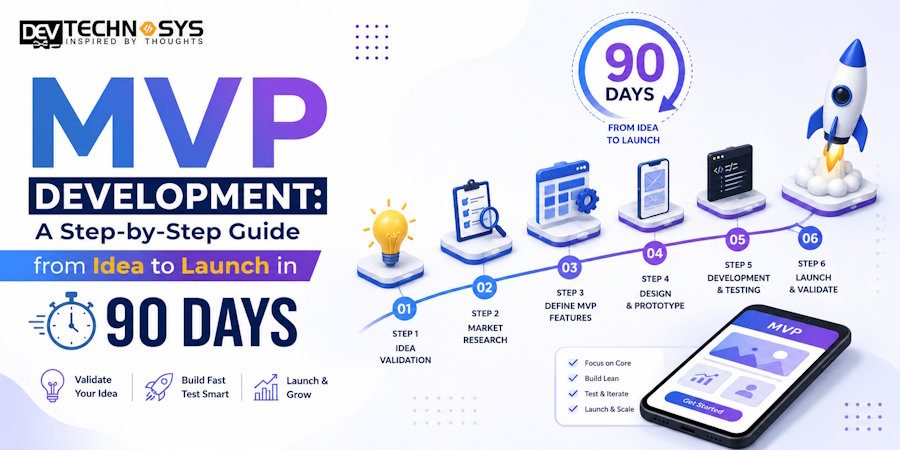
In this guide, we will walk through the complete MVP development process, broken into a realistic 90-day plan: what to do in each phase, which tech decisions matter, and how to avoid the mistakes that quietly kill startups. Whether you are building it in-house or evaluating an MVP development company, this roadmap applies either way.
First, What Exactly Is an MVP (and What It Is Not)?
Minimum viable product development is often misunderstood, so let's clear it up:
- An MVP is: a working product with one core feature set, released to real users, designed to test a business assumption.
- An MVP is not: a broken half-product, a design mockup, or a "lite version" stuffed with ten average features.
The idea comes from the lean startup methodology: build → measure → learn. You build the smallest testable version, measure how users respond, and learn what to build next. Companies like Airbnb, Dropbox, and Uber all began as stripped-down MVPs that did one thing well.
Quick distinction founders often ask about:
- POC (Proof of Concept): proves the tech is possible — internal only
- Prototype: clickable design that shows how the product will look — no real code
- MVP: real, working product in real users' hands
Now, the 90-day plan.
Phase 1: Validate Before You Build (Days 1–15)
Most failed products die here — not in coding, but in skipping validation. Before writing a single line of code:
1. Define the one problem you solve. Write it in a single sentence: "We help [target user] do [specific task] without [current pain]." If you cannot write this sentence, you are not ready for MVP development for startups — you are still in idea-exploration mode.
2. Talk to 20–30 potential users. Not friends and family. Real people from your target market. Ask about their current workflow, what frustrates them, and what they have already tried. Do not pitch — listen.
3. Study competitors honestly. If alternatives exist, that is actually good news (the market is real). Your job is to find the gap: cheaper, faster, simpler, or built for a niche the big players ignore.
4. Define one success metric. Sign-ups? Completed bookings? Paid conversions? Pick a single number that will tell you whether the MVP worked. This becomes your north star for the next 75 days.
Deliverable by Day 15: a one-page problem statement, user personas, and a clear success metric.
Phase 2: Prioritize Features Ruthlessly (Days 16–25)
Here is where discipline matters most. List every feature you dream of, then run it through the MoSCoW method:
- Must have — the product is useless without it
- Should have — important, but launch can happen without it
- Could have — nice extras for later versions
- Won't have (for now) — parked for post-launch
A good rule: your MVP should have one core flow done extremely well, plus only the supporting features that flow needs (sign-up, payments if you are charging, basic notifications). Everything else waits.
This is also where experienced MVP development services add real value — a seasoned team will push back on feature bloat, because they have watched overbuilt products fail. If a vendor says yes to every feature without questioning it, that is a red flag, not good service.
Deliverable by Day 25: a locked feature list for version 1, plus a parked list for version 2.
Phase 3: Design the User Journey (Days 26–40)
Design for an MVP is not about winning awards — it is about removing friction.
Wireframes first. Map the core flow screen by screen: how a user goes from landing to completing your success metric. Tools like Figma make this fast and collaborative.
Then a clickable prototype. Before development starts, test the prototype with 5–10 users from your Phase 1 interviews. Watching someone struggle with your navigation costs nothing now; fixing it after launch costs sprints.
Keep the UI simple. Use a clean design system, standard patterns (users should not have to learn your app), and clear calls-to-action. Fancy animations can wait for version 2.
Deliverable by Day 40: tested wireframes and a final UI kit ready for developers.
Phase 4: Choose the Right Tech Stack (Days 41–45)
Your stack should optimize for speed of iteration, not theoretical scale. You are building for your first 1,000 users, not your first 10 million. Common smart choices in modern MVP development solutions:
- Web MVP: React or Next.js frontend, Node.js or Django backend
- Mobile app development: Flutter or React Native — one codebase for Android and iOS, which cuts both cost and timeline nearly in half compared to separate native apps
- Database: PostgreSQL or MongoDB
- Cloud & DevOps: AWS, Google Cloud, or simpler platforms like Vercel/Firebase to skip infrastructure headaches early
- Ready integrations: Stripe or Razorpay for payments, Auth0/Firebase for login, Twilio for OTP, Mixpanel or Google Analytics for user analytics
Two practical tips: use third-party APIs instead of building from scratch (payments, maps, chat — all solved problems), and set up basic CI/CD from day one so releases stay fast. Also consider whether a no-code tool (Bubble, Webflow) can test your idea even faster — for some business models, that is a legitimate first MVP.
Deliverable by Day 45: finalized stack, architecture diagram, and sprint plan.
Phase 5: Build in Agile Sprints (Days 46–80)
Now the actual development — roughly five weeks, structured as agile sprints:
- Sprint 1 (Days 46–55): Core feature backbone — the one flow that defines your product, plus authentication
- Sprint 2 (Days 56–65): Supporting features — payments, notifications, user profile
- Sprint 3 (Days 66–75): Admin panel basics, analytics events, edge-case handling
- Days 76–80: Full QA cycle — functional testing, device/browser testing, load testing on expected traffic, and security basics (data encryption, secure APIs)
Rules that keep the 90-day promise alive:
- Demo every sprint. Working builds every 10 days — if you have chosen to hire MVP developers or an agency, insist on this rhythm.
- No new features mid-build. New ideas go to the version-2 parking lot. Scope creep is the number one killer of timelines.
- Track analytics from day one. Bake event tracking into the build so you can measure your success metric the moment users arrive.
Deliverable by Day 80: a tested, working product ready for release.
Phase 6: Launch, Measure, Learn (Days 81–90)
Launch is not the finish line — it is the start of the learning loop.
Your MVP launch checklist:
- App store submissions done (allow buffer for review time) or web domain, SSL, and hosting live
- Analytics and crash reporting active (Mixpanel/Firebase Crashlytics)
- Feedback channel ready — in-app form, support email, or a simple chat widget
- A small launch audience lined up: your interview list, a waitlist, niche communities, Product Hunt
- Onboarding emails or walkthrough prepared for first-time users
Then measure for 2–4 weeks: activation rate (how many sign-ups complete the core action), retention (do they come back), and qualitative feedback (what do users ask for repeatedly). This data — not opinions — decides your version-2 roadmap and moves you toward product-market fit.
How Much Does It Cost to Build an MVP?
The honest answer: it depends on scope, platform, and who builds it. The cost to build an MVP is shaped by three levers — feature count, design complexity, and team location/model (freelancers vs. dedicated agency vs. in-house). What matters more than the number is the structure:
- Ask for feature-wise estimates, not one lump sum
- Prefer milestone-linked payments tied to sprint deliveries
- Clarify recurring third-party costs (hosting, APIs, app store fees) upfront
- Confirm source code ownership transfers to you on final payment
A trustworthy MVP development company will volunteer this structure without being asked. For instance, teams like Dev Technosys typically run a discovery workshop first and quote MVP and full-product scope separately — that separation is a good sign in any vendor you evaluate, because it shows they understand the lean approach rather than just selling maximum billable hours.
Final Thoughts
Ninety days is enough — if you spend the first 45 on validation, prioritization, and design, and hold the line against scope creep during the build. The founders who win are rarely the ones who build the most features; they are the ones who learn from real users the fastest.
Start small, launch early, measure honestly, and let your users write your roadmap.
FAQs
Q1. How long does MVP development take? With disciplined scope, 60–90 days is realistic for most products: about two weeks for validation, three weeks for design and planning, five weeks for development, and one to two weeks for testing and launch.
Q2. What is the cost to build an MVP? It varies with features, platforms, and team model. A single-flow MVP costs a fraction of a full product — always ask an MVP development company for a feature-wise breakdown and milestone-based payments instead of a single lump-sum quote.
Q3. Should my MVP be a mobile app or a web app? Choose where your users already are. Web MVPs are faster to ship and update; mobile app development with Flutter or React Native makes sense when your product depends on notifications, camera, GPS, or on-the-go usage.
Q4. What is the difference between MVP, prototype, and POC? A POC proves the technology works internally, a prototype shows the design without real code, and an MVP is a working product released to real users to test a business assumption.
Q5. Can I build an MVP with a no-code tool instead of custom development? Yes, for simple flows no-code is a fast validation option. But custom MVP development solutions become necessary when you need unique logic, integrations, performance, or full code ownership for investors.

